For yoga instructors and wellness professionals, those numbers aren't abstract. They represent real demand for immersive, multi-day experiences that hourly classes simply can't deliver.
But starting a yoga retreat business is not the same as teaching more yoga. It's logistics, brand building, pricing, legal preparation, and guest experience management — often run by one person, before a single booking comes in.
This guide covers the full process: from defining your concept to delivering your first retreat and building toward a repeatable model.
Key Takeaways
- A yoga retreat business requires 6–12 months of lead time, upfront costs, and real operational planning
- Niche clarity determines everything downstream — venue choice, pricing, marketing, and guest experience
- Pricing must be built from costs up, not from what feels accessible to guests
- Legal and insurance requirements go beyond standard yoga teacher coverage
- Partnering with an established retreat venue is the lowest-risk entry point for first-time retreat leaders
What Is a Yoga Retreat Business?
A yoga retreat business involves curating and selling multi-day immersive experiences that combine yoga instruction with accommodation, meals, and intentional programming. As the host, you're responsible for the full guest journey — not just what happens on the mat.
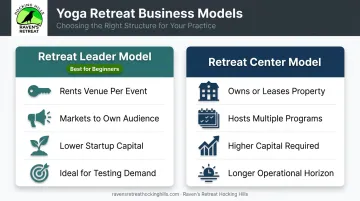
Two Primary Business Models
Retreat Leader Model: A yoga instructor rents a venue, markets to their own audience, and hosts their own participants. Lower capital, faster to test, no permanent infrastructure.
Retreat Center Model: The business owns or leases a permanent property and hosts multiple programs or rents space to other instructors. Higher capital, longer horizon, more operational complexity.
Most people starting out enter through the retreat leader model. Renting a venue first lets you test demand, refine your programming, and build a customer base before committing to permanent infrastructure. That's the model this guide focuses on.
What to Know Before You Start
Running a retreat is operationally different from teaching yoga classes. You're managing accommodations, meals, travel logistics, group dynamics, and safety, often solo when you're just getting started.
The Financial Reality
Retreat businesses run on lumpy cash flow:
- Large upfront costs (venue deposits, marketing, insurance) are paid months before revenue is collected
- If your retreat doesn't fill, those costs don't disappear
- Break-even participant count — total costs divided by participants — is the most important number you need to know before you launch, not after
That break-even number shapes how you price. WeTravel advises building your pricing around a minimum profitable group size — their example is a 15-spot retreat that breaks even at 8–12 participants. The goal isn't to sell out; it's to avoid losing money.
The Time Reality
- First-time retreat leaders typically spend 3–6 months planning and marketing before a guest arrives
- Most will still be running their regular yoga schedule alongside this work
- Hosting a one-off retreat to test demand is a very different commitment than building a repeatable retreat business — know which one you're actually starting
Why Start a Yoga Retreat Business (And When It Makes Sense)
This isn't a motivational pitch. The retreat model genuinely works under specific conditions.
Structural Advantages
- Charges premium pricing — multi-day participants pay far more per experience than drop-in class students
- Builds loyalty through repeat bookings — 39% of retreat travelers are returning participants
- Serves a specific niche audience in ways a general class schedule never can
- Scales naturally — start with one annual retreat, build systems, then expand
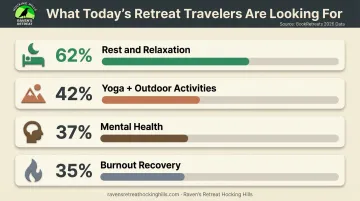
The strongest demand, per BookRetreats' 2026 data: 62% of retreat travelers seek rest and relaxation, 37% cite mental health, 35% burnout recovery, and 42% combine yoga with outdoor activities. Generic "yoga weekend" positioning underperforms compared to burnout recovery, restorative yoga, or yoga-plus-nature concepts.
That opportunity is real — but it only exists if your foundations are in place.
When It Doesn't Make Sense
Don't attempt a retreat launch if:
- You have no existing audience or community to market to
- You have no yoga teaching credentials or experience
- You have no budget for upfront costs
Build those foundations first. Trying to launch a retreat while simultaneously building credibility and an audience is a setup for an expensive, underbooked first event.
How to Start a Yoga Retreat Business — Step by Step
What separates successful first retreats from failed ones is execution order. Skipping validation, rushing launch, or underpricing to fill spots are the most common paths to a money-losing first retreat. These steps are sequential for a reason.
Step 1 – Define Your Niche, Audience, and Retreat Concept
Start with one specific question: who is this retreat designed for, and what transformation does it promise?
Examples with strong market signals:
- Burnt-out professionals seeking a nature-based digital detox
- Women navigating life transitions seeking restorative practice
- Creative professionals combining yoga with art and nature immersion
The clearer the niche, the easier every downstream decision becomes — venue choice, marketing message, pricing, and program design all follow from this. Vague positioning ("a yoga retreat for everyone who loves yoga") creates vague results.
Also define what makes your retreat distinct. With 782 U.S. yoga retreats listed on BookRetreats alone, differentiation isn't optional.
Step 2 – Validate Demand Before You Commit
Before signing any venue contract or spending on marketing, test whether your target audience would actually pay for this retreat.
Validation methods:
- Direct conversations with 10–15 people in your target audience
- Interest surveys with specific pricing included
- A soft-launch waitlist to gauge real intent, not polite encouragement
Step 3 – Choose Your Venue and Location
Evaluate venues on these factors:
- Adequate dedicated yoga practice space (not a repurposed living room)
- Sleeping arrangements matched to your price point
- Meal logistics — full kitchen, catering options, or included meals
- Natural environment aligned with your retreat theme
- Accessibility for your target guest (driving distance vs. flight)
For first-time retreat leaders, domestic locations reduce complexity significantly. Nature-rich destinations with included meals and private-room options have stronger booking evidence than generic properties.
Choosing a purpose-built venue vs. a generic rental
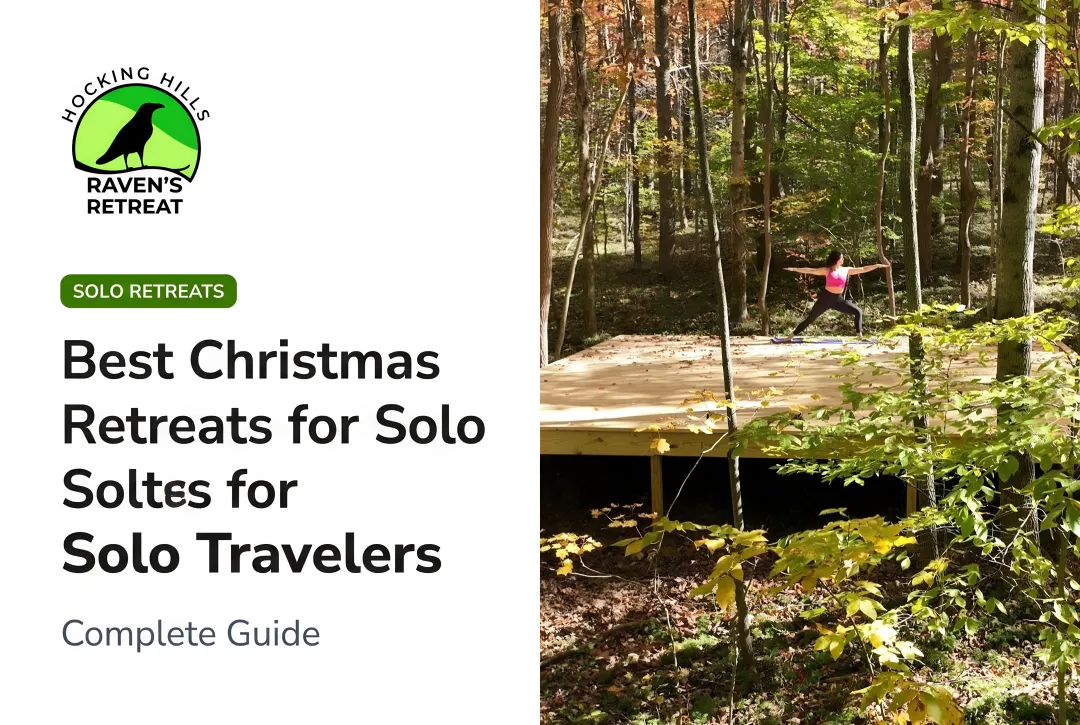
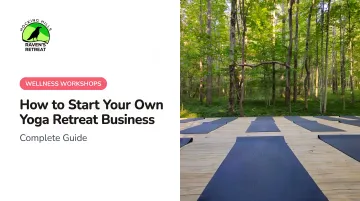
Purpose-built retreat venues let you focus on programming rather than patching together logistics. Raven's Retreat Hocking Hills, for example, is a 58-acre private nature preserve in Ohio with a dedicated indoor Shala, a 24-by-24-foot elevated forest yoga platform, and forest meditation zones — all built for retreat use.
The venue provides yoga mats, blocks, planning support, and coordination of add-on experiences like sound healing, forest bathing, and massage. It sits about an hour from Columbus and two hours from Cincinnati, making it accessible for Midwest participants without requiring a flight.
Step 4 – Build Your Pricing Model and Financial Plan
Full cost structure for a retreat:
| Cost Category | Notes |
|---|---|
| Venue rental | Often the largest single cost |
| Accommodations | Included in venue or separate |
| Meals | Self-catered, catered, or included |
| Facilitator fees | Your time plus any co-facilitators |
| Marketing spend | Social ads, email tools, photography |
| Payment processing | Typically 2–3% of revenue |
| Insurance | Retreat-specific coverage required |
| Contingency | Budget 10–15% above projected costs |
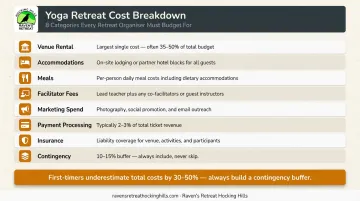
Many first-timers underestimate total costs by 30–50%. Build your pricing from costs up — not from what feels accessible to potential guests.
Pricing formula: Total costs ÷ minimum participant count = minimum per-person price. Then add your margin.
One note worth emphasizing here: low pricing doesn't fill retreats faster. It signals low value and tends to attract participants who aren't genuinely invested in the experience. Consider tiered options — early bird rates and payment plans improve conversion without cutting your floor price.
Step 5 – Handle Legal Requirements and Insurance
Non-negotiables:
- Most retreat businesses register as an LLC for liability protection
- Standard yoga teacher insurance often does not cover multi-day programs, outdoor activities, or group excursions — confirm retreat-specific coverage explicitly with your insurer
- Participant liability waivers should be reviewed by a lawyer familiar with the wellness industry, not pulled from a generic template
On insurance specifics: Alliant's Yoga Alliance member program covers up to $2M per claim. Insurance Canopy offers plans from $159/year with additional insured options. Confirm your policy covers the retreat format, location, activities offered, and the venue as an additional insured.
On licensing: Requirements vary by state, activities offered (food service, outdoor excursions, health-related programming), and venue location. The U.S. Small Business Administration outlines federal and state requirements, but local research — and a local business attorney — is essential before launch.
Step 6 – Design Your Retreat Program
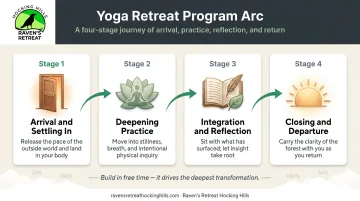
Build your schedule around a clear arc:
- Arrival and settling in — orientation, grounding, community building
- Deepening practice — core programming, workshops, experiential sessions
- Integration and reflection — unstructured time, journaling, nature immersion
- Closing and departure — integration ritual, next steps, send-off
Over-scheduled retreats are a top complaint in guest feedback. Experienced retreat leaders consistently report that free time drives the deepest transformations. Build in breathing room deliberately — don't fill every hour.
This arc applies whether your retreat is 3 days or 10 days. A 3-day format works well for accessible first retreats; 5–7 days supports deeper transformation and is a common sweet spot for participants balancing work and family commitments.
Step 7 – Market Your Retreat and Fill Your Spots
Start marketing 6–9 months before the retreat date for domestic programs. Begin with your warmest existing audience: current students, email list, social followers who already trust you.
Marketing sequence:
- Build awareness with social content showing the venue, the experience, and what participants will feel
- Address objections through email sequences (Is it for beginners? Can I come alone? What's included?)
- Drive decisions with urgency — limited spots, early bird deadlines, a waitlist
Personal outreach to specific individuals consistently outperforms broad advertising for first retreats. Gen Z retreat discovery is led by Instagram (55%), TikTok (52%), and YouTube (42%) per BookRetreats' 2026 data — but for most instructors, the first bookings come from people who already know them.
Step 8 – Deliver, Collect Feedback, and Stabilise Before Scaling
During the retreat, your job is to hold space and lead — not manage logistics in real time. That only works if pre-retreat operations are planned thoroughly: guest communications, a daily run-of-show, and any team briefings.
After the retreat:
- Collect structured feedback from every participant
- Document what worked and what didn't
- Calculate actual versus projected profit before deciding to run again
- Stabilise across 2–3 retreats before expanding to multiple programs, new locations, or a team
Scaling too fast after a first retreat is how most instructors end up with a second retreat that loses money or never happens at all. Nail the model first.
Conclusion
Starting a yoga retreat business is achievable for instructors and wellness professionals who treat it like a real business: validated demand, honest pricing, legal preparation, and a guest experience built around genuine transformation.
The most sustainable retreat businesses grow gradually — one well-executed retreat becomes a repeatable model, then a scalable one. Scaling before the model is proven is the single most common reason a first retreat never becomes a second one.
Start with a narrow focus and price honestly. Choose a venue purpose-built for the work — somewhere the environment itself supports the experience, whether that's a forest meditation space, an outdoor yoga platform, or simply a setting with room to breathe. Places like Raven's Retreat Hocking Hills in Ohio were designed exactly for this: a 58-acre nature preserve where the space does half the work for you.
Run the retreat well enough that participants leave wanting to return. That's the whole strategy.
Frequently Asked Questions
Do you need a license to host a retreat?
Licensing requirements vary by state and depend on your activities, food service, and any health-related programming — and can include food vendor permits, special event permits, and local business licenses. Consult a local business attorney and check venue-specific permit requirements before launch.
How much does it cost to start a yoga retreat business?
Costs vary significantly based on group size, venue, location, and whether you hire facilitators. Key categories include venue deposit, marketing spend, retreat-specific insurance, meals, and a contingency buffer. Many first-time retreat leaders underestimate total costs by 30–50% — build your financial plan from itemized costs, not estimates.
How far in advance should I plan and market a yoga retreat?
Plan for 6–9 months lead time for domestic retreats, and up to 12 months for international programs. Marketing should begin as early as possible — participants need time to plan travel, request time off, and budget for the experience. Starting too late is one of the most common reasons retreats don't fill.
What is the ideal group size for a first yoga retreat?
Groups of 8–15 participants tend to work best for first-time retreat leaders. This range allows personal attention and meaningful group connection while generating enough revenue to cover costs. A common industry approach is to price a 15-spot retreat to break even at 8–12 participants — design for minimum viability, not a sellout.
Do I need a yoga teacher certification to run a retreat?
A formal yoga teacher certification (such as a 200-hour RYT) isn't always legally required, but it's strongly recommended for credibility, insurance eligibility, and the ability to lead programming safely. Some insurers tie eligibility to Yoga Alliance membership or equivalent credentials — confirm with your insurer before launch.
How do I find a venue for my yoga retreat?
Search dedicated retreat venue directories (BookRetreats, Retreat Guru, RetreatHub), contact retreat centers directly, or reach out to nature-based wellness properties that host yoga programs. Properties like Raven's Retreat Hocking Hills — a nature sanctuary in Ohio with a dedicated yoga platform and customizable wellness programming — are purpose-built for exactly this. Always visit or thoroughly vet any venue before committing to a deposit; photos rarely capture logistics like practice space size, meal infrastructure, or noise conditions.