Introduction
Workplace stress isn't a soft problem. According to the WHO, depression and anxiety cost the global economy $1 trillion per year in lost productivity — that's 12 billion working days gone annually. Meanwhile, the APA's 2024 Work in America Survey found 25% of U.S. workers reported emotional exhaustion in the prior month.
Most organizations respond to burnout with individual interventions: apps, PTO, EAP hotlines. What they miss is that stress is a team-level problem requiring team-level solutions.
When designed intentionally, team building activities go well beyond morale-boosting. They activate the body's parasympathetic nervous system (the rest-and-recover mode), rebuild social trust, and interrupt the burnout cycle through mechanisms with real clinical support.
This article covers eight evidence-backed strategies — from nature immersion and creative workshops to movement-based activities — and how to implement each one, including why an off-site environment often determines whether any of it actually sticks.
Key Takeaways
- Unaddressed workplace stress directly erodes team cohesion, productivity, and retention
- Activities that blend movement, creativity, and mindfulness address stress on multiple levels simultaneously
- Low-stakes team building outperforms competitive formats for stress management goals
- Off-site, nature-based settings accelerate stress recovery beyond what in-office activities can achieve
- One purposeful team activity per month is enough to produce noticeable improvements in well-being
Why Team Building Is a Proven Stress Management Strategy
Social connection is physiologically protective. Research published in Frontiers in Neuroscience shows that social support dampens stress responses by functioning as a safety signal through threat-regulation pathways in the brain — feeling genuinely supported by your team changes how your nervous system responds to pressure.
This matters because the opposite is equally documented. A 2021 meta-analysis of 557 studies found that workplace social stressors are directly associated with poorer health outcomes, including burnout-related conditions. Teams that lack psychological safety and connection don't just feel worse — they perform worse, get sick more often, and quit.
Low-Stakes vs. High-Stakes Team Building
Not every team activity reduces stress — some reliably trigger it. A landmark 2004 meta-analysis of 208 lab studies found cortisol responses spike most in situations combining social-evaluative threat and uncontrollability: being judged while feeling powerless. Competitive team challenges, timed performance tasks, and forced participation exercises recreate exactly that dynamic.
For stress management, the design principle is clear: low-stakes, collaborative, non-evaluative activities work. High-energy competitions work against the goal.
The Business ROI
When stress is addressed proactively, the downstream effects are substantial. Gallup's 2024 Q12 Meta-Analysis found top-quartile engaged teams showed:
- 78% less absenteeism than bottom-quartile teams
- 21–51% less turnover
- 23% higher profitability
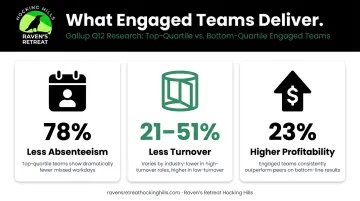
Those numbers reflect a direct return on investing in genuine team connection — lower attrition, fewer sick days, and measurable profitability gains.
8 Team Building Activities for Stress Management
1. Mindfulness and Guided Meditation Sessions
Group mindfulness sessions — belly breathing, body scans, short guided meditations — lower acute stress responses and create a shared ritual of calm across the team. The evidence here is strong and workplace-specific.
A 2025 randomized clinical trial involving 1,458 academic medical center employees found that just 10 minutes of daily digital meditation reduced perceived stress and job strain at 8 weeks, with improvements maintained at four-month follow-up. Even brief, consistent practice moves the needle.
Implementation tips:
- Add a 10-minute guided session to the start or end of weekly team meetings
- Use a licensed facilitator, a meditation app, or a recorded session — consistency matters more than format
- Close each session with a group intention or brief check-in word to strengthen both individual calm and team cohesion
- For corporate retreats, Raven's Retreat Hocking Hills offers guided meditation sessions on a dedicated elevated forest platform, with access to certified practitioners and somatic breathwork facilitators — including co-founder Raven Morgan, a certified breathwork coach
2. Nature Walks and Outdoor Exploration
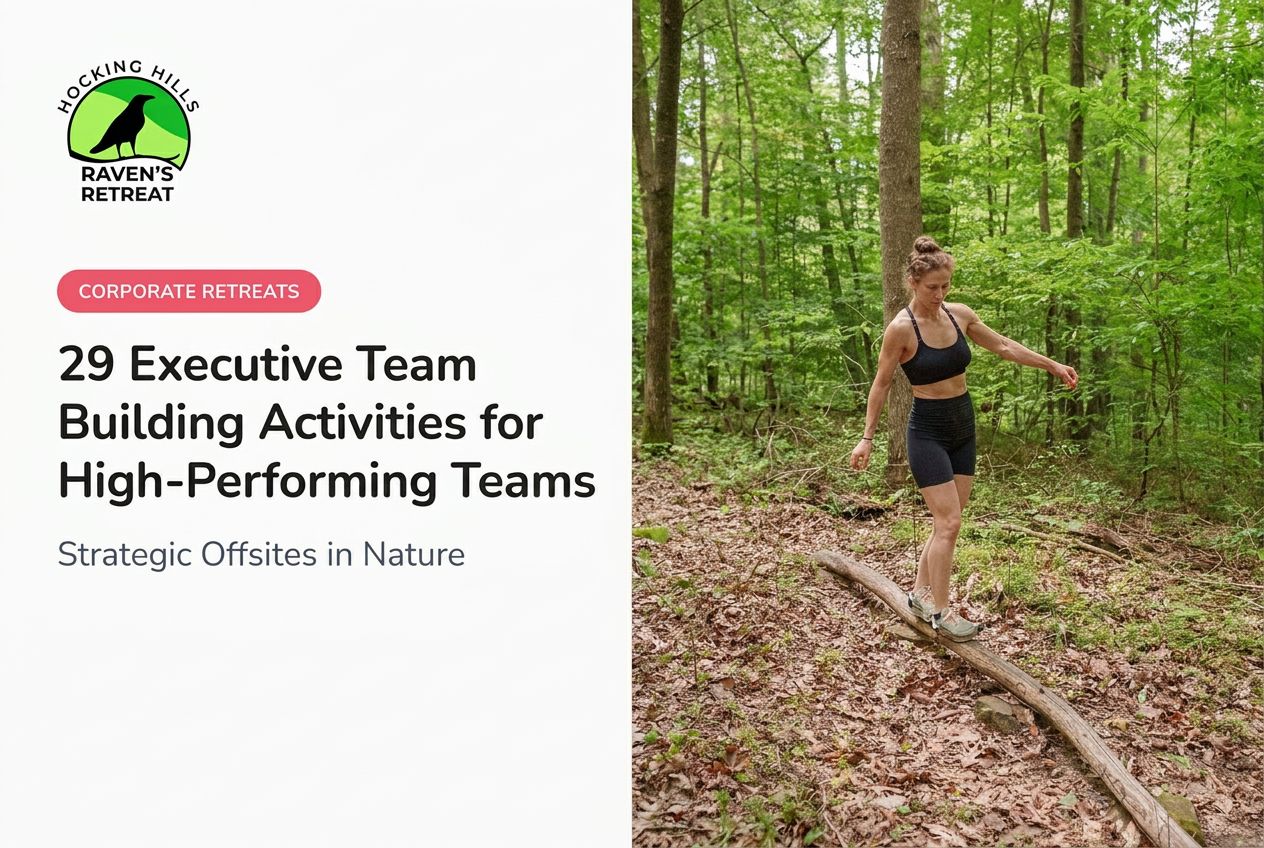
Time in nature is measurable in its effects. A 2019 Frontiers in Psychology study found a 20–30 minute nature experience was the most efficient duration for lowering salivary cortisol, with decline rates above normal diurnal patterns.
A separate study found 90-minute nature walks reduced both self-reported rumination and activity in the brain region associated with negative thought loops.
For teams, structure matters:
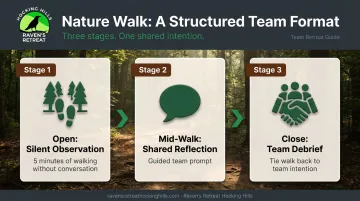
- Open with silent observation — 5 minutes of walking without conversation primes the nervous system
- Use shared reflection prompts mid-walk: "What's one thing weighing on you this week that nature doesn't care about?"
- Close with a brief debrief that ties the walk back to a team intention
Access to a private preserve — rather than a city park — deepens this effect by removing the ambient stress cues of urban environments.
3. Creative Art Workshops
Art-making shifts the brain into a flow state, interrupting rumination and stress loops. A 2016 study found that 45 minutes of visual art-making lowered cortisol in 75% of participants, regardless of prior artistic experience. Skill is irrelevant — the act of creating is what counts.
For corporate groups, the collaborative dimension adds real value: working alongside teammates on something creative dissolves professional hierarchies and opens up trust that agenda-driven meetings rarely reach.
Practical formats:
- Group painting or guided drawing
- Hands-on sculpting with facilitated instruction
- Collaborative projects where each person contributes to a single shared piece
Having a skilled artist facilitate the experience makes a meaningful difference. At Raven's Retreat, master sculptor Dustin Weatherby leads creative activation workshops and live sculpture performances — watching raw materials transform into finished art over a few hours becomes a surprisingly effective metaphor for team resilience and problem-solving.
4. Team Health Check-Ins and Open Conversations
Naming stress out loud reduces its psychological weight. The "Peaks and Valleys" format is simple: each person shares one recent high and one recent low. No advice-giving, no problem-solving — just acknowledgment.
The format is secondary. Setup is everything.
Ground rules before running a check-in:
- Confidentiality stays in the room
- No one is required to share more than they're comfortable with
- Responses should be listened to, not fixed
- Leaders go first — modeling vulnerability before asking for it is non-negotiable
Without psychological safety established in advance, check-ins feel performative. With it, they become one of the most efficient stress-relief tools available — no cost, no logistics, 20 minutes.
5. Physical Movement and Wellness Challenges
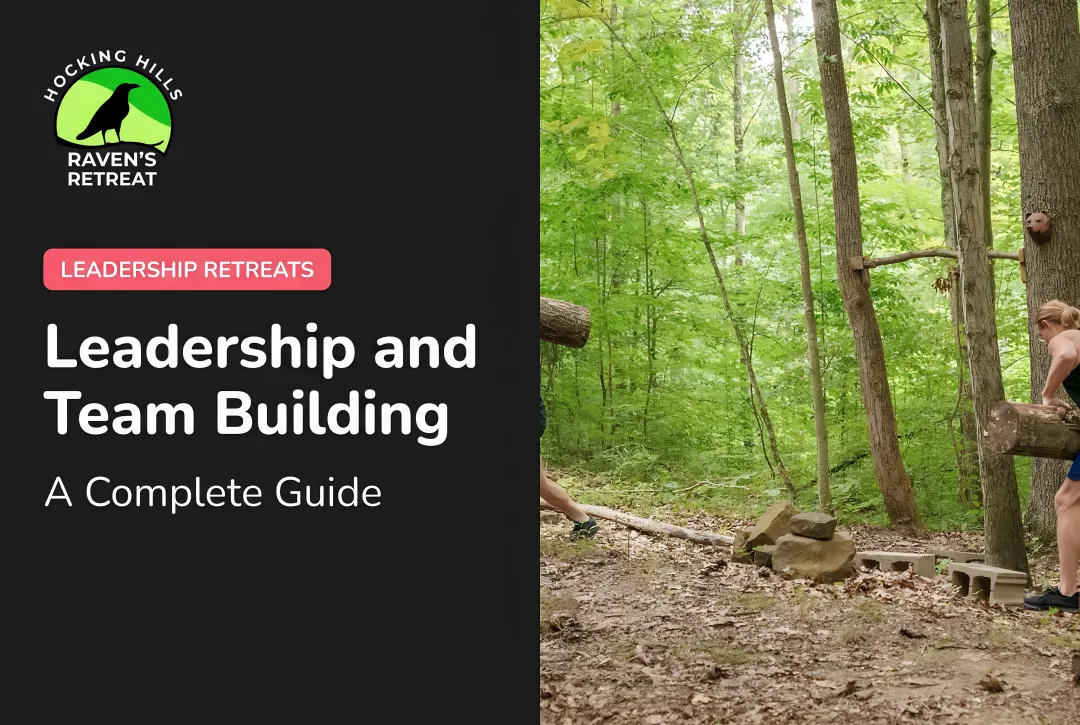
Exercise directly regulates stress hormones, and the team format amplifies the effect. A 2024 workplace study of 11,575 participants in a 6-week movement challenge found significant improvements in self-reported energy, sleep quality, mood, and overall health.
For stress management, the design of the challenge matters as much as the activity itself:
- Opt-in, not mandatory — autonomy reduces pressure
- Collective framing ("We walked 50,000 steps this week as a team") outperforms competitive leaderboards
- Low-barrier formats work best: step count challenges, group stretching breaks, outdoor walks, or short yoga sessions
If the challenge itself starts generating anxiety, redesign it — the goal is relief, not another performance metric.
6. Icebreakers and Connection Games
Loneliness at work is a documented health risk, not a soft concern. Cigna research found lonely workers are 5x as likely to miss work due to stress compared to connected colleagues. Gallup data shows employees who strongly agree they have a best friend at work are 7x more likely to be engaged.
Icebreakers, done well, build those connections deliberately.
Formats suited to stress management contexts:
- Reflection questions over performance prompts: "What's something you're genuinely proud of from the past month?" lands better than trivia competitions
- Two Truths and a Lie variants that invite personal storytelling rather than competitive guessing
- Storytelling prompts that build empathy: "Tell us about a time you felt completely out of your depth — and what happened next"
The goal is authentic self-disclosure in a low-risk setting. Those small moments of honesty are what build the friendships that actually buffer against burnout over time.

7. Collaborative Problem-Solving Activities
Escape rooms, creative build challenges, and group puzzle formats do something specific for stressed teams: they rebuild confidence in the group's collective ability to navigate difficulty. That confidence transfers directly to real workplace challenges.
The design principle is simple:
- The activity must be winnable — teams in burnout don't need another experience of falling short
- Contribution should be distributed — if one person dominates, others disengage
- The debrief matters — close by naming what the team did well, not just whether they succeeded
The outcome you're engineering is a felt sense of collective capability. That's what lowers anxiety about future challenges.
8. Digital Detox Experiences
Individual unplugging is useful. But when an entire team disconnects simultaneously, something different happens: the ambient pressure of asynchronous availability disappears — that low-grade stress of wondering who's messaging while you're away from your phone.
Digital overload is a significant driver of chronic stress in modern teams. A structured group detox addresses it collectively.
What this looks like in practice:
- Device-free meals with a no-phones table agreement
- Nature immersion windows (60–90 minutes) with phones left behind
- Analog creative sessions — drawing, sculpting, journaling
- A full off-site day structured entirely without screens
Pairing a digital detox with any other activity on this list amplifies the stress-relief effect. At Raven's Retreat, corporate groups often arrive tethered to devices and find that by day two, phones stay in rooms — not because it's required, but because presence deepens naturally in that setting.
How to Choose and Implement the Right Activities
Not all stress looks the same. Deadline-driven burnout, interpersonal conflict, isolation, and lack of purpose each call for different activity types — and mismatched programming can make things worse, not better.
Start with diagnosis:
- Run a short anonymous survey asking team members to name their primary stress source
- Conduct brief one-on-one manager check-ins before selecting activities
- Avoid defaulting to high-energy formats with a team in emotional burnout
Once you know what you're solving for, match the format to the need. A team dealing with isolation needs connection-focused activities; one facing burnout needs recovery and space — not another full-day workshop.
Simple implementation framework:
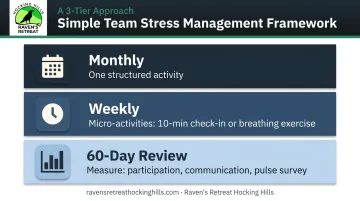
- One structured activity per month — enough to build a rhythm without adding another obligation
- Micro-activities weekly — a 10-minute check-in or breathing exercise woven into existing meetings
- Measure impact simply — participation rates, voluntary communication outside meetings, and a follow-up pulse survey after 60 days
Consistency beats variety every time. Teams that repeat a single well-matched activity for 90 days report stronger trust and lower stress than teams that rotate through formats without follow-through. If your team needs a deeper reset — a half-day offsite, a nature immersion, or a structured retreat like what Raven's Retreat Hocking Hills offers for groups of up to 18 that overnight — build that into your annual calendar as the anchor, with monthly micro-activities supporting it between sessions.
Why Taking Your Team Off-Site Amplifies the Results
The office itself is a stress trigger. Desks, email notifications, the background noise of organizational dynamics — all unconscious cues that keep the nervous system in low-grade activation. In-office team activities happen inside that context. Off-site ones don't.
Research comparing outdoor walks to office-based relaxation found that outdoor environments produced measurably greater psychological detachment and vitality. The physical setting changes what's cognitively possible.
Nature-based retreat settings extend that effect further. Access to forests, fresh air, and creative spaces without digital noise creates conditions for deeper bonding and more authentic conversation. That kind of openness rarely surfaces in a conference room.
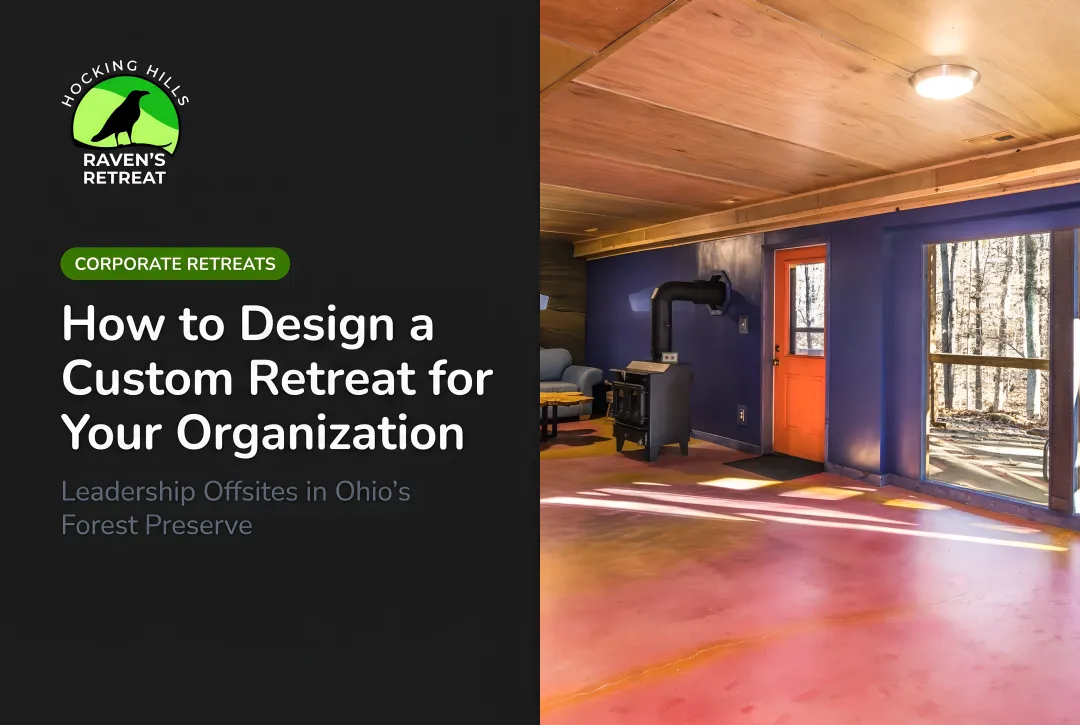
Raven's Retreat Hocking Hills is one example of what that environment looks like in practice. The 58-acre private nature preserve in Hocking Hills, Ohio lets corporate teams integrate multiple strategies from this article into a single off-site day or weekend:
- Guided forest bathing on private wellness trails
- Mindfulness sessions on an elevated forest platform
- Creative workshops led by master sculptor Dustin Weatherby
- Digital detox in a setting perfect for making disconnection feel natural
Practical considerations for planning:
- Full property buyout available for privacy, accommodating up to 18 overnight guests (up to 30 with coordinated nearby lodging)
- Old Man's Cave, Conkle's Hollow, and other Hocking Hills State Park attractions sit within 6–16 miles, extending outdoor access beyond the property's own mile-plus of private trails
- Yoga instructors, sound healing practitioners, breathwork coaches, and other wellness facilitators can be integrated into your itinerary through the retreat's coordination process
- Plant-based chef services are included with all-inclusive team day retreats for groups of 20 or fewer
Conclusion
Teams that handle stress well have one thing in common: shared rituals that help them recover together, not just individually.
The eight strategies above work because they address stress across multiple dimensions simultaneously — social, physical, creative, and physiological. No single activity is a solution, but two or three implemented consistently — with intentional design — produce measurable shifts in engagement, absenteeism, and team cohesion.
If you're ready to bring these strategies to life in a setting that removes the workplace distractions that dilute them, Raven's Retreat Hocking Hills offers a 58-acre private nature preserve in Hocking Hills, Ohio — with curated corporate retreat experiences designed around exactly these goals. Contact the retreat team at stay@ravensretreathockinghills.com or call 614-783-6143 for corporate retreat inquiries.
Frequently Asked Questions
What are fun activities to manage stress?
Activities that combine movement, creativity, and social connection tend to be both enjoyable and genuinely effective — nature walks, guided art workshops, group meditation, and collaborative games all qualify. The best options feel like something your team chooses, not something prescribed to them.
What is a fun 5-minute team building game?
"Two Truths and a Lie," a rapid icebreaker question round ("What's one thing you've never told a coworker about yourself?"), or a one-minute group breathing exercise all work well. All three build connection without prep time and fit easily into any existing meeting.
What are the 5 C's of stress management?
UCLA STAND's framework identifies the 5 C's as: Connect, Control, Calm, Cut (eliminate unnecessary stressors), and Care (for yourself and others). Team building activities address several of these simultaneously — particularly connection, calm, and a sense of shared control over team culture.
What are the 5 R's of stress management?
The 5 R's — Recognize, Relax, Review, Respond, and Return — form a mindfulness-based stress cycle referenced by WebMD and MSU Extension. Structured team activities help employees practice these steps together, especially recognition and relaxation.
How often should teams do stress management activities?
One dedicated stress-relief activity per month builds enough consistency to shift team culture. Lighter micro-activities — breathing exercises, structured check-ins, brief icebreakers — work best when woven into existing weekly meetings for sustained impact between larger sessions.
Can team building activities actually reduce employee burnout?
Yes, with an important caveat: they work best as part of a broader wellness strategy, not as a standalone fix. Gallup data shows employees who feel supported by their manager are 70% less likely to experience burnout regularly. Team building accelerates that felt support by giving people real shared experiences to draw from.