Introduction
Your mind may have moved on. Your body, though, often hasn't.
Trauma has a way of lodging itself in the nervous system , showing up as chronic tension, restless sleep, emotional flatness, or a vigilance that never quite switches off. Many people find that talking through these experiences only goes so far. The memories get processed, but the physical residue stays put.
Somatic breathwork addresses exactly this gap. Unlike general relaxation breathing, it's a body-centered practice that uses deliberate breath patterns to access and discharge trauma stored in the nervous system — engaging the body directly, not the thinking mind.
This guide explains what somatic breathwork is, why it works, what the research shows, which techniques are used, and what to expect during a session — including the physical signs that your nervous system is actually releasing.
Key Takeaways
- Somatic breathwork uses conscious breathing to regulate the autonomic nervous system and release trauma stored in the body, rather than relying on cognitive processing alone
- Trauma gets "stuck" when the body's stress cycle is never completed; breathwork helps finish that cycle
- Techniques range from gentle to intensive, each suited to different needs and experience levels
- Physical signs like trembling, spontaneous sighing, or emotional tears during a session are normal nervous system discharge responses
- Before starting any breathwork practice, consult a professional if you have medical or psychiatric conditions
What Is Somatic Breathwork?
"Somatic" comes from the Greek soma, meaning body. In clinical usage, the word refers specifically to bodily processes — and somatic breathwork stays true to that definition. It's a trauma-informed, body-centered practice that uses conscious breath patterns to regulate autonomic arousal, access stored emotional experiences, and support healing.
That distinguishes it from two things it's often confused with.
General breathwork — relaxation apps, standard pranayama — works through similar physical mechanics, but it isn't designed to access and discharge trauma stored in the nervous system. Somatic breathwork is specifically structured around that goal.
Talk therapy approaches the mind "top-down": starting with thoughts, beliefs, and language, then working toward the body. Somatic breathwork moves "bottom-up" — starting with physical sensation and breath, then working upward toward emotional awareness and integration. That distinction matters because trauma doesn't always exist in language. It lives in tension patterns, altered breathing, and nervous system dysregulation that cognitive approaches often can't reach.
Somatic Breathwork vs. Somatic Experiencing
These two are frequently conflated, but they're distinct practices. Somatic Experiencing (SE), developed by Dr. Peter Levine, guides attention to interoceptive and proprioceptive sensations — what you feel inside the body — to help the nervous system complete interrupted stress responses. Breath might be noticed during an SE session, but it's not the primary tool.
Somatic breathwork, by contrast, uses intentional breath patterns as the active lever. The body-first philosophy is shared; the method is different.
Why Somatic Breathwork Works for Trauma Release
The Incomplete Stress Cycle
When a traumatic event overwhelms the body's ability to respond and recover, the sympathetic nervous system (the fight-or-flight system) can remain chronically activated long after the threat has passed. The physiological response that was meant to protect you never fully completes.
That incomplete cycle doesn't simply disappear. It gets held in the body as altered breathing patterns, persistent muscle tension, and ongoing autonomic dysregulation.
Research confirms this: PTSD is associated with measurable abnormalities in sympathetic and parasympathetic nervous system function, including disrupted heart rate variability. As van der Kolk documented, traumatic stress can persist through conditioned somatic, sensory, and autonomic patterns — not only as verbal memory.
Somatic breathwork addresses this. By deliberately shifting breathing patterns, practitioners can move the body through the sympathetic activation phase and guide it back into parasympathetic rest, replicating the natural trauma-recovery arc the body couldn't finish at the time.
The Vagus Nerve Connection
The vagus nerve is the primary highway of the parasympathetic nervous system, running from the brainstem through the heart and digestive system. Slow, diaphragmatic breathing stimulates it directly, lowering heart rate, reducing cortisol output, and signaling safety to the brain's threat-detection centers.
Noble and Hochman's respiratory vagal stimulation model links specific breathing patterns to cardiac vagal tone and emotion regulation pathways. A study of 40 healthy adults found that 20 sessions of diaphragmatic breathing over 8 weeks reduced negative affect and salivary cortisol — concrete evidence that breath-based intervention measurably changes the body's stress chemistry.
What the Research Shows
The strongest trauma-specific evidence comes from studies on Sudarshan Kriya Yoga (SKY), a structured breathing-based meditation. Key findings:
- A 2014 randomized controlled trial of 21 Iraq and Afghanistan veterans found significant reductions in PTSD symptoms (effect size d = 1.16)
- A 2022 follow-up trial of 85 veterans found SKY non-inferior to Cognitive Processing Therapy over a 5-week protocol
These results are promising, though both studies used relatively small samples and researchers are still building the evidence base. Breathwork is best understood as a meaningful, clinically-supported adjunct to trauma care — not a standalone cure.
How Somatic Breathwork Works
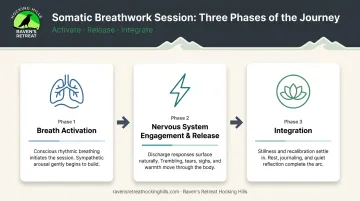
A somatic breathwork session typically moves through three phases. Understanding them helps you engage with the process rather than simply ride it out.
Phase 1: Breath Activation
The session begins with establishing a conscious, rhythmic breathing pattern — typically deep inhales and full exhales, often in continuous cycles. This shifts the body out of automatic, shallow breathing and into heightened somatic awareness.
Mild sympathetic activation during this phase — tingling, warmth, a rise in emotion — is expected. This isn't a sign something is wrong. It's the nervous system beginning to surface what's been held.
Phase 2: Nervous System Engagement and Release
With sustained conscious breathing, suppressed emotions, physical sensations, or somatic memories can surface. The body discharges these through natural mechanisms:
- Involuntary trembling or shaking (neurogenic tremor response)
- Spontaneous tears or laughter without a clear cognitive trigger
- Deep, spontaneous sighs or yawning
- Warmth or tingling in the extremities
- A wave of heaviness followed by a sense of lightness
These responses aren't dramatic reactions to avoid — they're the nervous system completing the stress cycle it couldn't finish before. TRE (Tension and Trauma Releasing Exercises) research describes these self-induced therapeutic tremors as a natural neurophysiological discharge process, not a sign of destabilization.
If any response feels overwhelming, grounding is always appropriate: open your eyes, feel the floor beneath you, slow the breath.
Phase 3: Integration
After the active breathing, the session moves into stillness. This is when the nervous system recalibrates. The physiological and emotional shifts that occurred during the release phase consolidate here — and practitioners typically report feelings of resolution, calm, or unusual lightness.
Integration isn't passive. The minutes and hours after a session matter as much as the session itself. Journaling, quiet time in nature, or resting without screens helps the nervous system hold what it processed.
Where you practice shapes that recovery. A quiet, sensory-rich environment — away from digital noise and urban stimulation — supports deeper parasympathetic engagement both during and after breathwork. Raven's Retreat Hocking Hills is built for exactly this: a private 58-acre nature preserve in Ohio with forest meditation zones, an elevated yoga platform, creek-side meditation areas, and a living natural soundscape that keeps the nervous system in rest-and-digest mode long after the session ends.
Common Somatic Breathwork Techniques for Trauma
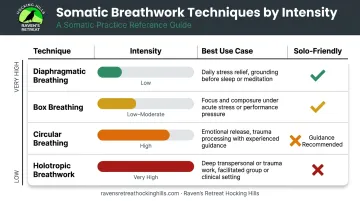
Somatic breathwork spans a wide spectrum — from gentle regulation practices you can do alone to intensive facilitated sessions that access deep emotional material. Understanding where each technique falls on that spectrum helps you choose an entry point that fits your history, comfort level, and goals.
| Technique | Intensity | Best For | Solo-Friendly? |
|---|---|---|---|
| Diaphragmatic Breathing | Low | Beginners, nervous system regulation | Yes |
| Box Breathing | Low–Moderate | Acute stress, pre-session grounding | Yes |
| Circular Breathing | High | Emotional release, altered states | No — facilitated only |
| Holotropic Breathwork | Very High | Deep trauma processing | No — trained facilitator required |
Diaphragmatic (Belly) Breathing
The safest and most accessible starting point. Lie or sit comfortably with one hand on your chest and one on your belly. Inhale deeply through the nose so the belly rises while the chest stays relatively still. Exhale slowly through the mouth.
It works because it directly engages the diaphragm and stimulates the vagus nerve, activating parasympathetic response. Start here — especially if you're new to trauma-informed breathwork or working independently.
Box Breathing
A 4-count inhale → 4-count hold → 4-count exhale → 4-count hold pattern. The equal-ratio structure regulates carbon dioxide and oxygen balance and interrupts hyperarousal by introducing conscious pacing.
Best used for grounding during acute stress or as a calm entry point before deeper trauma-release work. Research on brief structured respiration practices confirms it improves mood and reduces physiological arousal. It's stabilizing rather than deeply releasing — a tool for arriving steady before deeper work begins.
Circular Breathing
Continuous inhale-exhale cycles without pause between breaths. The sustained rhythm and associated CO2 reduction can access the limbic brain — where emotional memories are stored — and surface repressed material.
A 2025 study of 61 experienced practitioners found end-tidal CO2 falling to an average minimum of approximately 16.6 mmHg during circular breathwork, producing altered states and strong emotional activation. This is not a technique for solo home practice, particularly for those with significant trauma histories. Facilitated sessions are strongly recommended.
Holotropic Breathwork
Developed by Dr. Stanislav Grof in 1975, holotropic breathwork uses accelerated breathing combined with evocative music to induce a non-ordinary state of consciousness in which deeply held trauma can surface for processing.
The Institute for Holotropics describes the method as including:
- Focused bodywork when needed
- Mandala drawing for integration
- Group sharing after the session
This is the most intensive approach on this list. It carries the strongest contraindication requirements — practice it only with a trained facilitator in an appropriate clinical or retreat setting.
Safety Considerations and When Breathwork May Not Be Right for You
Key Contraindications
Do not attempt intensive breathwork techniques (circular breathing, holotropic breathwork) without professional screening if you have:
- Uncontrolled high blood pressure or cardiovascular disease — altered CO2 levels and autonomic arousal can raise blood pressure and affect cerebral blood flow
- Epilepsy or seizure history — voluntary hyperventilation can trigger seizures in absence epilepsy through hypocapnia
- Active psychosis or severe psychiatric conditions — altered-state practices can be destabilizing
- Severe panic disorder — rapid breathing can produce chest pain, dizziness, paresthesias, and symptoms that escalate rather than resolve
- Pregnancy — intensive breathwork is not recommended
Gentler techniques like diaphragmatic breathing carry a much lower risk profile. But even these are worth discussing with a physician or mental health professional if you have any concerns about your health or history.
These contraindications apply to intensive modalities — they're not a reason to avoid breathwork entirely. Understanding the common misconceptions around practice helps clarify where the real boundaries lie.
Common Misconceptions
- Breathwork is not a substitute for professional trauma therapy for those with complex or severe PTSD — it's a meaningful adjunct, not a replacement
- Emotional intensity during a session doesn't mean something is going wrong — but it should still be navigated with a trained guide, especially in the early stages
- More breathing, faster, is not more effective — technique, pacing, and facilitation quality matter far more than intensity
How to Practice Responsibly
- Start with diaphragmatic breathing and box breathing before attempting more intensive modalities — these build body awareness without triggering strong physiological responses
- Work with a qualified somatic breathwork facilitator for any trauma-specific goals, particularly if you're new to the practice — at Raven's Retreat Hocking Hills, Raven Morgan is a certified breathwork coach who works with guests on exactly this kind of intentional, trauma-informed practice
- Consult a physician or mental health professional if there's any uncertainty about physical or psychiatric suitability before progressing
- For intensive work, choose a structured setting — a proper retreat environment or clinical setting — rather than attempting it alone at home
Frequently Asked Questions
Do somatic exercises really release trauma?
Yes: research supports the role of somatic practices in reducing trauma symptoms. Breathwork works by completing the interrupted stress cycle in the body rather than processing trauma only cognitively. Clinical studies, including RCTs with veterans, show meaningful symptom reduction — though the evidence base is still growing and professional guidance matters.
What are the physical signs your body is releasing trauma?
The most common signs are involuntary trembling or shaking, spontaneous tears or laughter, deep sighs, tingling, and warmth in the extremities — followed by a shift from physical tension to a sense of lightness or calm.
What is the difference between somatic breathwork and regular breathwork?
Regular breathwork often targets relaxation, performance, or spiritual experience. Somatic breathwork is specifically oriented toward accessing and releasing trauma stored in the body — it's body-centered, emotion-aware, and practiced within a trauma-informed framework rather than a general wellness context.
How many sessions does somatic breathwork take to see results?
Some people experience meaningful shifts after a single session; others benefit most from consistent practice over weeks or months. The timeline depends on the depth of the trauma, the technique used, and whether the work is guided or self-directed.
Is somatic breathwork safe for everyone?
It's safe for most healthy adults, but not recommended without professional guidance for those with cardiovascular conditions, epilepsy, active psychosis, severe panic disorder, or pregnancy. Always consult a qualified practitioner or physician first.
Can I practice somatic breathwork on my own at home?
Gentle techniques like diaphragmatic breathing and box breathing are safe to practice independently. More intensive trauma-release techniques — circular breathing and holotropic breathwork — carry real emotional and physiological risks when done without a facilitator, especially for those with significant trauma histories.