That's relationship burnout, and it's more common than most couples admit.
Burnout isn't the same as falling out of love, and it isn't a sign your relationship is broken beyond repair. It's a state of chronic emotional exhaustion — and with the right strategies, it's recoverable. This guide walks through how to recognize burnout, what causes it, and concrete approaches for rebuilding connection, including daily rituals, structured frameworks, and environment-based resets.
Key Takeaways
- Relationship burnout is emotional exhaustion within a relationship — not a loss of love itself
- Warning signs include emotional numbing, persistent irritability, fading intimacy, and feeling like roommates
- Root causes include chronic external stress, unequal emotional labor, and communication breakdown
- Recovery requires mutual acknowledgment, daily connection rituals, and individual self-care
- Nature immersion and environmental change can accelerate nervous system reset and relational reconnection
What Is Relationship Burnout?
Relationship burnout is a state of emotional, mental, and physical exhaustion caused by prolonged relational stress, unmet needs, and accumulated disconnection. It's not a single argument or a bad week — it's what happens when relational demands consistently outweigh available relational resources.
Peer-reviewed research published in 2025 defines relationship burnout as involving four core markers:
Peer-reviewed research published in 2025 identifies four core markers of relationship burnout:
- Relational overload — persistent demands that exceed what partners can give
- Emotional detachment — withdrawing inward rather than connecting outward
- Diminished appreciation — positive qualities fade from view under accumulated stress
- Withdrawal of positive engagement — affection, humor, and effort drop off noticeably
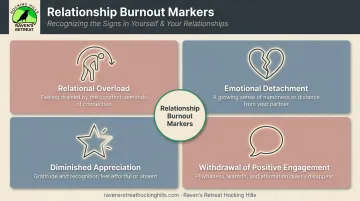
It's distinct from general dissatisfaction: burnout is a depletion process, not simply a measurement of happiness.
Burnout vs. Falling Out of Love
This distinction matters. Many couples misread burnout as the end of the relationship when it's actually a signal that the relationship needs attention. Burnout is exhaustion. The underlying connection may still be present, just buried under accumulated stress and unmet needs. Falling out of love involves a genuine loss of emotional attachment — a different dynamic entirely.
The challenge is that burnout develops gradually. By the time couples recognize it, the depletion already feels severe.
That slow build may explain why research from the Journal of Marital and Family Therapy found that couples wait an average of 2.68 years from the onset of serious relationship problems before beginning therapy. Nearly three years of operating on empty before seeking support.
Warning Signs You May Be Experiencing Relationship Burnout
Burnout doesn't always look like conflict. Sometimes the most telling sign is the absence of feeling entirely. These are the patterns that signal burnout has already taken hold:
Emotional Exhaustion and Numbing
One of the clearest early indicators is no longer feeling angry or sad about the relationship — just flat. Conversations feel draining rather than connecting, and time together offers no relief. The emotional withdrawal described in the burnout literature isn't indifference; it's depletion.
Persistent Irritability
Small habits that were once easy to overlook now feel unbearable. Minor disagreements escalate disproportionately — not because the issue is serious, but because both partners arrive at the conversation already depleted.
It's worth paying attention to this pattern early. Escalation that feels "out of proportion" often signals that one or both partners have been absorbing unresolved strain for far longer than either realizes.
Decreased Intimacy
Both physical and emotional intimacy fade — often with no conflict to point to. Emotional availability simply runs dry. This includes non-sexual affection: less eye contact, fewer casual touches, less warmth in everyday interactions.
The "Roommate Dynamic"
The Gottman Institute describes a pattern where partners function practically together while losing the emotional bond that made them more than housemates — what researchers call roommate syndrome. Conversations become task-oriented (schedules, bills, chores) with no space for curiosity, play, or any real dreaming about the future. One clinical analysis of over 1,300 individuals found that 62.9% felt like roommates, with 74.6% of those describing themselves as rarely connected or disconnected.
Withdrawal and Avoidance
Burned-out partners often stop initiating repair after conflict. They avoid meaningful conversations to "keep the peace" — and may begin fantasizing about solitude, not out of contempt, but out of desperate need for relief.
Root Causes of Relationship Burnout
Chronic External Stress Spillover
Work pressure, financial strain, parenting demands, and health challenges all deplete the emotional reserves both partners need to show up for each other. Research on couples and stress confirms that external stressors spill over into relational processes and outcomes — and when people are in survival mode, relational generosity is typically the first casualty.
Unbalanced Emotional Labor
Emotional labor in a relationship is the invisible work of tracking, managing, initiating repair, and holding the relationship together. When this falls predominantly on one partner, resentment and exhaustion accumulate over time.
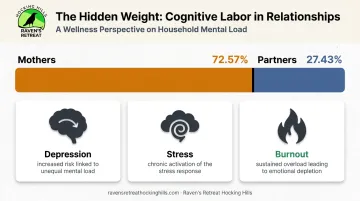
A 2024 study found that in heterosexual relationships, mothers performed 72.57% of cognitive household labor versus 27.43% for partners — and this imbalance was directly associated with depression, stress, burnout, and relationship functioning. The partner carrying less of the load is often unaware of the gap. That unawareness itself becomes a source of disconnection.
Communication Breakdown
Couples stop raising real concerns because previous attempts felt pointless or painful. The less that's communicated, the more disconnected both partners feel — and the harder it becomes to start again. Over time, silence starts to feel safer than the risk of another failed attempt.
The Gottman Institute's "Four Horsemen" — criticism, contempt, defensiveness, and stonewalling — describe how this plays out. Contempt, in particular, is identified as the strongest predictor of relationship deterioration.
Strategies to Recover from Relationship Burnout
Name the Burnout Together
Recovery starts with mutual recognition — both partners acknowledging that the relationship is depleted, without framing it as one person's fault. This matters because burnout recovery is a shared project. If one partner frames it as "fixing" the other, the dynamic replicates the same imbalance that contributed to burnout in the first place.
Rebuild Communication Through Small Bids
The Gottman Institute defines "bids for connection" as small attempts for attention, affection, or affirmation — a hand on a shoulder, a comment about something you noticed, a question about your partner's day. Research found that couples who stayed together turned toward each other's bids 86% of the time, while couples who divorced averaged just 33%.
Alongside bids, shift the language of difficult conversations. Replace "You never..." with "I feel overwhelmed when..." The goal is expressing a need, not assigning blame.
Reintroduce Daily Connection Rituals
Consistency with small gestures matters more than occasional grand ones during burnout recovery. Specific micro-rituals that help:
- A 20-minute distraction-free check-in each evening
- Morning coffee together without phones
- A nightly exchange of one specific appreciation
- A brief physical greeting and goodbye each day
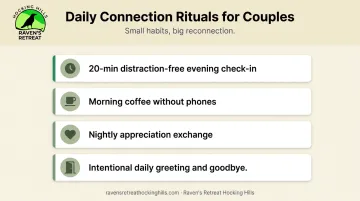
Research on relationship rituals across four studies found that couples with shared rituals report more positive emotions, greater satisfaction, and increased commitment — provided both partners agree the activity holds symbolic meaning.
Prioritize Individual Self-Care
Replenishing your own emotional reserves directly improves your capacity to be present with a partner. Sleep, movement, solo time, and social connection outside the relationship are direct inputs to relational health, not indulgences. A 2024 narrative review found significant bidirectional associations between relationship quality and sleep, with negative partner interactions linked to worse sleep outcomes. When you're rested and regulated, you're a different partner entirely.
Reset Your Environment Together
Novel, shared experiences interrupt negative relational patterns and create new associative memories. Research by Aron et al. found that couples who participated in novel and arousing activities together reported increased relationship quality. Your nervous system can, in effect, update its sense of safety with your partner when the context itself is new.
Nature immersion adds another layer. Studies on forest bathing (shinrin-yoku) show reduced cortisol and measurable physiological stress relief in forest environments. Kaplan's Attention Restoration Theory explains why: natural settings replenish directed-attention capacity, the same resource depleted by chronic relational and occupational stress.
For couples seeking this kind of reset, Raven's Retreat Hocking Hills is built around exactly these principles. Set on a 58-acre private nature preserve near Laurelville, Ohio, the property includes forest meditation zones, a 24×24 elevated yoga platform, private wellness trails, a hot tub, sauna, and immersive art installations by master sculptor Dustin Weatherby.
Their structured couples retreat (limited to five couples) runs three nights and four days, with guided connection exercises, somatic breathwork, creative sculpting workshops, and guided forest walks — all facilitated by practitioners with backgrounds in somatic coaching, nervous system regulation, and creative expression. Couples preferring a private stay can book the Art Bungalow starting at $400 per night, a secluded two-person sanctuary about an hour from Columbus.

The 3-3-3, 2-2-2, and 65% Rules in Relationships
Three popular frameworks offer practical structure for couples working to prevent or recover from burnout.
The 3-3-3 Rule
A structured reconnection habit built around escalating intentional time:
- 3 hours per week on a dedicated date
- 3 days per month on an overnight getaway
- 3 weeks per year on a dedicated vacation
Most burnout doesn't come from fighting — it comes from drifting. Treating relationship investment as a non-negotiable rhythm prevents the slow erosion that happens when connection is always deferred.
The 2-2-2 Rule
A similar framework with slightly different intervals:
- Date night every 2 weeks
- Weekend away every 2 months
- Vacation every 2 years
Both frameworks share one principle: stop waiting for life to calm down before investing in the relationship. The specific intervals matter less than building a consistent rhythm — because consistency is what creates felt security over time.
The 65% Rule (Gottman's 5:1 Ratio)
This one does have solid research behind it. The Gottman Institute's findings from conflict research show that in successful couples, positive interactions outnumber negative ones at roughly a 5:1 ratio — approximately five positive or neutral exchanges for every one negative interaction. Couples heading for dissolution averaged closer to 0.8 positive interactions per negative one.
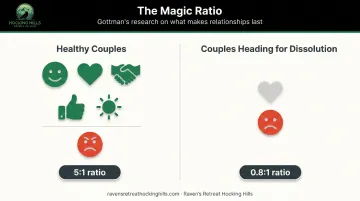
The practical implication: recovery doesn't require a conflict-free relationship. It requires shifting the ratio.
- Goal: More positive interactions than negative ones — not zero conflict
- Threshold: Even small positive gestures (acknowledgment, humor, physical touch) count toward the ratio
This makes the work feel manageable, because the goal is proportional — not perfect.
When to Seek Professional Support
Self-help strategies work well for mild to moderate burnout when both partners are willing and engaged. But some situations call for professional support:
- Persistent conflict cycles that don't resolve despite genuine effort
- One or both partners seriously contemplating separation
- Unresolved trauma affecting relationship dynamics
- Emotional detachment that hasn't shifted after several weeks of intentional reconnection
Emotionally Focused Therapy (EFT) is an attachment-based approach with a strong clinical evidence base. One peer-reviewed review reported that EFT produced 50% improvement in relationship quality and 70% recovery at three-month follow-up. The AAMFT also reports that over 75% of clients report relationship improvement after working with marriage and family therapists.
Timing matters more than most couples realize. Seek support earlier than feels necessary — research shows couples wait nearly three years on average before getting help. Most would benefit from acting sooner.
Frequently Asked Questions
How can couples recover from relationship burnout?
Recovery starts with both partners acknowledging the depletion, then rebuilding through daily connection rituals, individual self-care, and professional support when needed. Treating it as a shared project, not one person's burden, is what makes the difference.
What are the 3-3-3, 2-2-2, and 65% rules in relationships?
The 3-3-3 and 2-2-2 rules are scheduling frameworks for regular couple time at escalating levels: weekly dates, monthly overnights, and annual vacations. Gottman's research separately identifies a 5:1 ratio, meaning healthy couples average five positive interactions for every negative one.
Can relationship burnout be fixed, or does it mean the relationship is over?
Burnout is recoverable in most cases, especially when both partners are willing to engage. It signals a need for change, not an inevitable ending. The distinction between burnout (exhaustion) and a genuine loss of attachment matters here.
What is the difference between relationship burnout and falling out of love?
Burnout involves emotional exhaustion while the underlying connection is still present. Falling out of love means that attachment has genuinely faded. Couples often mistake one for the other, which is why getting an honest read on which is happening matters before making major decisions.
How long does it take to recover from relationship burnout?
With consistent effort and professional support when needed, many couples see meaningful improvement within three to six months. Timelines depend on severity and duration, but small signs of progress often appear well before that window closes.