Introduction
Where a team goes on retreat shapes what they bring back. Companies are learning this — and moving away from generic hotel conference rooms toward locations that combine purposeful programming, natural environments, and experiences that produce lasting behavioral change.
The numbers reflect this shift. According to Emburse's 2025 State of Corporate Offsites report, 44% of offsite time is now dedicated to social programming and team building, while traditional work activities account for just 36%. Meanwhile, 69% of high-performing companies have increased their retreat investment since 2019.
This guide breaks down the best team building retreat locations across the U.S. in 2026, with a focus on what makes each destination uniquely effective and how to match the right one to your team's specific goals.
Key Takeaways
- The best locations pair purposeful programming with memorable natural or cultural environments, not just beds
- Matching retreat type to the location's strengths is the most critical planning decision
- Private buyouts consistently outperform generic hotel blocks for team cohesion
- The Midwest — specifically Hocking Hills, Ohio — is one of the most underrated and accessible retreat regions in the country
- Book early; private buyout venues typically require more lead time
What Makes a Great Team Building Retreat Location?
The best retreat locations do three things at once: they remove teams from routine (disrupting habitual thinking), provide structured space for work sessions, and create an environment that naturally encourages connection.
Research backs this up. A PLOS One study found that four days of nature immersion increased creative problem-solving performance by 50% — a measurable cognitive shift that no hotel ballroom can replicate.
The Four Selection Factors That Matter Most
When evaluating a retreat location, weigh these criteria:
- Goal alignment: Does the setting support wellness, adventure, creative work, or strategic planning? A forest sanctuary serves a different purpose than an urban conference hotel.
- Accessibility: Travel burden affects team energy before the retreat even starts.
- Programming capacity: Can the venue handle private work sessions and group activities at the same time, or does everything funnel through one shared space?
- Customizability: Can you bring in external facilitators, private chefs, or specialized programming to shape the experience?
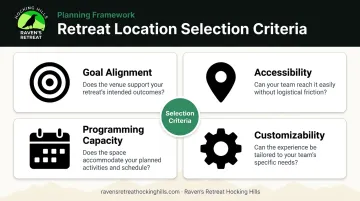
These criteria narrow the field quickly. Once you have them clearly defined, a common trap becomes easier to avoid: choosing a location based on aesthetics or cost alone. A beachfront resort may photograph beautifully but undermine deep strategy work if the setting doesn't match your goals. The environment is part of the program — it should be chosen with the same intentionality as the agenda itself.
Best Team Building Retreat Locations in 2026
This list spans diverse regions, retreat styles, and group sizes — selected for their combination of purposeful programming potential, unique environment, and team-building infrastructure.
Hocking Hills, Ohio — Raven's Retreat Hocking Hills
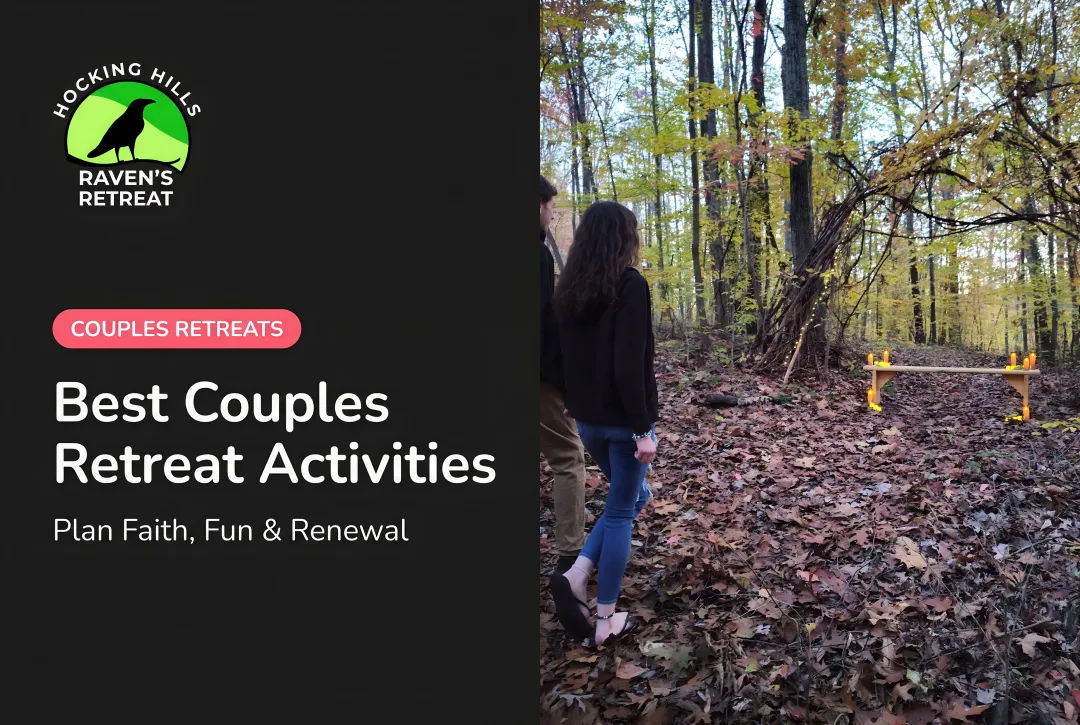
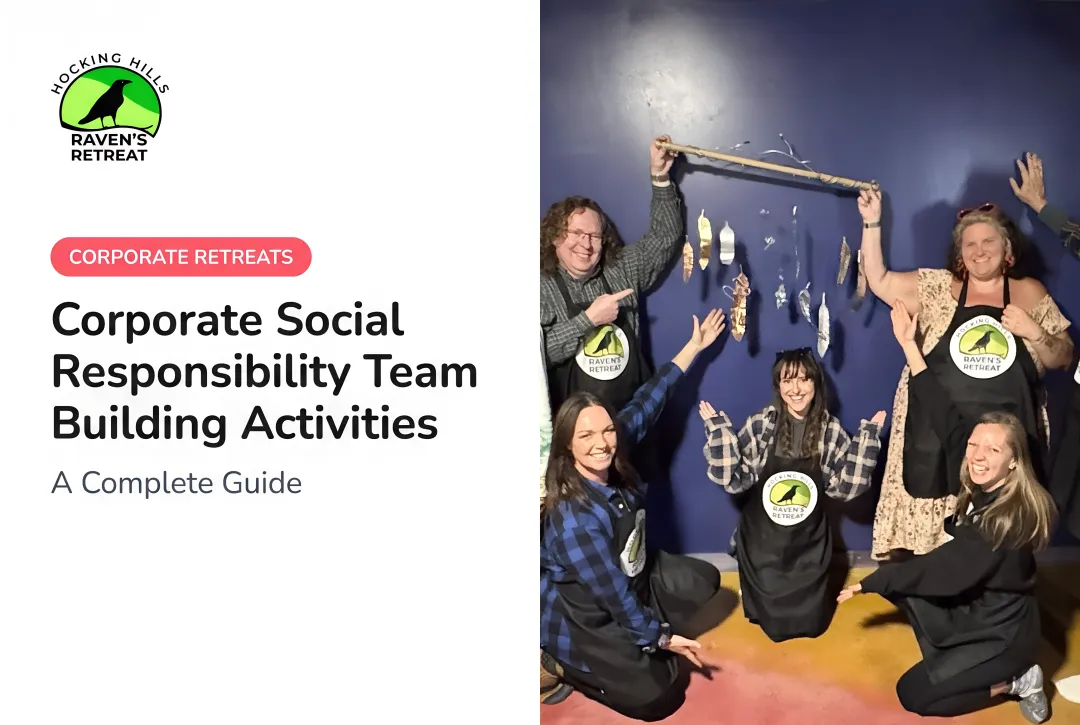
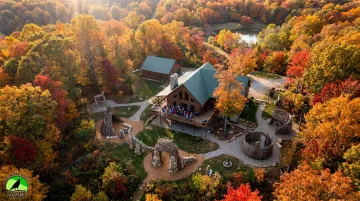
Raven's Retreat Hocking Hills is an adults-only immersive art and nature wellness retreat set on a 58-acre private preserve near Laurelville, Ohio. Co-designed by master sculptor Dustin Weatherby, the property is a living work of art — hand-crafted steel sculptures, wood carvings, tile murals, and a one-of-a-kind Sculptor's Art Lodge featuring a stunning black walnut kitchen. Its guest ratings speak for themselves: 4.96 on Airbnb, 4.95 on VRBO, 4.97 on Google.
What makes it exceptional for team retreats is the infrastructure, not just the aesthetics. The Art Lodge includes a dedicated indoor gathering space (the Shala) with a large presentation screen and 300+ Mbps Wi-Fi. A 24×24 elevated forest yoga platform, two designated forest meditation zones, and BioFit functional fitness stations support active programming.
A 6-person hot tub and 4-person infrared cedar sauna round out the on-site recovery amenities.
Full property buyout sleeps up to 18 guests on-site (16 in the Art Lodge, 2 in the Sculptor's Art Bungalow), with day retreat capacity for groups up to 20. Customizable add-ons include live sculpture performances by Dustin Weatherby, guided forest bathing, plant-based chef services, yoga, sound healing, NLP coaching, and scavenger hunts.
Rock House, Old Man's Cave, and Ash Cave are all within 6–14 miles — easy half-day excursions that don't require extra logistics.
Teams from Columbus (~1 hour), Cincinnati, Cleveland, and Pittsburgh (~2–2.5 hours) can reach the property without flights — a direct logistical win for Midwest-based organizations that want to skip airport delays entirely.
| Detail | Info |
|---|---|
| Best For | Creative retreats, wellness retreats, mastermind groups, leadership teams |
| Key Features | Full property buyout, immersive art installations, live sculpture experiences, wellness add-ons, 58-acre preserve, 300+ Mbps Wi-Fi, EV charging |
| Ideal Group Size | 6–18 overnight guests; up to 20 for day retreats |
Sedona, Arizona
Sedona is one of the most spiritually energizing retreat destinations in the country. Dramatic red rock formations, vortex sites, and a thriving wellness ecosystem make it ideal for teams that need a genuine reset alongside structured programming.
The infrastructure matches the setting. Enchantment Resort alone offers 218 guest rooms, 6 meeting rooms, and 9,660 sq. ft. of event space, with ballroom capacities ranging from 60 to 540 guests. The Wilde Resort & Spa adds another 6,000+ sq. ft. of indoor and outdoor event space, including soul-centered wellness workshops and guided meditation. Sedona's four-season climate (averaging 62°F daytime in winter at 4,500 ft elevation) keeps programming options open year-round.
| Detail | Info |
|---|---|
| Best For | Wellness retreats, leadership development, creative strategy off-sites |
| Key Features | Red rock setting, vortex hikes, resort-scale meeting space, wellness facilitators, year-round mild climate |
| Ideal Group Size | Small executive teams to mid-size groups of 80–540 depending on venue |
Asheville, North Carolina
Asheville sits at the intersection of mountain wilderness and creative culture — a Blue Ridge city known for its independent arts scene, craft brewery culture, and proximity to the Great Smoky Mountains. It's consistently ranked among the top U.S. corporate retreat destinations, earning the #2 spot on The Offsite Co's national list.
Venue options span the full range. The Omni Grove Park Inn offers 513 guest rooms, 86,852 sq. ft. of meeting space, and a grand ballroom accommodating up to 2,200 in theater-style. For smaller executive groups, The Horse Shoe Farm hosts 8–30 guests with private rooms and meeting space in The Sunset Barn. Team activities include pottery workshops, falconry, forest bathing, canoe relay races, and orienteering — programming that goes well beyond a ropes course.
| Detail | Info |
|---|---|
| Best For | Creative retreats, recreational retreats, remote team meet-ups |
| Key Features | Arts district, mountain access, craft food and beverage scene, diverse venues, four-season outdoor activities |
| Ideal Group Size | 8–30 (boutique/executive); up to 1,000+ (resort-scale) |
Lake Tahoe, California/Nevada
Lake Tahoe offers the most versatile year-round programming of any U.S. retreat destination — skiing and snowshoeing in winter, kayaking and hiking in summer, with an alpine backdrop that's genuinely motivating.
The meeting infrastructure is substantial. South Shore alone offers 100,000+ sq. ft. of meeting space across 20+ properties; North Shore adds 200,000 sq. ft. across 30+ venues. Edgewood Tahoe Resort contributes 154 guest rooms and 10,000+ sq. ft. of indoor and outdoor meeting space with direct lake views. With 300+ sunny days per year and Reno-Tahoe Airport offering 130 daily flights, logistics rarely get in the way.
| Detail | Info |
|---|---|
| Best For | Team-building retreats, recreational retreats, hybrid work-and-play off-sites |
| Key Features | Alpine lake scenery, year-round outdoor activities, resort amenities, 100,000+ sq. ft. South Shore meeting space |
| Ideal Group Size | Small groups to large conferences depending on venue |
Jackson Hole, Wyoming
Jackson Hole sits adjacent to Grand Teton National Park (1 mile from Teton Mountain Lodge) and within a 2-hour drive of Yellowstone — a setting that builds shared challenge and trust without a facilitator having to engineer it.
Teton Mountain Lodge & Spa offers 3 meeting rooms and capacity for up to 162 people; Red Rock Ranch feeds up to 120 team members with a commercial kitchen and log cabin accommodations. The adventure programming menu covers wildlife tours, via ferrata, guided hikes, skiing, horseback riding, and cookouts. For leadership teams and high-performance groups, that shared physical challenge does real work — trust accelerates when people push limits together.
| Detail | Info |
|---|---|
| Best For | Leadership retreats, adventure-focused team building, high-performance team off-sites |
| Key Features | Grand Teton access, adventure programming, luxury lodges, nonstop flights from 13 cities |
| Ideal Group Size | Intimate executive groups to mid-size teams (up to ~162 on-site) |
Austin, Texas
Austin is the default choice for innovation-focused retreats — a city with startup-charged energy, a world-class culinary and live music scene, and the infrastructure to match. With 1M+ sq. ft. of hotel meeting space citywide and 4,500+ companies including 3,000+ funded startups, Austin offers unique access to guest speakers, site visits, and the ambient energy of a functioning innovation ecosystem.
Sage Hill's Hill Country retreat accommodates up to 50 people in a private indoor and outdoor setting. Post-session, the city itself handles team bonding: live music on 6th Street, farm-to-table dining, and the kind of informal social infrastructure that makes evenings feel productive without feeling forced.
| Detail | Info |
|---|---|
| Best For | Professional development retreats, innovation workshops, tech and startup teams |
| Key Features | Startup ecosystem, estate rentals, live music and food culture, 1M+ sq. ft. citywide meeting space |
| Ideal Group Size | Small executive groups (50 at estate scale) to large conferences |
How We Chose These Retreat Locations
This list was evaluated against four criteria:
- Environmental fit — does the setting actively support the stated retreat goal?
- Programming infrastructure — private or semi-private space for both structured sessions and informal connection
- Accessibility — realistic travel logistics for U.S.-based teams
- Customizability — breadth of on-site and nearby experiences beyond aesthetics
Price range and group size suitability were also factored in. The list spans intimate executive off-sites (8–16 people) to mid-size departmental retreats (50–100+), so both scales have relevant options. Before booking, weigh your retreat type and team culture first — a leadership strategy session calls for structured seclusion; a creative team reset needs sensory variety and space to breathe.
Conclusion
The best team building retreat location does one thing well: it gets people out of their default patterns. Somewhere they can actually talk, think differently, and leave with momentum they didn't have when they arrived.
For teams looking for a distinctive Midwest option, Raven's Retreat Hocking Hills offers something genuinely different: a private 58-acre nature sanctuary where art, wellness, and team programming come together. Teams get full property buyouts, customizable programming (including live sculpture performances by co-founder Dustin Weatherby), and ratings that back it up: 4.96 on Airbnb, 4.95 on VRBO, and 4.97 on Google. Reach out to explore availability — a complimentary consultation call with co-founder Raven Morgan is included with direct bookings.
Frequently Asked Questions
What is the difference between team building and a retreat?
Team building refers to structured activities designed to improve collaboration and trust. A retreat is broader: it may include team building but also encompasses rest, strategy sessions, and culture-building over multiple days. Most effective modern retreats combine both intentionally rather than treating them as separate events.
How much does a company retreat cost?
Costs vary widely by group size, duration, and customization level. According to Wilder Retreats, high-impact retreats typically run $800–$1,500 per person per day, including boutique lodging, meals, and programming. Smaller companies (10–50 employees) often land in the $500–$1,000 per person total range for a multi-day event.
Can I write off a corporate retreat?
Retreat expenses are often partially or fully tax-deductible when the event has a legitimate business purpose. Meals are generally subject to a 50% limitation and entertainment costs are typically not deductible — consult a tax professional and IRS Publication 463 for your specific situation.
How far in advance should I book a team building retreat venue?
Book as early as possible, with accommodations confirmed well ahead of your target dates. Planning with a short lead time typically means limited availability and higher costs — private buyout venues require the longest lead time of all.
What should I look for when choosing a team building retreat location?
Prioritize: alignment with retreat goals, group size fit, travel accessibility, availability of private programming space, and customizability of experiences. The setting itself should actively support the type of connection and outcome you're seeking — not just look good in photos.