Introduction
Most couples share the same home, the same bed, and the same Netflix queue — but rarely share the same intentional, screen-free hour together. That gap is smaller than it sounds, and couples yoga is one of the most effective ways to close it.
Yoga is typically framed as a solo pursuit: flexibility, stress relief, a quiet moment for yourself. But when practiced with a partner, something different happens. The physical and mental benefits don't disappear — they compound. Layered on top of them are trust, attunement, and a kind of non-verbal closeness that's hard to build any other way.
This article breaks down the specific, research-supported benefits of couples yoga — the real changes couples notice in how they communicate, connect, and feel together. From stress reduction to restored intimacy, what the research shows may surprise you.
Key Takeaways
- Couples yoga builds trust and communication through real-time, non-verbal coordination — flexibility is secondary.
- Synchronized movement and intentional touch trigger physiological responses that deepen bonding and reduce stress hormones.
- No prior experience is needed; presence and partnership matter far more than technique.
- Benefits compound over time: consistent practice produces lasting improvements in how couples handle stress and conflict.
- Where you practice matters — a distraction-free setting, like a nature retreat, makes every benefit more accessible and lasting.
What Is Couples Yoga?
Couples yoga — also called partner yoga — is a shared practice where two people move through poses, breathwork, and intentional sequences together, relying on mutual support, physical contact, and synchronized effort. It's not two people doing solo yoga side by side. Every pose involves both partners: one counterbalancing the other, one supporting the other's stretch, both breathing in rhythm.
A few things it's not:
- A competition or performance
- Reserved for flexible or experienced practitioners
- The same as AcroYoga (which uses partner inversions as its foundation — couples yoga is much more beginner-friendly)
Yoga Journal describes it as a practice that "doesn't always have to be a solo pursuit" and confirms that couples don't need AcroYoga skill to have a "playful and fulfilling partner practice." The real value lies in the outcomes — deeper trust, improved communication, shared calm — not in executing the poses perfectly.
Key Benefits of Couples Yoga for Your Relationship
The benefits below focus on what couples actually feel — in their bodies, their conversations, and their day-to-day dynamic.
Benefit 1: Deeper Communication and Active Trust
Couples yoga is one of the few activities that requires real-time, non-verbal communication. There's no script. Partners must read physical cues, adjust to each other's pace, and signal needs without words. That's not a side effect of the practice — it's the core mechanic.
Each pose creates micro-moments of negotiation: how far to lean, how much weight to share, when to ease back. Couples who navigate those moments successfully on the mat are training the same attunement and sensitivity that matter in everyday relationship conflicts — the ability to listen not just with ears, but with presence.
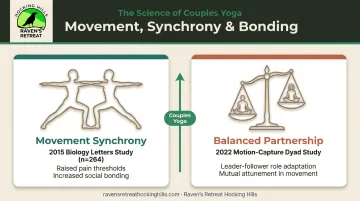
A 2015 study published in Biology Letters (n=264) found that synchronous movement independently raised both pain thresholds and self-reported social bonding. A separate 2022 study using motion-capture data from 38 dyads found that perceived movement synchrony was associated with a balanced leader-follower dynamic between partners — not one person dominating — which maps directly to the mutual give-and-take couples yoga requires.
When this benefit is felt most: Couples navigating a period of disconnect or poor communication often find the non-verbal, low-pressure nature of couples yoga easier than conversation alone. The body leads. The words follow.
Benefit 2: Emotional Intimacy and Restored Connection
Couples yoga deepens emotional intimacy through something everyday life rarely provides: sustained, intentional physical closeness combined with full mutual attention. Passive proximity — sitting on the couch together — isn't the same as active attunement, and most couples have more of the former than they realize.
The physiological dimension matters here. Research on affectionate touch in romantic relationships — including a 2012 longitudinal study of 120 new couples — found that oxytocin levels were significantly higher in new lovers than singles and correlated with affectionate touch, positive affect, and synchronized emotional states between partners. While the relationship between touch and oxytocin is complex (it's not a simple "more touch equals more bonding hormone"), the pattern supports what couples yoga practitioners report intuitively: intentional physical closeness with a partner feels different from ordinary contact.
There's also a less clinical benefit worth naming: laughter. Wobbling out of a pose together, catching each other mid-fall, discovering a partner is surprisingly terrible at balancing — these moments build a reservoir of positive shared memories that buffer against conflict and emotional distance over time.
For couples recovering from emotional drift or a particularly stressful season, couples yoga offers a structured way to re-establish closeness without requiring a difficult conversation first.
Benefit 3: Physical and Mental Wellbeing — For Both Partners
Couples yoga improves flexibility, posture, core strength, and physical tension — often more effectively than solo practice. A partner's body weight and support helps each person stretch deeper and hold balance longer than they could alone.
The mental health gains compound this. Yoga's focus on breath and synchronized movement activates the parasympathetic nervous system, reducing cortisol and supporting mood regulation. A 2024 systematic review links yoga to meaningful stress reduction, and the Mayo Clinic notes improvements in both nervous system function and joint range of motion. These effects are amplified when the activity is social: a 2021 study in the Journal of Social and Personal Relationships found that exercising with a romantic partner improved mood during the session, throughout the day, and relationship satisfaction overall.
The compounding relationship outcome: When both partners feel physically better and less stressed, the relationship itself improves. Lower individual stress directly reduces reactivity, irritability, and emotional withdrawal — the friction points that accumulate quietly over time.
For busy couples who rarely carve out time for both wellness and togetherness, couples yoga accomplishes both in a single session.
What Happens When Couples Skip the Shared Practice
There's a version of a healthy relationship where both partners pursue wellness diligently — solo gym sessions, individual meditation apps, separate routines — and drift toward each other feeling accomplished but disconnected. They're physically well. Relationally, they're operating in separate lanes.
Researchers call the underlying risk "parallel living." Wellness practiced in isolation doesn't generate the relational dividend that shared intentional movement produces. Trust, attunement, and intimacy grow through doing something together — particularly something novel or slightly challenging.
Arthur Aron's foundational research on self-expansion theory found that couples who shared novel, arousing activities reported higher relationship quality — and that experimental exposure to those activities increased relationship satisfaction more than familiar pleasant ones. The practical implication: novelty and shared physical engagement are relationship nutrients, not luxuries.
Couples who consistently skip shared presence-based activities don't necessarily suffer dramatic relationship crises. The cost is subtler — a quiet erosion of attunement, playfulness, and the simple feeling of being truly known.
How to Get the Most from Couples Yoga
Start Simple, Stay Consistent
Couples yoga works best as an ongoing practice, not a one-time date night. Starting points that require no prior experience:
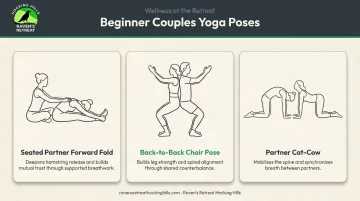
- Seated partner forward fold — one partner folds forward while the other applies gentle pressure to the back
- Back-to-back chair pose — both partners lower into a squat with spines pressed together, supporting each other's weight
- Partner cat-cow — facing each other on hands and knees, mirroring breath and spinal movement in sync
Build gradually — the complexity of the poses matters far less than the consistency of showing up together.
Mindset Matters as Much as Mechanics
Couples who approach the practice with curiosity and humor — laughing when poses don't land, celebrating small wins, staying attuned rather than competitive — consistently report the deepest relational benefits. The goal is mutual presence, not perfect form.
Let the Environment Do Some of the Work
Where you practice shapes the experience more than most people expect. Practicing in a distraction-free setting — away from phones, notifications, and the ambient noise of daily life — allows couples to be genuinely present with each other, often for the first time in weeks.
For couples looking to fully reset their practice, a dedicated retreat setting can be transformative. Raven's Retreat Hocking Hills offers customizable wellness experiences — including yoga with certified instructors — on a 58-acre private nature preserve near Laurelville, Ohio. Sessions are held on a 24-by-24-foot elevated wooden platform within the forest canopy, with sunrise and sunset flows that create the kind of shared memory couples carry long after they leave — or indoors at the guest's own space, for a more private setting.
The retreat is adults-only and designed specifically to strip away everyday noise. Couples can pair yoga with:
- Sound baths and guided meditation
- Forest bathing and somatic breathwork
- Hot tub soaks in a secluded forest setting
Or simply let the preserve do the rest.
Conclusion
The value of couples yoga isn't in any single session — it's in what accumulates over time. Non-verbal negotiation builds communication habits. Shared physical support deepens trust. Intentional presence restores attunement. These aren't things you can rush or manufacture; they're what consistent practice quietly produces.
Treat it as an ongoing investment, not a one-time experience. Whether you practice at home with two mats and a beginner pose guide, in a local studio, or at an immersive retreat — somewhere away from daily noise, where the environment itself supports the work, the results build steadily in the same direction: toward a relationship where both partners feel more connected, more attuned, and more at ease with each other.
The mat just marks the starting point. What grows between two people who keep showing up — that's the whole thing.
Frequently Asked Questions
Do we need prior yoga experience to try couples yoga?
No experience is necessary. Couples yoga is designed to be accessible to all levels, with beginner-friendly poses that prioritize communication and support over flexibility or technique.
How often should couples practice together to notice relationship benefits?
Even once a week can produce noticeable improvements in communication and closeness over time. Consistency across several weeks tends to yield the most meaningful relational shifts — quality of presence matters more than session length.
What are the easiest couples yoga poses to start with?
Seated partner forward fold, back-to-back chair pose, and partner cat-cow are all beginner-friendly starting points. None require prior skill, and all naturally build physical trust and a shared physical rhythm.
Can couples yoga actually help with communication problems in a relationship?
Couples yoga isn't a substitute for therapy, but it does build body-based listening skills and patience in a low-pressure physical context. Many couples find those skills transfer directly to how they communicate off the mat — with more patience and less reactivity.
Is couples yoga only for romantic partners?
The practice is open to any two people — close friends, family members, or colleagues. That said, the trust-building and intimacy benefits make it especially impactful for romantic couples who want to deepen their connection.
What should couples wear or bring to a couples yoga session?
Comfortable, flexible or form-fitting clothing, bare feet or grip socks, and a yoga mat each (or one large mat). Most importantly: bring an open, playful mindset — and a willingness to laugh at yourselves when things get wobbly.