Introduction
Most people who feel burned out don't need another hotel with a forest view. They need to be in the forest — and the difference matters more than most retreat marketing suggests.
Screens, noise, and constant connectivity have pushed adult stress levels to a point where a weekend away feels insufficient if the environment itself isn't doing active work. That's where forest bathing retreats with intentional architecture come in.
Unlike a cabin rental or a nature-themed resort, a well-designed forest bathing retreat uses its physical structure, materials, and landscape placement to dissolve the barrier between guest and forest. The immersion starts the moment you arrive.
This article covers the science behind shinrin-yoku, how architecture either amplifies or undermines that practice, the design principles that separate genuine wellness retreats from nature-themed accommodations, and what to look for when choosing a retreat that will actually restore you.
Key Takeaways:
- Forest bathing (shinrin-yoku) is a slow, sensory practice rooted in Japanese tradition — not exercise, not sightseeing
- Architecture shapes nature immersion through materials, orientation, and indoor-outdoor transitions
- Evidence-backed benefits include cortisol reduction, improved NK cell activity, and lower blood pressure
- Multi-day retreats compound these benefits significantly beyond brief nature exposure
- Hocking Hills, Ohio offers sandstone gorges, hemlock forests, and private preserve access for genuine shinrin-yoku
What Is Forest Bathing and Why It Matters Now
The Practice Itself
Shinrin-yoku — loosely translated as "taking in the forest atmosphere" — was introduced in 1982 by Japan's Forest Agency as a national health program addressing overwork culture and stress-related illness. It's not hiking. There's no destination, no fitness goal, and no pace to keep.
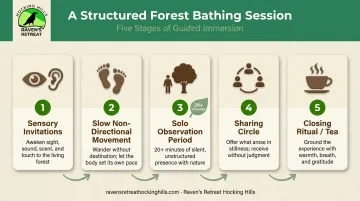
A structured forest bathing session involves:
- Sensory invitations — guided prompts that direct attention to specific sights, sounds, textures, or smells
- Slow, non-directional movement through natural environments
- Solo observation periods (20+ minutes) for unstructured presence
- Sharing circles to integrate the experience
- A closing ritual, often tea
The Association of Nature and Forest Therapy (ANFT), whose certified guides now operate in over 65 countries, describes the guide's role simply: "The Forest is the Therapist, the Guide opens the Doors." The guide facilitates — the forest does the work.
The Cultural Moment
This isn't a niche trend. Wellness tourism reached $830.2 billion globally in 2023 and is projected to hit $1.35 trillion by 2028 — growing at 10.2% annually. Nature-based therapy is driving a meaningful portion of that growth as adults increasingly seek restoration that goes deeper than a spa day.
That demand is pushing the infrastructure forward. Japan's Forest Therapy Society now certifies 65 dedicated forest therapy sites, each with scientifically evaluated therapy roads. Retreat centers worldwide are responding — designing spaces, programming, and environments specifically built around the practice rather than simply gesturing toward nature as a backdrop.
Why Architecture Shapes the Forest Bathing Experience
The Threshold Problem
Most resort guests never fully leave the built environment — mentally or neurologically. They move between climate-controlled rooms, look at forest views through sealed glass, and re-enter nature only for scheduled activities. The building becomes a bubble, and the forest stays at arm's length.
Intentional retreat architecture works differently. Biophilic design — a philosophy rooted in E.O. Wilson's 1984 Biophilia framework — holds that built environments designed to integrate, frame, or mimic nature produce measurable psychological and physiological restoration. When Kellert and Calabrese defined biophilic design in 2015, they described it as "creating a good habitat for people as biological organisms" — not just aesthetically pleasant spaces, but environments that support biological wellbeing.
The distinction is whether a building retreats from nature or extends into it.
What the Research Shows
The science here is specific enough to inform real decisions about where you stay:
- Touching natural wood decreases prefrontal cortex activity and increases parasympathetic nervous activity compared with artificial materials (Ikei et al., 2017). The material of your bed frame, countertop, and floor is not decorative — it's physiological.
- Viewing nature scenes before a stressor produced heart rate variability recovery of 50.0 ms vs. 34.8 ms for built scenes (Brown et al., 2013). Window orientation matters.
- Biophilic indoor settings — including indoor greenery, outdoor views, or both — produced greater physiological stress recovery and lower anxiety scores than non-biophilic environments (Yin et al., 2020).
Those findings reframe what to look for in a retreat. The question shifts from "does it look natural?" to "does the building actually put you in contact with nature?" Several retreats have answered that question structurally:
Global Architecture Examples
| Retreat | Key Design Move |
|---|---|
| Løvtag, Denmark | Cabin raised 8 meters, wraps around a living tree, panoramic windows, canopy-level screened shower |
| Arcana, Ontario | Mirrored stainless steel cabins reflect surrounding deciduous forest — nearly invisible from within |
| PAN Cabins, Norway | 40m² cabins elevated on steel to minimize ground impact in Finnskogen forest |
| Juvet Landscape Hotel, Norway | Glass walls oriented directly to forest, river, and mountain — interior dissolves into landscape |
| Raven's Retreat, Ohio | Hand-crafted wood elements (walnut kitchen, timber carvings) throughout; 58-acre preserve surrounds the lodge with forest access steps from the door |
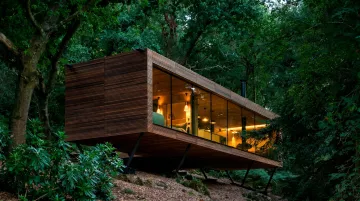
Each approach is different, but the outcome is consistent: guests spend more time in genuine contact with nature, not just proximity to it.
Design Principles Behind the Best Forest Bathing Retreats
Deliberate Site Integration
Great forest retreat architecture starts before a single wall is raised. Architects site structures to preserve existing trees, follow natural topography, and avoid unnecessary clearing. The forest should be undisturbed and fully present around the guest — not cleared back to make room for a building.
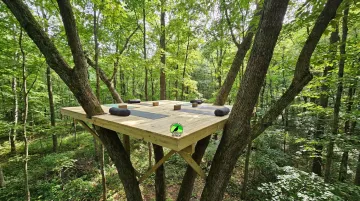
Elevation is a meaningful tool here. Canopy-level placement (like Løvtag's 8-meter elevation or Raven's Retreat's elevated yoga platform set into the forest) transforms the guest's relationship to the trees from "looking at" to "being among."
Sensory Materiality and Craft
Mass-produced interiors — laminate surfaces, painted drywall, synthetic fabrics — offer nothing to engage the senses. Handcrafted elements with organic irregularity work differently: they invite touch, slow the eye, and draw the nervous system toward attention rather than indifference.
At Raven's Retreat Hocking Hills, this principle runs throughout the 4,000-square-foot Sculptor's Art Lodge. Master sculptor Dustin Weatherby built the kitchen cabinetry from tornado-salvaged black walnut wood sourced from the Hocking Hills region, with live-edge white oak countertops.
Bathroom tile murals came from reclaimed and second-hand materials. Wood carvings, metal sculptures, and custom-made headboards are integrated into functional spaces, so the tactile invitation of the forest begins the moment guests step inside.
Permeable Indoor-Outdoor Transitions
The features that dissolve boundaries most effectively:
- Outdoor showers that put bathing itself into the landscape
- Expansive decks at or near canopy height
- Floor-to-ceiling windows that eliminate the visual gap between room and forest
- Open-plan game rooms and movement spaces that open fully to exterior access
The Sculptor's Art Lodge's floor-to-ceiling windows and rear covered balcony overlooking 58 acres of preserve are designed with this explicitly in mind — the forest becomes, as the hosts describe it, "an ever-changing art installation."
Intentional Simplicity and Visual Quiet
When an interior competes visually with the landscape outside, the forest loses. Restraint indoors is an amplifier outdoors. The most effective retreats achieve this through:
- Muted palettes that recede rather than assert
- Minimal furniture that keeps sightlines open to the windows
- Absence of screens, ensuring the trees remain the only compelling focal point
The best forest retreat interiors feel understated by design. They resist the temptation to decorate — because their job is to disappear into the landscape beyond them.
The Wellness Science Behind Immersive Nature Retreats
The evidence base for forest bathing has expanded substantially over the past two decades. A few findings are particularly relevant for retreat guests:
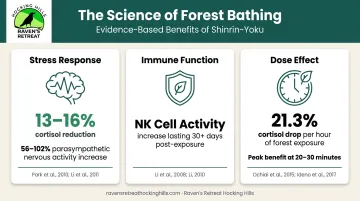
Stress and autonomic nervous system: Park et al. (2010), studying 24 forests across Japan, found forest environments produced:
- 13–16% lower salivary cortisol than urban settings
- Lower pulse rate, systolic, and diastolic blood pressure
- Parasympathetic (HF power) increases of 56–102% vs. urban environments
Immune function: Li (2009) found that a 3-day/2-night forest bathing trip significantly increased Natural Killer (NK) cell activity and anti-cancer protein levels. These effects lasted more than 30 days — city trips produced no comparable change.
Dose and duration: Even brief exposure helps. Hunter et al. (2019) found nature experiences produced a 21.3% per hour drop in cortisol, with peak efficiency at 20–30 minutes. But multi-day retreats produce immune-level changes that brief exposure simply cannot — the nervous system needs time to fully decompress.
Phytoncides: Trees emit volatile organic compounds — alpha-pinene, limonene — that research links to increased NK cell activity and reduced stress hormones. Staying in dense forest — with open-air access throughout the day and night — means guests absorb these compounds continuously, not just during a single walk.
That sustained exposure is where architecture becomes a multiplier. When design deepens sensory engagement — timber interiors, open-air transitions to the forest floor, structures built into the canopy — guests enter a parasympathetic state faster and hold it longer. The science suggests the difference isn't just qualitative: multi-day immersion in a well-designed forest environment produces physiological changes that a day hike or urban park visit simply doesn't reach.
Where Art Meets the Wild: Raven's Retreat Hocking Hills
Raven's Retreat sits on a 58-acre private nature preserve near Laurelville, Ohio — about an hour from Columbus — created by co-owners Raven Morgan and master sculptor Dustin Weatherby. Every element of the property reflects a deliberate intention: that art and nature should amplify each other, not compete.
The retreat's Sculptor's Art Lodge sleeps up to 16 guests across six bedrooms and operates as the Midwest's most architecturally distinctive forest bathing retreat. Dustin spent five years building the space from recycled and locally salvaged materials — tornado-fallen black walnut, reclaimed tile, live-edge maple and walnut. His sculptures, carvings, and custom lighting concepts are integrated into every functional space — so guests don't visit a gallery; they live inside one.
Forest bathing at Raven's Retreat is available as a guided add-on, led by Mark Bucha, certified by the Association of Nature and Forest Therapy (ANFT). Sessions move through the property's over a mile of private wellness trails, two designated forest meditation areas (one beside a glacier-deposited granite boulder formation, one at the preserve's deepest point beside a creek), and a 24-by-24-foot elevated wooden yoga platform set into the forest. Sound healing with certified practitioner Manda Bucha can be layered in for a more comprehensive session.
The land itself carries ecological weight beyond the guest experience. Raven's Retreat serves as a wildlife release site for The Ohio Wildlife Center, manages a 1,600-square-foot pollinator garden, and harbors endangered species including whippoorwills and two-lined salamanders. Leave-no-trace policies — wildlife-friendly lighting, no pets, no hunting or fishing, no synthetic scents — ensure the forest remains undisturbed.
Corporate groups and private buyouts are well-supported here. The Shala indoor movement space doubles as a meeting room, with high-speed connectivity (300+ Mbps) and a presentation screen. Available add-ons include:
- Live sculpture performances — guests watch Dustin create a piece in real time, then take it home
- Plant-based chef meals, massage, NLP coaching, and guided creative workshops
- Full property buyout for up to 18 overnight guests seeking complete privacy
How to Choose a Forest Bathing Retreat
Not all nature retreats are forest bathing retreats. The differences are practical, not philosophical.
Questions to Ask Before Booking
- Does the architecture integrate with the forest, or simply sit inside it? (Check for biophilic materials, window orientation, canopy access)
- Are natural and locally sourced materials used throughout interior spaces?
- Is there access to genuinely biodiverse, undisturbed forest — not landscaped grounds?
- Does the retreat offer guided sessions, or is the experience entirely self-directed?
- Does the retreat's philosophy (eco-conscious, leave-no-trace, wildlife-protective) reflect values you actually hold?
Match Retreat Type to Intention
| Guest Type | Best Retreat Features |
|---|---|
| Solo or couples | Private, high-solitude setting; guided forest bathing option; minimal group programming |
| Corporate teams | Flexible indoor collaboration space; forest access between sessions; max 14–16 guests |
| Creative professionals | Art programming alongside nature immersion; handcrafted environments that activate creative attention |
| Wellness practitioners | Property that supports yoga, meditation, and somatic practices outdoors |
Seasonal and Logistical Considerations
- Proximity to state park trails extends the experience beyond the property itself
- Look for retreats within 90 minutes of major metros for accessible multi-day stays
- Hocking Hills is accessible year-round, with distinct sensory experiences each season — spring waterfalls, summer canopy density, fall color, winter quiet; Raven's Retreat Hocking Hills sits on a 58-acre private preserve two miles from Laurelville with guided forest bathing available as an add-on
Frequently Asked Questions
What is forest bathing and how is it different from a regular nature walk?
Forest bathing (shinrin-yoku) is a slow, sensory practice of deliberate immersion in natural environments — with no destination, no exercise goal, and no pace. Where a nature walk is destination-driven, shinrin-yoku uses guided sensory invitations to help practitioners notice what's immediately present: texture, sound, smell, light.
How does architecture enhance a forest bathing experience?
Biophilic design — natural materials, canopy-level orientation, and dissolving indoor-outdoor boundaries — activates parasympathetic responses before guests step outside. Buildings that use raw wood, oriented windows, and open transitions prime the nervous system for nature immersion rather than creating a psychological barrier to it.
What health benefits can I expect from a forest bathing retreat?
Evidence-based benefits include reduced cortisol levels, lower blood pressure, increased Natural Killer cell activity, and improved mood. Multi-day retreats amplify these effects; the immune benefits from a 3-day forest stay have been shown to persist for over 30 days.
How long should I stay at a forest bathing retreat to feel the benefits?
Even 20–30 minutes in nature produces measurable cortisol reduction. For nervous system decompression and immune-level changes, multi-day stays produce deeper, more lasting restoration. The body simply needs time to fully shift out of sympathetic activation.
Are forest bathing retreats suitable for corporate groups or team getaways?
Yes. Nature immersion reduces cortisol and supports the open, associative thinking that strategic sessions benefit from. Retreats with flexible indoor-outdoor spaces — like Raven's Retreat's forest-connected yoga platform and covered gathering areas — can weave structured work alongside genuine restoration.
What makes Hocking Hills, Ohio a good destination for forest bathing?
Hocking Hills offers sandstone gorges, hemlock-shaded ravines, cascading waterfalls, and diverse forest ecosystems — features that engage all five senses simultaneously. Private preserve options near Laurelville, like Raven's Retreat's 58-acre sanctuary, provide undisturbed forest with designated trails and meditation areas suited to genuine shinrin-yoku practice.