What makes Hocking Hills work for adult hikers is range. The same region offers fully paved, wheelchair-accessible strolls to spectacular falls and rugged, unmarked gorge hikes requiring advance permits. You can experience multiple waterfalls in a single day or dedicate an entire weekend to exploring just two or three trail areas properly.
This guide covers the 10 best waterfall hiking trails in Hocking Hills — with verified trail details, practical tips, and everything you need to time your visit for peak flow.
Key Takeaways
- Spring (March–May) delivers peak waterfall flows — many falls run dry or low during summer drought
- Hocking Hills' trail areas are not all connected — plan driving time between separate trailheads
- Most main trails are one-way loops with no backtracking permitted — study the map before you start
- All main state park trails are free; Robinson Falls (Boch Hollow) and Sheick Hollow require advance ODNR permits
- Laurelville sits within 14–16 miles of every major waterfall trailhead
Why Hocking Hills Is Ohio's Waterfall Hiking Capital
The story starts roughly 350 million years ago. Black Hand Sandstone — named for the dark handprint-shaped markings found in similar rock — formed from ancient sand deltas compressed into layered rock. The sandstone's structure, harder on top and bottom with a softer middle layer, made it vulnerable to water erosion by hollowing out from within rather than crumbling uniformly.
The result is what you see today — recess caves carved hundreds of feet wide, gorges descending 100 feet below the surrounding terrain, and the conditions for dramatic multi-tiered waterfalls that exist nowhere else in Ohio.
ODNR manages seven scenic areas within the Hocking Hills State Park complex, with additional waterfalls found in surrounding State Nature Preserves. Note: Several Nature Preserves require separate permits and enforce stricter access rules than the main park trails — worth checking before you go.
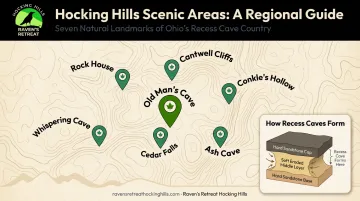
Each trail below is matched to fitness level and available time, so you can find the right waterfall — whether you want a crowd-drawing icon or a quiet gorge most visitors never reach.
10 Best Hocking Hills Hiking Trails with Waterfalls
1. Old Man's Cave — Upper Falls & Lower Falls
Distance: 1.0–1.5 miles | Difficulty: Moderate | One-way loop
Old Man's Cave is the most visited trail area in Hocking Hills, and the Upper Falls — framed beneath the historic stone bridge — is the region's most-photographed waterfall. The composition is hard to beat: the arch of the bridge, the gorge walls closing in on both sides, and the falls dropping into the pool below.
Most casual visitors turn back after Upper Falls. Don't. The Lower Falls, further along the gorge floor past Devil's Bathtub, tends to be quieter and often more impressive after rain.
Practical tip: Arrive at 7–8 a.m. on weekdays. By 10 a.m., parking lots fill and the one-way loop gets crowded. The trail includes stairs, tunnels, and uneven gorge-floor terrain — not suitable for strollers.
2. Cedar Falls
Distance: 1 mile | Difficulty: Moderate | Loop
Cedar Falls drops approximately 50 feet over Black Hand Sandstone into a rugged gorge with boardwalks threading between massive boulders. It's widely considered the most consistently beautiful waterfall in the park because it flows year-round, not just after rain — making it a reliable choice even in drier months.
The trail from the Cedar Falls parking area is manageable for most adult hikers, though the stairs into and out of the gorge rule out strollers. For a longer hike, the Grandma Gatewood Trail connects Cedar Falls to Old Man's Cave at 6 miles total.
Practical tip: Cedar Falls freezes dramatically in winter, creating one of the most striking ice formations in the region. Worth a January or February visit if you're comfortable on icy stairs with appropriate footwear.
3. Ash Cave Falls
Distance: 1/4 mile gorge trail (Easy, ADA-accessible) + 1/4 mile rim trail (Moderate) | Difficulty: Easy to Moderate
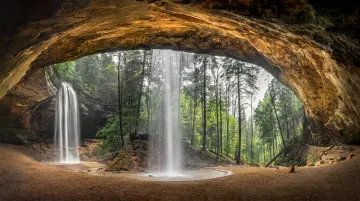
Ash Cave is Ohio's largest recess cave — 700 feet end to end, 100 feet deep — and in peak flow, a seasonal waterfall spills over its entire horseshoe rim in a broad, dramatic cascade. The first view stepping into the cave — water curtaining across the full rim with the sandstone ceiling overhead — stops most visitors mid-stride.
The gorge trail is paved and wheelchair accessible, making this the most accessible waterfall hike in the park. The rim trail, which completes the loop via stairs climbing past the falls, is moderate.
Practical tip: Visit in spring after significant rainfall for the most powerful flow. The gorge trail alone is worth the trip even if the falls are reduced — the scale of the cave itself justifies the visit.
4. Conkle's Hollow Falls
Distance: 1.1 miles out-and-back (gorge trail) | Difficulty: Easy to Moderate
Conkle's Hollow is one of the deepest gorges in Ohio — lush, narrow, and dramatically enclosed by 200-foot sandstone walls. The waterfall appears at the end of the lower gorge trail, and the approach through the hollow makes it feel earned.
This is a State Nature Preserve, so dogs are not permitted. A portion of the gorge trail is wheelchair accessible. The upper rim trail adds cliff-edge views but is far more demanding — expect steep climbs and exposed edges.
Practical tip: The final stretch to the waterfall transitions from paved to unpaved terrain — wear sturdy footwear. Spring visits after rain deliver the strongest flow; midsummer the falls can slow to a trickle.
5. Whispering Cave Falls
Distance: 4.5 miles | Difficulty: Difficult | Loop with suspension bridge
Whispering Cave earned the top spot in the 2024 USA Today 10Best Readers' Choice Awards for Best Hiking Trail — and the 105-foot seasonal waterfall inside a 300-foot-wide recess cave explains why. The cave's natural amphitheater creates an acoustic effect that gives it the name; you hear the waterfall and the surrounding forest differently inside it.
This is the most physically demanding trail on this list. ODNR lists it as Difficult, with significant elevation gain via long boardwalks and stairways.
Practical tip: The 4.5-mile loop includes a suspension bridge crossing — budget 2.5–3 hours and bring trekking poles. The waterfall is seasonal, so check recent rainfall before making this your only destination for the day.
6. Big Spring Hollow Falls
Distance: 1.2 miles | Difficulty: Easy | Out-and-back
Big Spring Hollow Falls is the tallest waterfall in the Hocking Hills region — estimated at approximately 120 feet, though no official ODNR height measurement has been published. The trail itself is short and relatively flat, which makes the sheer scale of the falls at the end feel disproportionate — you round a bend expecting a modest drop and get a 120-foot curtain of water instead. When it's running after spring rains, you hear it before you see it.
The broad flat rocks at the base make an ideal rest spot. Located near the Hocking State Forest Rappelling Area off Big Pine Road.
Practical tip: This is a lesser-known trail compared to the main park areas. Significantly less crowded, particularly on weekday mornings. Plan your visit within a day or two of significant rainfall — flow drops off quickly in dry stretches.
7. Cantwell Cliffs Falls
Distance: 2 miles total (two 1-mile loops) | Difficulty: Difficult
Cantwell Cliffs sits further north than the central Hocking Hills cluster, which means fewer crowds and a more remote feel. The seasonal waterfall cascades from a dramatic box canyon rim, framed by layered sandstone walls. The two one-mile loops include stone stair descents and the iconic "Fat Woman's Squeeze" — a narrow passage between rock faces that requires turning sideways to pass through.
Practical tip: Budget 60–80 minutes per loop. Combine with nearby Rock House (6 miles from Raven's Retreat) since both are farther from the central park cluster. The waterfall runs on rainfall — if it's been dry for a week, treat the canyon scenery as the main draw and the falls as a bonus.
8. Rockbridge Falls
Distance: 2.8 miles total trail system | Difficulty: Moderate
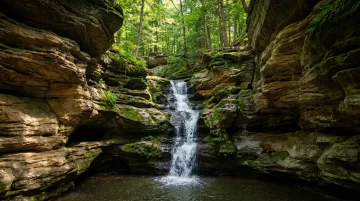
Rockbridge is a State Nature Preserve (no dogs) built around Ohio's largest natural stone arch bridge — more than 100 feet long, arching 50 feet across a ravine. The waterfall here is modest in scale but framed against the arch span in a way that photographs far better than the individual elements suggest.
Local outfitters offer canoe and kayak access to view the natural bridge from the Hocking River, adding an alternative approach for those who want to see the arch from the water.
Practical tip: Less crowded than the main park trails, making it ideal for hikers who want a quieter, more contemplative experience. Pair with Cantwell Cliffs for a full day on the northern trail circuit.
9. Broken Rock Falls
Distance: ~0.25 miles additional spur off Old Man's Cave loop | Difficulty: Moderate
Broken Rock Falls is an out-and-back spur off the 1.5-mile Old Man's Cave loop — a short detour that rewards hikers with a striking waterfall appearing to emerge directly from a pile of fractured boulders. It's not a destination in its own right, but it's an excellent bonus for anyone completing the full Old Man's Cave loop.
Practical tip: The spur includes additional stair climbing along the bluff line. Skip it if legs are already tired from the gorge — save it for the end of a fresh morning hike.
10. Robinson Falls (Laurel Falls) — Boch Hollow
Distance: Short but rugged | Difficulty: Challenging | Permit required
Boch Hollow State Nature Preserve covers 703 acres and 7 miles of trails in northern Hocking County. Robinson Falls — officially designated Laurel Falls by ODNR — sits at the end of an unmarked, unmaintained gorge route through a narrow canyon valley with steep drops. The falls themselves are modest in height, but the canyon setting makes the experience exceptional for experienced hikers comfortable with route-finding.
Practical tip: A special use permit from ODNR is required — apply at least 14 days before your visit. Proper hiking boots are non-negotiable. This is not a trail for casual visitors.
Tips for Hiking Hocking Hills Waterfall Trails
Navigation and Planning
- Download an offline map before leaving — cell service is unreliable throughout the hills and hollows. Printed maps are available at the Hocking Hills State Park Visitor Center.
- Most popular trails are designated one-way loops — once you start, you complete the loop. Study the map before descending into a gorge.
- Separate trailheads mean separate drives — Old Man's Cave and Cedar Falls sit miles apart. Factor 10–20 minutes of driving between areas into your day plan.
Safety and Trail Etiquette
- Rocks and stairs become treacherous when wet — the most common source of injuries near waterfalls. Assume every damp surface has zero grip.
- Swimming and wading in any water is prohibited in the park — enforced by ODNR rangers.
- Cliff edges on rim trails have limited railings. Stay on marked paths.
- Winter visits offer dramatic ice formations around caves and falls — but require ice cleats and careful footing on frozen stairs.
Best Timing
- March–May weekday mornings = peak flow + minimal crowds
- Summer = lush greenery but lower flows and busy weekends
- Fall = foliage color with moderate flows
- January–February = ice formations in caves, dramatic winter scenery
Best Time to Visit Hocking Hills for Waterfalls
Spring delivers peak waterfall flow in Hocking Hills. March through May, rainfall recharges the sandstone formations and turns seasonal trickles into powerful cascades. The most famous seasonal falls — Ash Cave, Whispering Cave, Cantwell Cliffs — can be dry or reduced to a thin ribbon in summer drought conditions. Cedar Falls is the exception, flowing year-round.
Quick seasonal reference:
| Season | Waterfall Flow | Crowds | Conditions |
|---|---|---|---|
| Spring (Mar–May) | Peak flow | Moderate | Wildflowers, mud on unpaved trails |
| Summer (Jun–Aug) | Reduced/variable | High | Lush greenery, longer daylight |
| Fall (Sep–Nov) | Moderate | Moderate | Foliage color, cooler temperatures |
| Winter (Dec–Feb) | Ice formations | Low | Dramatic caves, icy stairs — bring cleats |
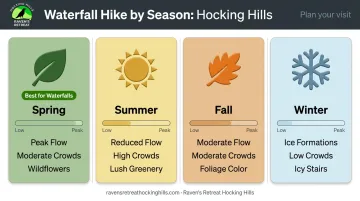
For a first visit, aim for mid-March through April — you'll catch full waterfalls before summer crowds arrive. Fall runs a close second if foliage color matters as much as water volume.
Make Raven's Retreat Your Home Base for Waterfall Adventures
Every trail on this list sits within 16 miles of Raven's Retreat Hocking Hills — an adults-only art and nature wellness retreat nestled on a 58-acre private preserve near Laurelville. Old Man's Cave is 14 miles away. Ash Cave and Whispering Cave are also 14 miles out. Cedar Falls is 16 miles. Rock House is just 6 miles.
Staying here means hitting the trailhead before 8 a.m. — before parking lots fill and the one-way loops get crowded — and returning to a property that genuinely restores you after a long day of hiking.
The Sculptor's Art Lodge sleeps up to 16 guests and is built around the kind of recovery adult hikers actually need:
- Black walnut kitchen for post-trail meals
- Gas fireplace for evening wind-downs
- 6-person hot tub for muscle recovery
- 4-person infrared cedar sauna for deep restoration
Master sculptor Dustin Weatherby's sculptures and wood carvings are placed throughout the preserve's private trail system — over a mile of terrain with 220 feet of elevation change. The immersive experience begins the moment you step outside the lodge door.
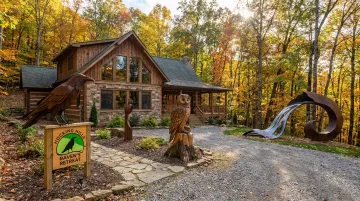
If you're planning a trip around Hocking Hills' waterfall season, inquire about availability at ravensretreathockinghills.com or call or text 614-783-6143.
Frequently Asked Questions
What is the largest waterfall in Hocking Hills?
Big Spring Hollow Falls is generally considered the tallest waterfall in the Hocking Hills region, estimated at approximately 120 feet (no official ODNR measurement has been published). It's a seasonal waterfall located near the Hocking State Forest Rappelling Area and flows most powerfully after significant spring rainfall.
How long is the 3 Sisters Falls hike?
There is no verified "3 Sisters Falls" trail within Hocking Hills State Park or the surrounding ODNR preserves. The Three Sisters Falls name primarily refers to trails in California and San Diego County. The closest multi-waterfall experience in Hocking Hills is the Old Man's Cave loop, which passes Upper Falls, Lower Falls, and the Broken Rock Falls spur.
Are Hocking Hills waterfalls seasonal or year-round?
Most Hocking Hills waterfalls are rain-dependent and seasonal, flowing strongest in spring and after heavy rain. Cedar Falls is the exception, flowing year-round with the greatest water volume in the county. Ash Cave Falls, Whispering Cave Falls, and Cantwell Cliffs Falls may be dry or minimal during summer droughts.
What is the best time of year to visit Hocking Hills for waterfalls?
Spring (March–May) delivers peak waterfall flows, and weekday morning visits significantly reduce crowds at popular trailheads like Old Man's Cave and Ash Cave. Winter (January–February) offers a dramatic alternative, with ice formations framing the falls inside the recess caves, though icy stairs require caution.
Do any Hocking Hills waterfall hikes require permits?
Yes. Robinson Falls (Boch Hollow State Nature Preserve) and Sheick Hollow both require advance special use permits from ODNR, submitted at least 14 days before your visit. All main Hocking Hills State Park areas, including Old Man's Cave, Cedar Falls, and Ash Cave, are free with no permit required.
Is the hike to Corlieu Falls in Hocking Hills?
Corlieu Falls is not in Hocking Hills. It's located in California's Sierra National Forest along the Lewis Creek National Scenic Trail. For a challenging Hocking Hills waterfall hike with comparable effort, the Whispering Cave Trail (4.5 miles, Difficult) is the closest equivalent, and it claimed the top spot in the 2024 USA Today Best Hiking Trail readers' poll.