
The Sound Relationship House is the framework that explains what that "deeper" actually looks like. Developed after studying more than 3,000 couples in Gottman's University of Washington "Love Lab," it maps the seven levels that distinguish thriving relationships from struggling ones — and identifies the two structural forces that hold everything together.
This guide walks through every level, explains why the order matters, and shows how couples can actually use the framework in real life.
Key Takeaways
- The Sound Relationship House is a 7-level framework built from research on over 3,000 couples, not abstract theory
- Levels 1–3 build the friendship foundation; skip these and every upper floor becomes unstable
- Two weight-bearing walls — Trust and Commitment — run the full height of the structure and support every level
- Conflict management sits at Level 5, not Level 1 — friendship and emotional safety come first
What Is the Sound Relationship House?
Dr. John Gottman introduced the Sound Relationship House in The Seven Principles for Making Marriage Work (originally published in 1999, co-written with Nan Silver, and now a New York Times bestselling book with over a million copies sold). The theory became the clinical foundation for the Gottman Method and the organizing framework behind how Gottman-trained therapists assess and work with couples.
The metaphor is precise: a healthy relationship functions structurally like a house. It has floors that build on each other, and two load-bearing walls without which the entire structure collapses. A crack in the foundation doesn't just affect the ground floor. It puts pressure on every level above it.
What makes the framework useful is that it turns abstract, emotional health into something concrete. Relationship struggles are hard to name and harder to fix without structure. The Sound Relationship House gives couples a clear map — where things are strong, where they're cracking, and where to start.
The research backing is substantial. Gottman's longitudinal studies led to a 93.6% accuracy rate in predicting which couples would divorce — a figure that reflects just how reliably the framework's underlying patterns appear across relationships.
The Foundation: Levels 1 Through 3 — Building Friendship
The Gottmans' research produced one finding that surprises most people: deep friendship between partners is the single strongest predictor of relationship satisfaction — more predictive than communication style, sexual compatibility, or shared values.
Levels 1 through 3 build that friendship. No other levels work well without them.
Level 1 — Build Love Maps
A Love Map is a mental guide to your partner's inner world — their current worries, life dreams, daily stressors, what they need when overwhelmed. It's the difference between knowing your partner's job title and knowing what about that job is draining them this week.
Couples with detailed Love Maps approach each other with understanding rather than assumption. That matters most during high-stress periods, when the temptation to fill in blanks with frustration runs highest.
The practice doesn't require much. Questions like What's weighing on you most right now? What are you excited about? keep the map current. Consistency matters more than depth.
Level 2 — Share Fondness and Admiration
This level isn't about feeling appreciation for your partner — most people do. It's about saying it out loud. "I noticed how patient you were in that conversation" lands differently than quietly thinking your partner handled something well.
The Gottman Institute identifies Sharing Fondness and Admiration as the direct antidote to contempt — one of the Four Horsemen predictors of divorce, and the one Gottman identifies as the single most destructive force in relationships. A consistent habit of expressed appreciation doesn't just feel good; it actively counteracts the erosion that contempt causes.
Building that habit of expressed appreciation sets up the third level — which operates at an even smaller, more frequent scale.
Level 3 — Turn Toward Instead of Away
Every day, partners make small bids for connection: commenting on something outside the window, sighing heavily, asking how the day went. These seem minor. They aren't.
According to Gottman Institute research, couples who stayed married turned toward each other's bids 86% of the time, while couples who divorced averaged just 33%. That gap — accumulated across thousands of small moments — is what separates a relationship that feels safe from one that feels lonely.
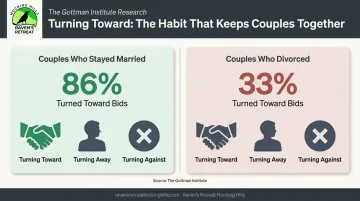
There are three responses to a bid: turning toward (engaging), turning away (ignoring), or turning against (responding negatively). Which response becomes habitual largely determines whether closeness grows or quietly erodes over time.
The Upper Floors: Levels 4 Through 7 — From Perspective to Shared Vision
Once the friendship foundation is stable, the upper floors shift focus: how partners interpret each other, navigate conflict, support each other's individual lives, and build something together.
Level 4 — The Positive Perspective
When Levels 1–3 are healthy, something shifts in how partners interpret each other. Neutral gestures read as benign. Ambiguous comments get the benefit of the doubt. This is what Gottman calls positive sentiment override — a kind of goodwill reserve that cushions ordinary friction.
The math behind it is concrete. Gottman's research found that stable, happy relationships maintain a 5:1 ratio: for every one negative interaction during conflict, there are five or more positive interactions. This isn't idealism — it's an observed pattern from longitudinal studies tracking couples over nine years.
When Levels 1–3 are depleted, that reserve runs dry. Kind gestures start reading as manipulation. Innocent questions sound like criticism. The math flips, and conflict becomes harder to recover from.
Level 5 — Manage Conflict
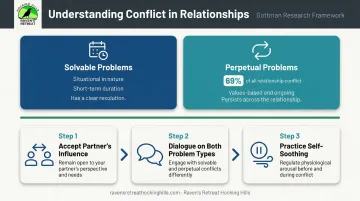
The Gottmans make a critical distinction most couples miss: not all conflict is the same kind of problem.
- Solvable problems are situational — scheduling conflicts, household logistics, short-term disagreements that have workable solutions
- Perpetual problems are rooted in core values, personality differences, or fundamental needs — and research shows these account for 69% of relationship conflict
Perpetual problems don't get solved. They get managed. The goal isn't resolution; it's dialogue — understanding what each partner needs, why the issue matters, and how to keep discussing it without it becoming a weapon.
Three components define healthy conflict management in this framework:
- Accept your partner's influence — allow their perspective to genuinely shift your thinking
- Dialogue about both problem types — don't avoid perpetual issues because they're uncomfortable
- Practice self-soothing — recognize when you're physiologically flooded during an argument and pause before continuing
Level 6 — Make Life Dreams Come True
This level asks couples to look beneath recurring surface arguments. Conflicts about money, time, or chores often aren't really about those things — they're proxies for unspoken dreams or unacknowledged needs.
The partner who pushes back on weekend plans might be grieving a creative pursuit they've abandoned. The one frustrated about finances might be carrying an unexpressed dream about what security actually means to them.
Level 6 asks couples to get genuinely curious: What do you want your life to look like? What matters to you that we've never really talked about? Supporting each other's individual dreams isn't separate from relationship health — it's part of it.
Level 7 — Create Shared Meaning
At the top of the house sits the shared life a couple builds together: rituals of connection (how you celebrate, what Sunday mornings look like, how you mark endings and beginnings), shared values, and a sense of purpose as a unit.
Unlike Level 1 — which is about understanding your partner as an individual — shared meaning is about what you construct together. That might look like:
- Recurring rituals that mark time (Sunday dinners, anniversary traditions, how you say goodbye)
- Shared symbols or objects that carry meaning for both of you
- A common narrative about who you are as a couple and where you're headed
It sits at the top because it's only fully accessible when the floors below are stable. Shared meaning built on weak friendship or unresolved contempt has no structural support to hold it.
The Weight-Bearing Walls: Trust and Commitment
The seven levels describe skills. The two walls describe something different: the structural conditions that make those skills possible.
These two walls each carry a specific weight:
- Trust: Your partner acts with your interests in mind, not just their own. It accumulates through small choices — being honest when it's easier not to be, showing up when it's inconvenient, choosing the relationship when it's optional.
- Commitment: The relationship is a long-term project, not a provisional arrangement. It means staying curious about your partner instead of building a case against them, and investing in its future even during difficult seasons.
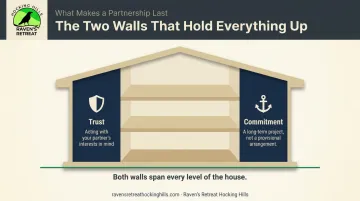
Neither wall is declared once. Both are built through hundreds of small decisions over time, and both can be damaged in concentrated moments of betrayal, deception, or chronic disengagement. When either wall is seriously compromised, every level of the house becomes destabilized. Repair is possible, but it typically requires sustained, intentional work — often with professional support.
How Couples Put the Sound Relationship House Into Practice
A common misconception: the Sound Relationship House is not a checklist. Couples don't graduate from Level 1 and move on permanently. Relationships cycle through different seasons, and which level needs attention shifts constantly — after a job loss, a new baby, a period of distance, a conflict that went unresolved.
The practical entry point is usually simple: identify which level feels most neglected right now. Then find one micro-habit that addresses it.
- Level 1: Ask one Love Map question over dinner
- Level 2: Name one thing you genuinely appreciate about your partner before bed
- Level 3: When your partner bids for connection, put the phone down and respond
Small shifts in these foundational levels often change the emotional tone of a relationship faster than any conversation about the relationship itself.
Physical removal from ordinary life supports this kind of intentional work. When couples stay in the same environment — same kitchen, same daily pressures, same incoming notifications — the nervous system stays in task mode. Presence is hard to access when nothing has changed.
A nature retreat addresses this directly. Raven's Retreat Hocking Hills, an adults-only art and nature wellness sanctuary on a 58-acre private preserve in Ohio, removes the competing demands that make relationship attention feel impossible at home. In that space, conversations tend to stretch naturally, the foundational friendship levels become easier to tend, and couples reconnect at the layers that hold everything else up.
Frequently Asked Questions
What is the Gottman Sound Relationship House?
The Sound Relationship House is a research-based framework developed by Drs. John and Julie Gottman that maps seven levels of relationship health, supported by two structural walls of Trust and Commitment. It was developed from observational research on over 3,000 couples and forms the foundation of the Gottman Method.
Who created the Sound Relationship House theory?
Dr. John Gottman and Dr. Julie Schwartz Gottman, founders of the Gottman Institute, developed the theory. The model, introduced in The Seven Principles for Making Marriage Work (1999), was built on 40+ years of observational couples research at the University of Washington.
What are the two walls of the Sound Relationship House?
Trust and Commitment are the two weight-bearing walls. Unlike the seven levels (which are sequential skills), these walls run the full height of the structure and support every level simultaneously — making them foundational rather than sequential.
How does the Sound Relationship House relate to the Gottman Method?
The Sound Relationship House is the central organizing theory of the Gottman Method. Gottman-trained therapists use it to assess where a couple's relationship is strong and where it's under strain, then guide targeted interventions at the specific levels that need attention.
Can couples use the Sound Relationship House without a therapist?
The framework is educational and accessible for self-guided use. Reading through it and identifying which levels need work is a useful starting point. Couples dealing with trust ruptures, serious conflict patterns, or longstanding disconnection typically benefit most from working through it with a trained Gottman Method therapist — or in a dedicated couples retreat setting that creates the space and focus the work requires.