The good news: connection is a skill, and like any skill, it responds to practice. Whether you're six months in or sixteen years deep, the right shared experiences can reignite attraction, rebuild trust, and create the kind of closeness that actually lasts.
This guide covers 30+ relationship-building activities organized by category — playful, emotional, outdoor, creative, and at-home — so you can find what fits your season.
Key Takeaways
- Couples who try novel experiences together report measurably higher relationship satisfaction
- Small, consistent micro-habits outperform occasional grand gestures over time
- Activities that combine something new, something personal, and a shared goal tend to stick
- Most couples overlook nature, creativity, and play — three of the highest-impact bonding tools
- A strong relationship practice mixes everyday rituals with periodic immersive experiences
Why Relationship-Building Activities Actually Work
Not all time together is equal. Scrolling on opposite ends of the couch technically counts as "being together," but it doesn't deepen a bond — it just fills time.
The difference comes down to active, intentional engagement. Research by Aron et al. in the Journal of Personality and Social Psychology found that couples assigned to novel, arousing shared tasks reported greater relationship quality increases than couples assigned to mundane ones.
The mechanism is self-expansion theory, introduced by Arthur Aron and Elaine Aron: we're wired to grow through our relationships. When partners learn, explore, and challenge themselves together, they associate that growth with each other.
A follow-up study in Journal of Experimental Social Psychology found that shared novel experiences boost satisfaction not just through excitement, but through felt security — the sense that your partner is there, present, exploring alongside you.
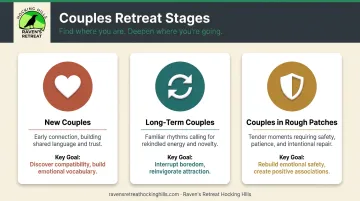
This matters at every relationship stage:
- New couples use shared activities to discover compatibility and build emotional vocabulary
- Long-term couples use them to interrupt boredom and reinvigorate attraction
- Couples navigating rough patches use them to rebuild emotional safety and positive associations
The activities don't have to be dramatic. They just have to be intentional.
Fun & Playful Activities to Reignite Your Spark
Playfulness is one of the most underrated tools in a relationship. Research published in the Journal of Research in Personality found that other-directed playfulness — being playful toward your partner — was positively linked to both partners' relationship satisfaction.
A separate study in Personal Relationships found that simultaneous shared laughter predicted relationship quality and closeness. Couples who laugh together genuinely bond better.
Spontaneous & Game-Based Activities
These work because they lower defensiveness and remind you both why you chose each other.
- Recreate your first date, same outfits, same restaurant, same order if you can manage it. The nostalgia is powerful.
- Host a couples trivia night: team up against a trivia app or invite another couple for a friendly rivalry
- Conquer an escape room, which requires real-time communication and lateral problem-solving under pressure
- Build a DIY indoor scavenger hunt, each clue tied to a shared memory or inside joke
- Plan a "mystery day" where each partner plans a surprise half-day for the other, no hints allowed
- Start a couples bucket list: write it together, then commit to checking off one item per month
- Host a kitchen bake-off: pick the same recipe, set a timer, compare results
- Run a blindfolded taste test — coffee, pizza, chocolate. Simple setup, genuinely ridiculous results.
Practical tip: Rotate who plans the weekly fun activity. Both partners feel seen, and you get honest insight into each other's idea of a good time.
Playful Learning Experiences
Game-based fun is energizing, but learning something new together goes a layer deeper. When neither person is the expert, vulnerability and humor arise naturally — and that combination builds real closeness.
- Salsa or swing dancing lessons — clumsy coordination is part of the charm
- Cooking or mixology class — competitive with an edible payoff
- Pottery or paint-and-sip session — hands in clay, wine in hand, no artistic talent required
- Photography walk — pick the same subject and challenge each other to capture it differently
Emotional & Deepening Bonding Activities
Fun matters, but emotional intimacy — feeling genuinely known and safe — is the bedrock of a relationship that holds. These activities go beyond entertainment into the kind of shared vulnerability that creates real closeness.
The Gottman Institute describes emotional safety as the condition that makes collaboration, honesty, and free expression possible in relationships. You don't need a therapist's office to build it. A kitchen table and an honest question will do.
Vulnerability & Communication Exercises
- The 36 Questions — Arthur Aron's research-based prompt set uses progressively personal questions to build closeness between two people. UC Berkeley's Greater Good in Action hosts the full list. Block two hours, put your phones away.
- Nightly gratitude ritual — each partner names one specific thing they appreciated about the other that day. One sentence. Consistent.
- Handwritten love letters — not texts. Actual letters. The effort communicates something digital shortcuts can't.
- Couples vision board — physical or digital, built together. Align on shared dreams before they diverge.
- Relationship autobiography — share the story of your childhood, your first heartbreak, and what love meant in your family of origin. You will learn things you didn't know.
- Monthly relationship check-in — three questions: What's going well? What needs attention? What's one thing we can do this month?
Trust & Teamwork Activities
Trust isn't built in crisis moments. It's built in small, consistent acts of reliance — and these activities create those moments deliberately:
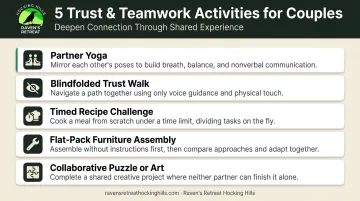
- Partner yoga — requires physical coordination and silent communication between partners
- Blindfolded trust walk — one partner guides, one partner surrenders control
- Cook a complex recipe under a time limit — you'll negotiate, adapt, and either laugh or panic — sometimes both
- Assemble flat-pack furniture — a deceptively accurate stress test and teamwork diagnostic
- **Two-person puzzle race or collaborative art project** — shared focus, shared win
Some of these activities hit differently when you're away from home — no distractions, no obligations, just the two of you. Retreats like Raven's Retreat Hocking Hills are designed exactly for that kind of focused time together, with guided experiences available if you want more structure.
Outdoor, Adventure & Creative Experiences
Changing your physical environment changes your relational dynamic. When you leave the house — especially for somewhere genuinely unfamiliar — you shed the roles and habits that come with the home setting. Conversations go differently. Attention sharpens.
Research shows that urban nature experiences produce a significant drop in salivary cortisol — up to 21.3% per hour — creating a calmer physiological baseline that's ideal for honest conversation and connection. Lower stress, fewer defenses.
Nature-Based Adventures
- Hike a new trail (coordinate who plans the route, who packs the snacks — what this reveals is half the value)
- Kayak or canoe as a two-person team, where synchronization is non-negotiable
- Nighttime stargazing at a dark-sky area or a field far enough from city lights
- Camping weekend with full unplugging — no notifications, no agenda
- Sunrise or sunset picnic at a scenic overlook — early alarms are worth it
- Birdwatching: low-key, meditative, and surprisingly absorbing once you start
- Spontaneous road trip with a direction but no fixed destination
Nature's effect on the nervous system extends beyond cortisol reduction. Research in Journal of Environmental Psychology found that shared time in nature increased feelings of interpersonal closeness and social connection — the environment itself becomes part of the bond.
Creative & Artistic Couple Experiences
Creative activities invite couples into a shared flow state — that deeply present, absorbed experience where time disappears and self-consciousness dissolves. It's one of the most connecting states available, and it doesn't require talent.
- DIY art night at home — watercolors, sculpting clay, collage-making
- **Live pottery or painting workshop**
- Collaborative photography or journaling project
- Designing or decorating a shared space together
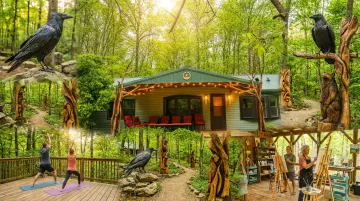
For couples wanting a more immersive option, Raven's Retreat Hocking Hills combines art and nature in a way that's genuinely hard to find elsewhere. The property is a 58-acre adults-only preserve near Laurelville, Ohio, where co-owner and master sculptor Dustin Weatherby (whose work has appeared on Disney+ and the History Channel) has hand-crafted steel sculptures, wood carvings, and tile murals across the entire grounds.
Couples can customize their stay around a mix of creative and wellness experiences:
- Live sculpture performances with Dustin (typically a few hours), plus hands-on sculpting and painting workshops
- Wellness add-ons including forest bathing, couples yoga on an elevated forest platform, sound healing, and private chef dinners
- Full property buyout for exclusive access to the entire 58-acre preserve — no other guests, no shared spaces
At-Home & Daily Connection Habits
Grand gestures matter. But what actually sustains a relationship is the small stuff — the daily moments most couples stop noticing.
John Gottman's research on bids for connection — those small moments when one partner reaches toward the other for attention or affection — found something striking: in a six-year follow-up of newlyweds, couples who stayed married turned toward each other's bids 86% of the time, while couples who divorced averaged just 33%.
The gap isn't dramatic. It's built from hundreds of small moments, repeated consistently over time.
Daily & Weekly Micro-Habits
- Start with a 20-second hug — research by Grewen et al. links warm physical contact with lower blood pressure and cardiovascular reactivity during stress
- Send one intentional "thinking of you" text — not a logistical message. An actual thought.
- Create a shared memory jar — write and deposit small happy moments throughout the year, open together on your anniversary
- Host a themed movie marathon night — pick a director, a decade, or a country's cuisine and cook food to match
- At-home spa night — face masks, candles, the whole thing. Low effort, high return.
- Cook from a "travel the world" cookbook — one country per week or month
- Stargaze from the backyard — a blanket and 20 minutes of sky works
Building a Monthly Rhythm
The key isn't doing any of these once. It's making them relationship culture — something you both expect and look forward to.
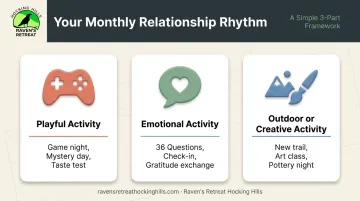
A monthly framework worth trying:
- One playful activity — game night, mystery day, taste test
- One emotional activity — 36 Questions, relationship check-in, gratitude exchange
- One outdoor or creative activity — new trail, art class, pottery night
Calendar them like appointments. Not afterthoughts — actual scheduled time. Most couples don't lose connection all at once. They lose it gradually — and the ones who stay close are the ones who kept showing up before it became urgent.
Frequently Asked Questions
What is the 7-7-7 rule for couples?
The 7-7-7 rule suggests a date night every 7 days, a weekend getaway every 7 weeks, and a week-long vacation every 7 months. It's a structured cadence for keeping romance and deep connection consistently prioritized — though relationship researchers note the underlying principle (consistent, intentional time together) matters more than the exact numbers.
What is the 2-2-2 rule for couples?
The 2-2-2 rule recommends a date night every 2 weeks, a weekend away every 2 months, and a longer trip every 2 years. It's a less intensive version of the 7-7-7 approach, better suited for couples with busier schedules or tighter budgets who still want a structured connection rhythm.
What is the 3-3-3 rule in relationships?
The 3-3-3 rule is a communication-focused guideline sometimes referenced in relationship advice: 3 minutes of daily check-in, 3 hours of quality time each week, and 3 days away together each year. The emphasis is on small, consistent deposits of attention rather than occasional large investments.
What is the 3-6-9 rule in relationships?
The 3-6-9 rule is a relationship checkpoint framework: reassess goals and communication patterns at 3 months, 6 months, and 9 months. It's most useful for newer couples building shared expectations — though it's a popular heuristic, not a clinically validated protocol.
What activities are best for rebuilding connection in a long-term relationship?
Novelty, vulnerability, and screen-free presence work best together. Try something neither of you has done before, pair it with gratitude rituals or honest conversation prompts, and do it somewhere unfamiliar — a place where neither of you has an existing routine. Even a single intentional weekend in that kind of environment can shift relational dynamics noticeably.
How does spending time in nature together benefit a relationship?
Research links time in natural environments to reduced cortisol levels, increased feelings of awe, and greater psychological openness. All three lower defensiveness and create conditions where honest, emotionally connected conversation becomes easier. In short, nature reduces the friction that makes hard conversations feel hard.