Three days changes everything. You get time to move slowly, catch golden hour light on the rim trails, explore the trails that see far fewer visitors, and actually recover between hikes rather than limping home exhausted.
The park sits about an hour south of Columbus, roughly 2.5 hours from Cincinnati and Pittsburgh. Entry is free, parking is free, and the trails are open year-round. This guide maps out a day-by-day itinerary, covers what to pack, and points you toward the best places to eat and sleep — including one lodging option that turns recovery time into its own kind of experience.
Key Takeaways
- Three days is enough to cover all six main trail areas plus a few hidden gems without feeling rushed
- The park is free year-round, but waterfall flow, crowds, and trail conditions vary significantly by season
- Each day in this itinerary builds in difficulty — accessible wonders first, more remote routes last
- Download offline maps before you go; cell service is unreliable throughout much of the park
- Where you sleep shapes your stamina: staying on-site in Hocking Hills saves 30–60 minutes of driving per day and makes back-to-back hiking days far more manageable
Before You Go: Planning Your Hocking Hills Hiking Trip
Best Seasons to Visit
Timing your trip changes everything about what you'll see on the trails:
- Spring — Peak waterfall flow and wildflowers; muddy trails but dramatic cascades worth it
- Summer — Long days for hiking, but falls can slow to a trickle in drought and crowds peak on weekends
- Fall — Peak foliage typically arrives late October; the most popular season, so book accommodations early
- Winter — Ice formations coat the sandstone walls at Ash Cave and Cedar Falls into frozen curtains unlike any other season; ODNR recommends ice cleats for winter hiking; crowds are minimal
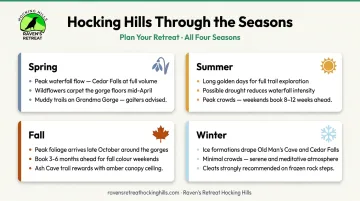
Weekday visits beat weekends in every season — often dramatically so.
Trail Rules and Practical Prep
A few rules catch visitors off guard. Know these before you arrive:
- Pets: Leashed dogs are welcome on most state park trails, but not at Conkles Hollow State Nature Preserve or Rockbridge Preserve — no exceptions
- Cell service: Unreliable in many trail areas. Download maps on AllTrails before you leave your lodging each morning
What to pack:
- Sturdy hiking shoes or trail boots (terrain is rocky, often muddy)
- Rain jacket — especially April through June
- Refillable water bottle
- Trekking poles for steep sections like Conkles Hollow Rim
- Sunscreen
- Ice cleats if visiting November through February
Park hours run from half an hour before sunrise to half an hour after sunset.
Day 1: Arrival and First Impressions
Arrive early afternoon, check in, and head straight to the Visitor Center near Old Man's Cave off State Route 664. Grab a paper trail map, check for any closures or trail condition updates, and spend a few minutes in the geological exhibits — the Black Hand Sandstone that carved these gorges formed over 300 million years ago.
Two hikes fit comfortably on an afternoon arrival day.
Ash Cave: The Grand Opening Act
Ash Cave is the right starting point for any Hocking Hills trip. The lower gorge trail is paved, roughly 0.5 miles round trip, and wheelchair accessible: an easy warm-up with a spectacular payoff.
According to ODNR, Ash Cave is Ohio's largest recessed cave: horseshoe-shaped, nearly 700 feet wide and 100 feet high, sheltering a seasonal waterfall that freezes into an ice sculpture in winter.
Early settlers found a pile of ash inside measuring 100 feet long, 30 feet wide, and 3 feet deep. The remnants point to centuries of Native American use, including by the Adena culture.
Standing inside it, the scale surprises even repeat visitors. Budget 30–45 minutes here.
Conkles Hollow: Golden Hour on the Rim
From Ash Cave, drive to Conkles Hollow in time for late afternoon light. Conkles Hollow is a State Nature Preserve: no pets allowed, and visitors must stay on designated trails.
Two trail options:
| Trail | Distance | Elevation Gain | Best For |
|---|---|---|---|
| Gorge Trail | 1.1 miles out-and-back | 75 ft | Families, accessible hiking |
| East/West Rim Trail | 2.2 miles | 380 ft | Views, solitude |
The rim trail climbs nearly 200 feet above the valley floor, where sandstone cliffs frame a gorge barely 100 feet wide in places. The light turns golden on those walls in the last hour before sunset. If conditions are icy, stick to the gorge; exposed drop-offs on the rim demand full attention.
Day 2: The Heart of Hocking Hills
This is the highest-mileage day. Start by 8–9 AM, especially on weekends — Old Man's Cave is the most visited trail in the park and congestion builds quickly after mid-morning.
Old Man's Cave Gorge Loop: The Crown Jewel
The trail begins near the Visitor Center and follows the Black Hand Sandstone gorge through a sequence of features worth slowing down for:
- Upper Falls — the first waterfall encounter as you descend into the gorge
- Devil's Bathtub — a naturally eroded pool carved into layered sandstone
- The main cave recess — named for hermit Richard Rowe, who reportedly lived here in the 1800s
- Sphinx Head — a rock formation in the lower gorge that most visitors walk past without noticing; worth finding
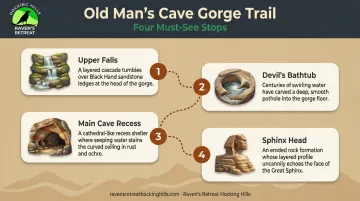
The basic cave loop runs roughly 0.8–1.5 miles depending on your route. You can extend toward Whispering Cave (3.4 miles with 291 ft elevation gain as a loop) or connect all the way to Cedar Falls via the Buckeye Trail — but save Cedar Falls for the afternoon rather than combining it into a mega-route on tired legs.
Cedar Falls: Ohio's Most Powerful Waterfall
After a morning in the gorge, Cedar Falls is the right afternoon pace — short on distance, long on payoff. The trail runs about 0.5 miles from the trailhead, winding through eastern hemlock and oak into a sandstone gorge. Explore Hocking Hills notes it carries the greatest water volume of any waterfall in Hocking County, plunging 50 feet over Black Hand Sandstone — though in a summer drought, flow can drop to a trickle. Spring is when Cedar Falls earns its reputation.
The hemlock canopy filters green light down into the gorge, and the sandstone walls create natural framing that makes this one of the best photography spots in the park. Plan 45 minutes to an hour — enough time to linger without rushing back before dark.
Day 3: Remote Trails and Hidden Gems
Day 3 is the explorer's day. These trails see far fewer visitors, spread across a wider geographic area, and reward those willing to drive a bit between trailheads.
Start later if legs need rest from Day 2.
Rock House: The Only True Cave
Rock House is unlike anything else in Hocking Hills: it's the park's only genuine tunnel-style cave, carved midway up a 150-foot sandstone cliff face. The cave itself runs 200 feet long and 25 feet high, with gothic-arch windows cut by erosion overlooking a forested valley.
The loop trail covers 1.3 miles with 249 ft of elevation gain. Inside, chiseled troughs once held water for past occupants, and small recesses in the rear wall served Native Americans as baking ovens.
Quick trail facts:
- Local lore calls it "Robbers Roost," tied to horse thieves and bootleggers in the 1800s
- One of the few Hocking Hills trails where dogs are allowed on leash
- Noticeably quieter than Old Man's Cave — plan for a mid-morning arrival
Cantwell Cliffs: The Dramatic Finale
Cantwell Cliffs sits about 17 miles from Old Man's Cave, which keeps visitor numbers low. AllTrails describes it as one of the least-visited areas in Hocking Hills — a 1-mile loop with roughly 246 ft of elevation gain.
The trail passes through "Fat Woman's Squeeze," a narrow rock passage where the gorge walls close in to just a body-width apart. The soaring black sandstone walls here are what many repeat visitors call the most dramatic scenery in the entire park.
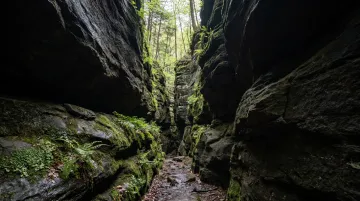
Worth knowing before you go:
- ODNR has rerouted many Hocking Hills trails for one-way hiking — follow posted signage carefully at Cantwell Cliffs
- Afternoon light (3–4 PM) hits the sandstone with a warm golden tone worth timing your hike around
- If energy allows, the Airplane Rock and Chapel Cave Loop in Hocking State Forest offers 4.3 miles of off-the-beaten-path terrain with 629 ft of elevation gain — a quiet conclusion for experienced hikers
Beyond the Trails: More Ways to Experience Hocking Hills
Hiking doesn't have to fill every hour. A few worthwhile additions:
On the water: Hocking Hills Canoe Livery offers kayaking, canoeing, and rafting on the Hocking River with 5-mile and 7-mile trip options. Lake Logan State Park has boat rentals through Lake Logan Marina for a more relaxed afternoon.
Dining worth planning ahead for:
- Kindred Spirits at the Inn & Spa at Cedar Falls — reservations strongly recommended; the dining room fills quickly
- Millstone BBQ (12790 Grey Street, Logan) — solid post-hike fuel
- Brewery 33 (12584 College Prospect Drive, Logan) — locally owned craft brewery with food trucks and live music
Arts and culture: Jack Pine Studio in Laurelville is a glass art studio about 6 miles from Raven's Retreat — stop in on the way to Cantwell Cliffs for free live glassblowing demonstrations, or book a paid workshop. They also host a fall festival worth timing your trip around.
Where to Stay for Your Hocking Hills Hiking Adventure
The Lodging Landscape
Options range across the full spectrum:
- Hocking Hills State Park Campground — 169 sites (electric and non-electric), heated showers, reservations through ReserveOhio up to 6 months in advance
- Cabin rentals — hot-tub cabins, treehouses, and cottages available through multiple local rental platforms; browse listings on Explore Hocking Hills and HockingHills.com
- Hocking Hills State Park Lodge — 81 hotel-style guest rooms, full-service restaurant, indoor/outdoor pools, opened 2022
Fall weekends fill fast across all categories. Book early.
Raven's Retreat Hocking Hills: A Different Kind of Stay
For adults wanting something more restorative than a rental cabin, Raven's Retreat Hocking Hills sits on a 58-acre private nature preserve at 17683 Thompson Ridge Road, about 2 miles east of Laurelville. All six main trailheads are within 6–16 miles — close enough for easy day trips, yet remote enough to feel genuinely away from it all.
Two accommodation options:
The Sculptor's Art Lodge sleeps up to 16 guests across 6 bedrooms and 3 bathrooms, making it ideal for groups, corporate retreats, or multi-couple trips. Co-owner and master sculptor Dustin Weatherby (whose work has appeared on Disney+ and the History Channel) has hand-crafted the steel sculptures, wood carvings, and tile murals throughout the property. The kitchen, built from tornado-salvaged black walnut, doubles as an art installation.
Property amenities include:
- 6-person hot tub
- Infrared cedar sauna and outdoor shower
- Stone fire pit
- Over a mile of private hiking trails
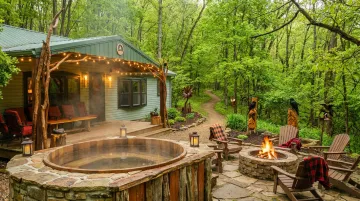
Nightly rates start at $1,200.
The Sculptor's Art Bungalow sleeps two and is designed for couples or solo travelers. It features a king bed, hot tub overlooking a tranquil pond with forest views, a fire pit, and full access to the preserve's private trails. The name comes from a honey bee hive in a nearby sassafras tree — visible through the south-facing window. Starting at $400 per night.
Both properties are adults-only (21+ for the bungalow, 25+ for the lodge) and pet-free, reflecting the property's active wildlife rehabilitation mission. Wellness add-ons are available by appointment: yoga, forest bathing, massage, sound healing, sculpture workshops, and live performances by Dustin.
Ratings hold at 4.96 on Airbnb, 4.95 on VRBO, and 4.97 on Google across hundreds of verified reviews. Fall weekends book out quickly — book early to secure your preferred dates.
Frequently Asked Questions
How many days do you need to hike Hocking Hills?
Three days is the sweet spot — enough to cover Old Man's Cave, Ash Cave, Cedar Falls, Conkles Hollow, Rock House, and Cantwell Cliffs without rushing, with room for optional detours like Airplane Rock or a paddle on the Hocking River.
What's the best hike in Hocking Hills?
Old Man's Cave is the most iconic and geologically rich. Conkles Hollow's rim trail is widely considered the most scenic, especially at golden hour, while Cantwell Cliffs delivers the most dramatic cliff scenery with the fewest crowds.
What should you not miss in Hocking Hills?
Don't leave without seeing:
- Ash Cave's massive rock overhang
- Devil's Bathtub and the Sphinx Head formation at Old Man's Cave
- Conkles Hollow's rim views and Cedar Falls in high flow
- The "Fat Woman's Squeeze" passage at Cantwell Cliffs
What are the seven trails of Hocking Hills?
The seven recognized trail areas are Old Man's Cave, Ash Cave, Cedar Falls, Conkles Hollow, Rock House, Cantwell Cliffs, and Whispering Cave. Most are short individually — experienced hikers often combine two or three in a single day.
Is hiking at Hocking Hills free?
Yes. All trails in Hocking Hills State Park are free to access, and parking is free at every trailhead — making it one of the most affordable multi-day hiking destinations in the Midwest.
What should you wear and bring for hiking at Hocking Hills?
Sturdy trail or hiking shoes are essential — terrain is rocky and regularly muddy. Bring a rain jacket (especially spring and fall), a refillable water bottle, sunscreen, and downloaded offline trail maps. In winter, add ice cleats to the list.