
This guide is for couples at a milestone anniversary, those who navigated something hard and came out the other side, couples who didn't get the wedding they actually wanted, or anyone who simply feels deeply happy and wants to honor that out loud. There are no rules here. No wrong reasons.
You'll learn what a vow renewal is, why couples choose them, what the ceremony involves, how to write vows that actually mean something, how to choose a setting, and what the practical planning looks like from start to finish.
Key Takeaways
- Vow renewals are entirely symbolic — no license, no paperwork, no legal requirements
- There's no minimum years married; any time that feels right is the right time
- The strongest vow renewal vows draw from specific shared moments, not generic sentiment
- Venue setting shapes the emotional tone of the entire day
- Make it yours — there's no template to follow, only what matters to you both
What Is a Vow Renewal Ceremony?
A vow renewal is a ceremony in which a married couple reaffirms their commitment to each other. According to The Knot and Brides, it is purely ceremonial — no new marriage license is required, no officiant certification is needed, and no legal documents are signed. The Clark County, Nevada Clerk's Office confirms that a vow renewal certificate is "not a record of marriage or an official document that can be used to prove marriage." You're already married — a vow renewal is simply the act of choosing each other again, on your own terms.
How a Vow Renewal Differs from a Wedding
The absence of legal obligation creates something valuable: total freedom. Unlike a first wedding, a vow renewal comes with no inherited traditions couples are obligated to follow, no family expectations about guest lists, and no social pressure to perform a certain kind of day.
Key differences at a glance:
- No marriage license required in the US
- No registered officiant legally necessary — a friend, family member, or the couple themselves can lead
- No gift registry expectations — this isn't about setting up a household
- No format obligations — the ceremony can be 15 minutes or an entire weekend
- Complete creative freedom over attire, venue, size, and structure
Vow renewals are typically less stressful than traditional weddings, with more room for creativity and casualness. For most couples, that freedom is the whole appeal.
Why Couples Choose to Renew Their Vows
Vow renewals happen for all kinds of reasons — and none of them need to be justified. What they share is intention: a deliberate choice to show up for each other again, on your own terms.
Milestone Anniversaries
The 5th, 10th, 25th, and 50th anniversaries are among the most popular times for vow renewals, according to both The Knot and Brides. These milestones invite couples to look back at what they've built while marking the beginning of the next chapter. The ceremony gives that reflection a place to land — something to point to and say, this is where we chose each other again.
Overcoming Hardship Together
Couples who navigated illness, financial crisis, loss, or serious relationship strain often find a vow renewal to be a powerful declaration: we made it through. These ceremonies tend to carry the most emotional weight. The vows aren't hopeful — they're proven.
Wanting a Different Wedding Experience
Many people had weddings shaped by budget constraints, family pressure, or circumstances that had nothing to do with who they are as a couple. A vow renewal offers the chance to design a celebration that's entirely theirs — the aesthetic, the guest list, the location, all of it.
Welcoming New Life Chapters
Becoming parents, blending families, retiring, relocating — these transitions can prompt couples to recommit in a way that acknowledges how their partnership has evolved. Some couples involve their children directly in the ceremony, whether through readings, a symbolic role, or simply as witnesses.
Simply Celebrating Love
No dramatic reason required. Some couples renew their vows because they are deeply happy and want to say so publicly. A celebration doesn't need a crisis behind it to mean something.
What Happens During a Vow Renewal Ceremony
Brides notes that a typical vow renewal ceremony runs 20 to 30 minutes, often including a processional and a closing kiss. Here's what that usually looks like:
The Opening
Most ceremonies begin with an intentional moment of presence — an officiant, a close friend, or the couple themselves acknowledging where they are and why. This grounding sets the emotional tone before any vows are spoken.
The Reflection on the Journey
Many ceremonies include a brief spoken tribute to the years shared — specific milestones, challenges overcome, moments of growth. That shared history gives the vow exchange its weight — context that no first wedding can offer.
The Vow Exchange
This is the centerpiece. Each partner reads personal promises to the other. The key difference from first wedding vows: these are spoken from lived experience rather than hopeful anticipation. Instead of asking "will you?", each partner is saying "here's what I've learned, and here's who I'm choosing to keep becoming alongside you."
The Symbolic Exchange
Couples may:
- Re-exchange original wedding bands
- Present upgraded or newly engraved rings
- Commission a custom keepsake — engraved items or a commemorative certificate
- Incorporate a unity ritual that reflects their relationship
Ring exchanges are optional but common. Most couples gravitate toward whatever element feels most personally resonant — the ritual itself matters less than the intention behind it.
The Celebration
The ceremony typically closes with a kiss, a toast, or a moment of shared joy, followed by whatever celebration the couple has planned — an intimate dinner, a gathering of close friends, or the start of a second honeymoon.
How to Write Meaningful Vow Renewal Vows
The best vow renewal vows don't sound like wedding vows. They sound like someone who actually knows this person.
Start with Your Shared History
Before writing a word, spend time in your memories. Specific moments make better vows than any generic sentiment about love being a journey: the inside joke from year three, the night everything fell apart and you stayed anyway, the morning one of you made coffee without being asked for the ten-thousandth time.
The Three-Part Structure That Works
Here's a simple framework to adapt:
Part 1: Reflection — "Over these [X] years, I've watched you..." Part 2: Gratitude — "What I didn't know when I first said 'I do' was..." Part 3: New Promise — "What I promise you now, knowing who we are today, is..."
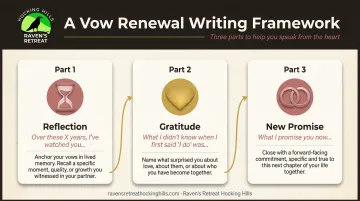
This structure honors the past, acknowledges the present, and commits to a specific future — rather than simply repeating what was said the first time.
Match the Tone to Who You Actually Are
Vow styles to consider:
- Heartfelt and emotional: lean into specific vulnerable moments rather than broad declarations
- Lighthearted and humorous: open with a shared joke, then land on something genuine
- Adventure-focused: frame vows around a defining trip or challenge you faced together
- Family-inclusive: name the children, the home, the life — not just the marriage
Write in the voice you use with each other, not in language you'd never say out loud.
Practical Tips for Getting Started
- Keep a small journal in the weeks before — note moments that make you grateful
- Review old photos and letters together
- Ask yourself: what's one thing my partner does every day that still makes me fall in love?
A good target length is 1 to 3 minutes spoken aloud, or roughly 150 to 300 words per person — enough to be meaningful without losing the room.
Choosing the Right Vow Renewal Venue and Setting
Venue options range widely:
- Original wedding venue — for couples drawn to nostalgia and full-circle meaning
- Destination location — for couples who want adventure and a memory tied to place
- Home or backyard — for intimate simplicity, where the surroundings already hold meaning
- Nature retreat or private preserve — for couples seeking emotional depth and genuine separation from daily life
Brides confirms that vow renewals can be held anywhere at any time, including private homes, restaurants, international destinations, or nondenominational chapels.
Retreat and Nature Settings: A Uniquely Meaningful Choice
There's a reason so many couples choose outdoor and wilderness settings for vow renewals specifically. The stillness, the physical separation from routine, and the absence of distraction create conditions for genuine emotional presence — something a banquet hall rarely delivers. That shift in presence is often what couples remember most about the day.
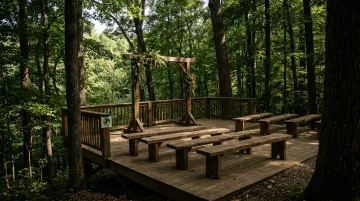
Raven's Retreat Hocking Hills is one of the Midwest's most distinctive options for couples seeking exactly this. Located on a 58-acre private nature preserve near Laurelville, Ohio, the retreat offers dedicated intimate forest ceremonies and vow renewals on a property designed to be a living work of art. Master sculptor Dustin Weatherby has created steel sculptures, wood carvings, and tile murals throughout the grounds — installations that serve as both backdrop and metaphor for a renewal ceremony. Both Raven Morgan and Dustin Weatherby are ordained ministers and can officiate the ceremony on-site, making it easy for couples to plan a complete, self-contained celebration without sourcing a separate officiant.
Practical details worth knowing:
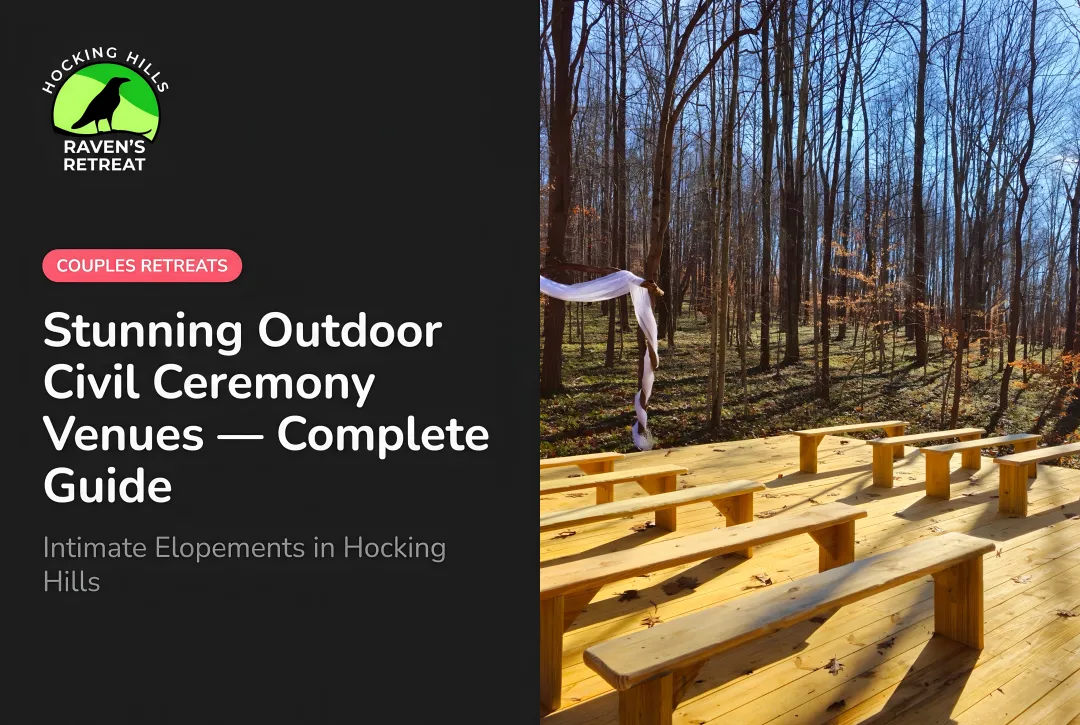
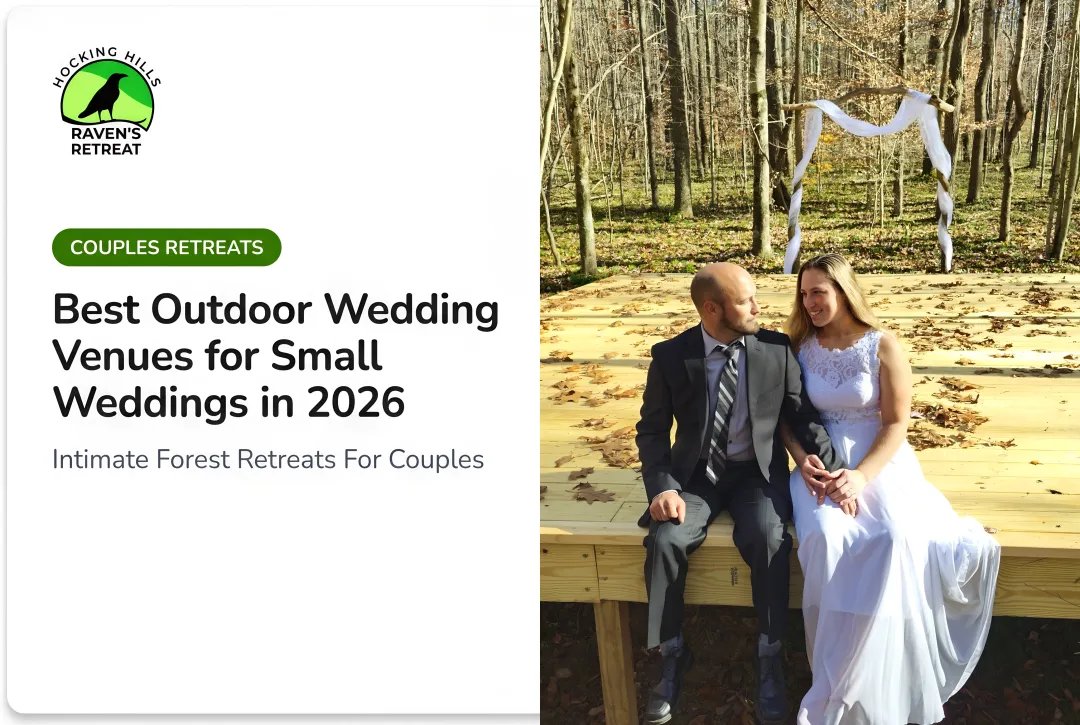
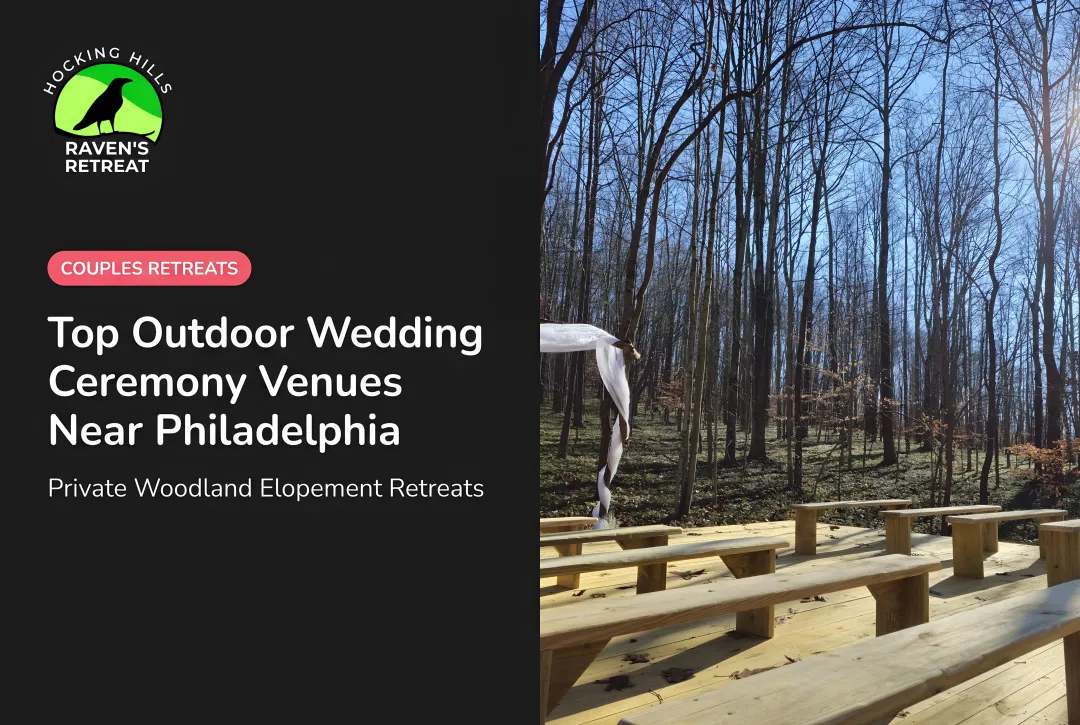
- Ceremony spaces include an elevated 24-by-24-foot forest platform, a rustic arch, and guest benches already in place
- The preserve features creek-side meditation areas, ravine-front photo spots, and over a mile of private hiking trails
- Full property buyout is available for complete privacy across all 58 acres
- Add-on experiences include live sculpture performances by Dustin Weatherby (at 50% discount for ceremony bookings), plant-based chef services, guided meditation, sound healing, forest bathing, massage, and yoga
- Custom ceremony packages range from $2,500–$6,000 for weekday bookings and $4,500–$8,000 for weekends, depending on season and group size
The private setting doesn't mean isolated. The property sits within easy reach of Hocking Hills State Park — which draws more than 3 million visitors annually for its towering cliffs, waterfalls, and hemlock-shaded gorges. Old Man's Cave is 14 miles away, Rock House just 6 miles. Couples can hold an intimate ceremony on the preserve, then spend the following days exploring one of Ohio's most striking natural regions.
Planning Your Vow Renewal: Practical Essentials
Officiant and Ceremony Format
No licensed officiant is legally required for a vow renewal. Options include:
- A professional officiant for a more structured, polished ceremony
- A trusted friend or family member who knows you well
- A religious leader, if faith is part of your story
- Just the two of you, leading the ceremony yourselves
The choice shapes the entire tone. An officiant who knows your story will say things no stranger could.
Budget, Attire, and Guest List
Vow renewals carry no inherited obligations. Budget varies enormously based on your choices — Zola points to cost drivers like venue type, guest count, catering approach, and whether you DIY elements or hire vendors. A backyard ceremony with close friends costs a fraction of a destination weekend, and the right choice depends entirely on what feels true to you.
A few practical decisions worth thinking through early:
- Attire: Wear whatever reflects who you are now — the original dress, something new, or something casual
- Guest list: Invite only who you genuinely want there; smaller gatherings tend to feel more intimate and personal
- Venue: Match the setting to the tone you want, whether that's a backyard, a nature preserve, or a destination weekend
Preserving the Memories
Document the day intentionally. Options include:
- Professional photography (worth prioritizing — these images will tell the story of who you were at this chapter)
- Videography for vows and toasts
- A guest keepsake book or time capsule to open at a future anniversary
- A commemorative certificate from your officiant
If you're planning a formal vow renewal, Zola recommends sending save-the-dates 6 to 8 months in advance (or 8 to 10 months for destination events), with invitations going out 2 to 4 weeks before the ceremony.
Frequently Asked Questions
What do you do during a wedding vow renewal ceremony?
A typical ceremony includes an opening reflection, personal vow exchange, a symbolic gesture (rings or a unity ritual), and a closing celebration. That said, there's no required order — couples shape every element to fit the tone they want.
What do you say during a wedding vow renewal ceremony?
Couples typically speak personal vows that acknowledge their shared journey, express gratitude, and make new promises for the years ahead. Vows can be freshly written, adapted from originals, or spoken spontaneously — whatever feels most authentic to the two of you.
Do couples exchange rings at a wedding vow renewal ceremony?
Ring exchanges are common but entirely optional. Couples may re-exchange original bands, present upgraded or engraved rings, or skip rings entirely in favor of another meaningful token or gesture.
How many years do you have to be married before renewing your vows?
There is no required waiting period. Some couples renew after one or two years; others wait for the 25th or 50th anniversary. Any time that feels significant to the couple is the right time.
Is a vow renewal legally binding?
No. A vow renewal carries no legal status. The couple is already legally married, so no marriage license, certified officiant, or paperwork is required — the ceremony is purely symbolic and personal.
Do you need an officiant for a vow renewal?
An officiant is not required. Couples can lead their own ceremony, ask a close friend or family member to guide it, or hire a professional for a more structured experience. The decision is entirely theirs and should reflect the tone they want to set.