A couples retreat addresses that gap head-on. Unlike a vacation, which focuses on leisure, a retreat is built around purpose: reconnecting spiritually, rebuilding warmth and playfulness, and restoring what daily life quietly depletes.
This guide covers specific faith-centered, fun, and nature-based activities that make retreats genuinely transformative — plus practical planning steps to help you design one that actually works.
Key Takeaways
- A retreat differs from a vacation in one word: intention — you choose specific goals, not just destinations
- The strongest retreats weave together spiritual depth, playful connection, and restorative wellness — not just one
- Prayer walks, trust games, partner yoga, and creative workshops each build a different dimension of connection
- Aligning on goals before booking dramatically improves retreat outcomes
- Nature-immersive settings reduce cortisol and lower defensiveness — making honest conversation easier
What Makes a Couples Retreat More Than a Getaway
A vacation is passive — you unwind, you rest, you return home largely unchanged. A retreat is active in a quieter way: couples choose specific topics to discuss, activities that stretch and reconnect them, and an environment designed to create emotional access.
The difference shows up in outcomes. The National Marriage Project's 2023 Date Night Opportunity report, analyzing 2,000 married Americans, found that 83% of wives and 84% of husbands who prioritized regular dedicated time together reported being very happy in their marriage — compared to 68% and 70% without it.
The Three Pillars That Define a Meaningful Retreat
A well-designed couples retreat rests on three distinct elements:
- Faith anchors shared purpose — giving couples a framework larger than logistics or disagreements
- Fun rebuilds warmth — playfulness is one of the first casualties of a busy, stressed relationship
- Renewal restores reserves — emotional depletion makes everything harder, from communication to intimacy
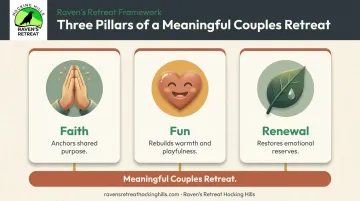
Each pillar serves a function. Skip one, and the retreat feels either too heavy (all processing, no joy), too shallow (all activity, no depth), or too passive (rest without direction).
Why the Setting Matters More Than Most Couples Expect
The environment shapes the conversation. A setting free of household chores, children's schedules, and work email removes the ambient pressure that keeps couples in management mode rather than connection mode.
Raven Morgan and Dustin Weatherby, co-founders of Raven's Retreat Hocking Hills, designed their 58-acre preserve with this principle in mind: preserving the natural soundscape of birds, bees, and dense wildlife because it helps couples "slow down, calm their nervous system, and practice mindfulness in a more organic way."
That deliberate design choice reflects environmental psychology — the science-backed idea that natural settings lower cortisol, reduce defensive communication, and open couples to the kind of honest conversation that daily life rarely makes room for.
Faith-Centered Activities for Your Couples Retreat
Faith-based retreat activities work best when they open conversations that ordinary life rarely creates space for. These five practices cover different dimensions of spiritual connection.
Shared Scripture Reading with Reflection Prompts
Read a short passage together, then each partner answers a guided question independently before sharing aloud. A question like "What does this reveal about how we're relying on each other — and on God?" moves the conversation somewhere most date nights never reach. The structure matters: individual reflection first prevents one partner's answer from anchoring the other's.
Prayer Walks
Walking together while taking turns voicing gratitude, concerns, and hopes aloud combines movement with meaningful conversation. Movement lowers defensiveness physiologically, and walking side-by-side (rather than face-to-face) reduces the performance pressure of direct conversation.
Research by Fincham and Beach (2014) found that praying for a partner is associated with increased commitment in romantic relationships. The relational benefits of prayer extend well beyond devotion.
Couples Mission Statement
Drawing from Gottman's principle of creating shared meaning, spend one retreat session writing a joint marriage vision statement. Map 2–3 concrete goals for the coming year grounded in shared faith values.
Gottman's framework treats shared meaning (rituals, roles, goals, symbols) as foundational to relationship stability. Writing a vision statement together turns that framework into something you can actually return to.
Structured Devotional Sessions
Programs like FamilyLife's Weekend to Remember (which has served 1.5 million couples across 75 locations) and WinShape Marriage's 3-day Christ-centered retreats offer pre-built frameworks couples can follow independently. Pick one topic and work through it together using a structured resource rather than improvising:
- Communication — how you speak and how you listen
- Intimacy — emotional and spiritual closeness, not just physical
- Conflict — patterns to break and repair cycles to build
Journaling and Shared Reflection
Each partner independently journals answers to the same prompt, then shares. Try:
- "Where have I seen God working in our marriage this year?"
- "What am I still holding onto that I need to release?"
Independent writing before sharing creates genuine vulnerability rather than reactive conversation. Most couples find they say things on paper they wouldn't say face-to-face — which is exactly the point.
Fun and Connection Activities to Deepen Your Bond
Playfulness isn't optional — it's structural. Reissman, Aron, and Bergen's foundational 1993 study assigned 53 married couples to either exciting or pleasant shared activities for 10 weeks. The exciting-activity group showed significantly stronger satisfaction gains. Fun, novelty, and play are part of the serious work, not a break from it.
Memory and Nostalgia Games
"Remember When" is simple and effective: each partner writes down specific memories from early in the relationship, then shares them. Revisiting origin stories reconnects couples to the emotional reasons they chose each other. This works especially well mid-retreat when the energy from arrival has settled but deeper conversations haven't yet fully opened.
Trust-Based Physical Challenges
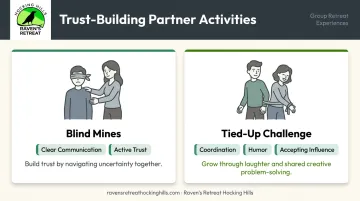
Two activities worth trying:
- Blind Mines: One partner is blindfolded while the other guides them verbally through a simple obstacle course. The guiding partner practices clear communication; the blindfolded partner practices trust.
- Tied-Up Challenge: Each partner has one hand immobilized. Completing a simple task together requires coordination, humor, and mutual adaptation — which the Gottman Institute describes as "accepting influence," one of the core markers of relationship health.
Knowledge-Deepening Games
Even couples married for decades discover things through games like Two Truths and a Lie or Gottman's Love Map format — where partners test how well they know each other's inner world: fears, dreams, preferences, stress responses. The low-stakes format creates curiosity rather than performance pressure.
Shared New Experiences
Try something neither of you has done before. Good options include:
- A pottery or creative workshop class
- A challenging new trail through unfamiliar terrain
- A cooking challenge built entirely from scratch
A 2019 Baylor University study of 20 couples found that shared creative activities — including painting classes and board games — were associated with increases in oxytocin, the bonding hormone. New shared experiences create memories that belong uniquely to the retreat.
Daily High-Low Check-Ins
Even during a retreat, schedule a 15-minute daily conversation where each partner shares their best and hardest moment of the day. It sounds small, but it keeps emotional attunement active even when the retreat itself is pleasant — and it's a habit worth bringing home.
Nature, Wellness, and Creative Experiences
At a certain point, the best retreat activities stop being scheduled and start being felt. The setting itself becomes part of the work.
Forest Bathing
Qing Li's 2022 review on Shinrin-yoku (forest bathing) reports that immersion in forest environments reduces blood pressure, heart rate, and stress hormones. A separate 2024 Journal of Environmental Psychology study found that shared time in nature increased feelings of social connection. For couples, this matters practically: physiological calm makes honest conversation easier.

At Raven's Retreat Hocking Hills, Mark Bucha — certified by the Association of Nature and Forest Therapy — leads guided forest bathing sessions on the 58-acre private preserve. Couples can also explore more than a mile of private trails independently, including a secluded meditation area at the deepest point of the preserve, anchored by pink granite boulders deposited by Illinoian glaciers thousands of years ago.
Partner Yoga and Meditation
Partner yoga works through physical trust and synchronized breathing — neither of which requires skill, just willingness. The elevated 24x24-foot wooden forest platform at Raven's Retreat positions couples inside the tree canopy for sessions that feel distinctly different from a studio class. Certified yoga instructors are available as add-ons, or couples can use the platform for self-guided practice and quiet morning meditation.
Art-Based Creative Experiences
Shared creative activity lowers self-protective emotional walls — you're both imperfect at something, which creates connection. Talent is optional. Willingness to be awkward together is the whole point.
At Raven's Retreat, master sculptor Dustin Weatherby offers:
- Sculpting workshops and painting classes — hands-on sessions for all skill levels
- Live sculpture performances — a few hours where couples watch a raw log become a finished piece, then take it home as a keepsake
Weatherby's sculptures, wood carvings, and tile murals are found throughout the property — turning every walk into something between a hike and a gallery visit.
For couples who want nature immersion, certified forest therapy, partner yoga, and creative workshops in one place, the Sculptor's Art Bungalow at Raven's Retreat offers a fully private experience starting at $400/night. A full property buyout is also available for complete exclusivity.
How to Plan Your Couples Retreat
The most common reason retreats disappoint: mismatched expectations. One partner wants emotional depth; the other wants relaxation. Both are valid. Without a conversation before arrival, though, the retreat becomes a negotiation rather than an experience.
Step 1: Align on Goals First
Before choosing dates or destinations, ask each other:
- What do I need most right now?
- What would make this feel like a success?
- Is there anything I want to address — or anything I'd like to avoid?
Twenty minutes of this conversation prevents most retreat friction.
Step 2: Choose the Right Format for Your Season
| Relationship Season | Best Format |
|---|---|
| Healthy, maintenance/enrichment | 2-3 night private nature retreat |
| Structured learning preferred | Faith-based weekend program (Weekend to Remember, WinShape) |
| Significant stress or transition | Longer retreat with guided facilitation |
| Limited time or budget | One-night reset with clear intentions |
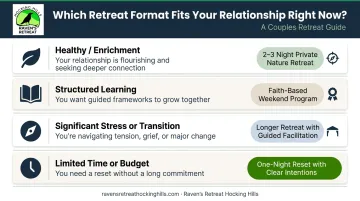
Most couples in a healthy season find that 2-3 nights in a distraction-free, nature-immersive setting provides the best balance of depth and practicality. Major programs like FamilyLife, WinShape, and Focus on the Family have settled on this same format for good reason: it's long enough to decompress, short enough to stay practical.
Step 3: Prepare Discussion Topics and Build in Fun
Select 3-5 topics in advance — marriage health, spiritual goals, finances, dreams, intimacy — and prepare 2-3 reflection questions per topic. Then deliberately schedule unstructured time so the retreat doesn't feel like a performance review.
That unstructured time is where some of the best moments happen — a shared soak in a hot tub, a slow walk through the woods, or watching a live sculpture performance. Couples planning a Midwest retreat can book a full private-property experience at Raven's Retreat Hocking Hills, about an hour from Columbus, with optional add-ons like guided meditation, forest bathing, or chef-prepared delicious, healthy meals on a 58-acre nature preserve.
Frequently Asked Questions
What do you do at a couples retreat?
Retreats typically blend guided discussions, devotionals, or workshops with connection-building activities, wellness practices like yoga or forest bathing, and unstructured time together. The mix depends on whether the retreat is faith-based, adventure-oriented, or wellness-focused — and how much structure the couple wants.
How long should a couples retreat last?
Most couples find 2-3 nights provides enough time to decompress, go deeper in conversation, and experience meaningful activities. One-night retreats work as annual resets for busy couples; weekend formats are the most common for deeper renewal.
What topics should couples discuss at a retreat?
Focus on the current state of the relationship, spiritual goals, finances, future dreams, intimacy, and any tensions that need calm space to address. Preparing specific questions before arrival makes these conversations significantly more productive.
What is the difference between a couples retreat and couples therapy?
Couples therapy is a clinical intervention led by a licensed therapist to address specific relational dysfunction. A retreat is an enrichment experience focused on connection and growth. Retreats can include therapeutic elements, but they're not a substitute for professional help when serious issues are present.
Do couples retreats actually work?
Research on marriage enrichment programs consistently shows gains in communication and relationship satisfaction — and results hold when couples put what they practiced into use at home. A distraction-free environment away from daily demands accelerates progress that weekly sessions rarely match.