Somatic breathwork brings intentional awareness to that automatic process. Rooted in the idea that the body holds stress and emotion as physical patterns, it pairs conscious breathing with attention to bodily sensations to calm the nervous system, ease anxiety, and interrupt the stress cycle. No equipment, no experience, and no special setting required — though, as you'll see, environment does matter.
This guide covers what somatic breathwork actually is, why the research supports it, and seven accessible exercises you can start today.
Key Takeaways
- Somatic breathwork combines intentional breathing with physical body awareness to regulate the nervous system
- It activates the parasympathetic ("rest and digest") system to counteract stress
- Research links regular practice to lower cortisol, reduced blood pressure, improved mood, and eased chronic pain
- Seven exercises below range from basic breath awareness to humming-based techniques
- Most healthy adults can practice safely; those with cardiovascular, respiratory, or mental health conditions should consult a doctor first
What Is Somatic Breathwork?
"Somatic" comes from the Greek soma, meaning body. Somatic breathwork is therefore a body-centered practice — one that pairs intentional breathing with interoceptive awareness, meaning attention to internal sensations like tension, tightness, warmth, or ease as they arise in real time. That internal attention is what gives the practice its depth — and what distinguishes it from simply breathing slowly.
More Than Just Deep Breathing
Standard deep breathing tells you to take bigger breaths. Somatic breathwork asks a different question: what does your body feel as you breathe? That shift — from technique to awareness — is what separates it from generic relaxation exercises. When you track how your body responds breath by breath, you start to shift out of the stress state rather than simply pause it.
The Nervous System Connection
When you're stressed, breathing tends to become shallow and rapid. This pattern keeps the sympathetic nervous system — your "fight or flight" network — activated. Research on respiratory vagal stimulation shows that slow, diaphragmatic breathing can increase parasympathetic activity by stimulating the vagus nerve, shifting the body toward a "rest and digest" state measurable through heart rate and blood pressure changes. The exhale drives much of this effect — a longer out-breath actively slows the heart rate, which is why extended exhalation is a cornerstone of most somatic breathing techniques.
Benefits of Somatic Breathwork
Physiological Benefits
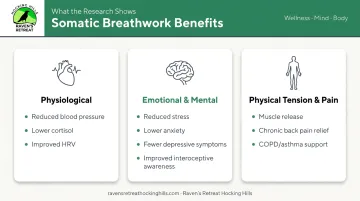
The evidence for breathwork's physical effects is growing. A meta-analysis of 15 randomized controlled trials involving 1,097 participants found that breathing exercises reduced systolic blood pressure by 7.06 mm Hg, diastolic blood pressure by 3.43 mm Hg, and heart rate by 2.41 bpm. Studies on diaphragmatic breathing specifically show reductions in salivary cortisol and improvements in heart rate variability (HRV) (a marker of how well your nervous system adapts to stress).
Emotional and Mental Health Benefits
A 2023 meta-analysis of 12 RCTs found breathwork was associated with meaningfully lower self-reported stress (g = -0.35), anxiety (g = -0.32), and depressive symptoms (g = -0.40). Beyond those numbers, breath-focused practices improve interoceptive awareness — your ability to read and respond to your body's internal signals — which supports emotional regulation over time.
Physical Tension and Pain Relief
That calming effect on the nervous system reaches the body directly. Chronically tensed muscles in the neck, shoulders, and back often release when the stress response settles. Systematic reviews show breathing exercises can also:
- Reduce perceived pain and ease lumbar disability in chronic low back pain
- Improve quality of life for people managing COPD and asthma
- Support recovery as a complementary practice alongside medical care
7 Somatic Breathwork Exercises to Try Today
Not every technique suits every person. Approach these with curiosity rather than the pressure to do them correctly. Start with 1–3 minutes per exercise and build from there.
Exercise 1: Breath Awareness Scan
How to do it: Sit or lie comfortably. Close your eyes and simply observe your breath without changing it. Notice where your body moves — chest, belly, sides, back. Feel the air in your nostrils. Identify any areas of tightness or ease.
Why it works: This non-directive awareness quiets the mind's "doing" mode and sharpens the body awareness that makes every other exercise more effective. Some people with anxiety notice heightened alertness at first — that's a normal initial response. Stay with it for a few cycles.
Exercise 2: Diaphragmatic (Belly) Breathing
How to do it:
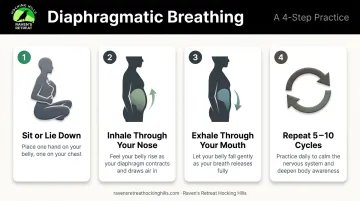
- Sit or lie down and place one hand on your belly, one on your chest
- Inhale slowly through the nose — belly rises, chest stays relatively still
- Exhale gently through the mouth — belly falls
- Repeat for 5–10 cycles
Why it works: This is the most research-supported somatic breathing technique. A randomized controlled trial by Ma et al. found that diaphragmatic breathing over 8 weeks reduced salivary cortisol, lowered negative affect, and improved attention. It also directly activates the vagus nerve, triggering the parasympathetic response.
Exercise 3: Box Breathing (4-4-4-4)
How to do it:
- Inhale for a count of 4
- Hold for 4
- Exhale for 4
- Hold for 4
- Repeat 4–6 cycles, visualizing each side of a square
Why it works: When your thoughts are spinning, the equal-count rhythm gives the mind something concrete to follow — while the pattern itself activates the parasympathetic nervous system. It's particularly effective for re-centering before a difficult conversation or decision.
Exercise 4: 4-7-8 Breathing
How to do it:
- Inhale through the nose for 4 counts
- Hold for 7 counts
- Exhale slowly through the mouth for 8 counts
- Beginners: start with 4-4-6 and work toward the full ratio
Why it works: The extended exhale is the mechanism. A longer exhalation relative to inhalation signals the nervous system to downshift. This makes 4-7-8 especially useful for acute anxiety, winding down before sleep, or resetting after a stressful moment.
Exercise 5: Cyclic Sighing
How to do it:
- Take a full inhale through the nose
- Add a short second "top-up" inhale to fully fill the lungs
- Exhale long and slowly through the mouth — let an audible sigh arise naturally
- Aim for 5 minutes; even 3–5 cycles yield a noticeable shift
Why it works: A 2023 study in Cell Reports Medicine by Balban et al. tested four daily 5-minute practices — cyclic sighing, box breathing, cyclic hyperventilation, and mindfulness meditation — over roughly one month. Cyclic sighing produced the strongest improvements in positive affect and the greatest reduction in respiratory rate.
Stanford Medicine summarized it plainly: five minutes a day of this technique reduces anxiety and improves mood more effectively than meditation alone.
Exercise 6: Alternate Nostril Breathing (Nadi Shodhana)
How to do it:
- Block the right nostril with your thumb; inhale through the left
- Close the left nostril with a finger; release the thumb; exhale through the right
- Inhale through the right; close it; exhale through the left
- That's one round — continue for 5–8 rounds
Why it works: Research on alternate nostril breathing shows consistent cardiorespiratory benefits — including reduced blood pressure and heart rate — across both hypertensive patients and healthy young adults. It's well suited for moments when you want to feel both calm and mentally clear, not just relaxed.
Exercise 7: Humming Breath (Bumblebee Breath)
How to do it:
- Inhale slowly and deeply through the nose
- Exhale with a gentle, sustained hum — lips lightly closed
- Feel the vibration in your chest and face
- Repeat 5–8 rounds somewhere you're comfortable making noise
Why it works: The hum extends the exhalation naturally, deepening the parasympathetic response. Research also shows that humming increases nasal nitric oxide production significantly compared to quiet exhalation, which supports a distinct physiological mechanism. This makes humming breath one of the most soothing techniques for emotional distress, physical pain, or pre-sleep wind-down.
How to Make Somatic Breathwork a Daily Habit
Attach It to What You Already Do
The biggest mistake is treating breathwork as a separate task that requires carved-out time. Instead, attach it to existing anchors:
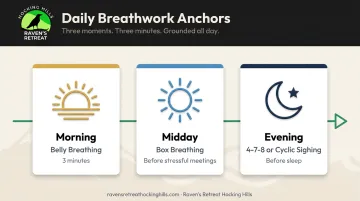
- Morning: 3 minutes of belly breathing before checking your phone
- Midday: Box breathing before a stressful meeting or call
- Evening: 4-7-8 or cyclic sighing during the last few minutes before sleep
Even 2–5 minutes of intentional breathing produces measurable benefits when done consistently. The Balban et al. study used just 5 minutes per day — and saw significant mood and arousal improvements across a month.
Pair Breathwork with Movement and Nature
Walking while practicing rhythmic breathing — inhaling for 2–3 steps, exhaling for 3–4 — amplifies the calming effect. Natural settings independently lower cortisol and support nervous system regulation, which means an outdoor walk makes your breathwork more effective, not just more pleasant.
For those who want to go deeper, a dedicated retreat environment offers something a daily home practice can't fully replicate: complete removal from the obligations that keep the nervous system on alert. Raven's Retreat Hocking Hills, set on a 58-acre private nature preserve in Ohio, offers structured somatic breathwork sessions led by Raven Morgan, a certified breathwork coach, alongside guided forest bathing and a purpose-built forest yoga platform designed specifically for nervous system reset.
Stay Consistent Without Being Rigid
- Use stress or boredom as a cue to pause and breathe rather than reaching for a screen
- Set gentle phone reminders if that helps initially
- Treat missed days with curiosity rather than frustration — consistency over weeks matters more than perfection in any single session
Safety Considerations: Who Should Proceed with Care
Somatic breathwork is broadly safe for healthy adults, but certain groups should consult a medical professional first:
- Pregnant individuals
- Those with cardiovascular conditions or poorly controlled blood pressure
- People managing severe respiratory disorders (COPD, poorly controlled asthma)
- Those with serious mental health diagnoses, including active psychosis or schizophrenia
- Anyone with a trauma history that may be triggered by focused body awareness
Stop immediately and return to normal breathing if you experience: dizziness, tingling, chest pain, shortness of breath, or worsening anxiety. If symptoms persist, seek guidance from a licensed somatic or breathwork professional.
Every exercise in this guide should feel manageable. If something feels wrong, stop — your nervous system will benefit more from a gentle practice you can return to than one you push through.
Frequently Asked Questions
Is somatic breathwork legitimate?
Yes — it has a growing body of peer-reviewed research behind it, including meta-analyses on cortisol reduction, blood pressure, anxiety, and mood. Results vary by technique and individual, but it is an active area of clinical research rather than a fringe practice.
Can breathing exercises lower blood pressure?
Yes. A meta-analysis of 15 RCTs found slow, diaphragmatic breathing reduced systolic blood pressure by an average of 7.06 mm Hg. These techniques work best alongside medical treatment, not as a substitute.
What's the difference between somatic breathwork and regular breathwork?
Regular breathwork follows a fixed count or pattern. Somatic breathwork adds a layer of body awareness — tracking physical sensations, tension, and emotional responses as they arise. The goal is nervous system regulation, not just pattern execution.
How long should I practice each day?
Two to five minutes of intentional breathwork daily is enough to produce measurable benefits for most people. Beginners should start with 1–2 minutes per exercise and build up gradually as comfort and familiarity increase.
Can somatic breathwork help with anxiety?
Yes. Research on techniques like 4-7-8 breathing and cyclic sighing shows measurable reductions in both acute and chronic anxiety by shifting the nervous system out of fight-or-flight mode. Those with diagnosed anxiety disorders should work with a therapist, as some techniques can temporarily increase alertness before calming.