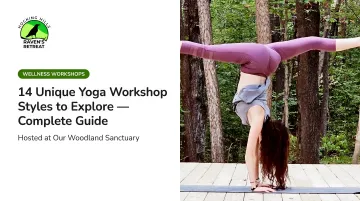
With so many formats available, knowing which style fits your goals matters more than ever. This guide breaks down all 14 yoga workshop styles, what distinguishes each one, and how to match the right format to what you actually need right now.
Key Takeaways
- Yoga workshops go deeper than regular classes — typically 2–8 hours, focused on one style, skill, or theme
- All 14 styles fall into four categories: movement and flow, rest and restoration, breath and energy, and mindfulness and grounding
- No single style is universally best — the right choice depends on experience level, physical capacity, and what you're genuinely seeking
- Setting shapes experience — natural environments measurably deepen grounding, restorative, and mindfulness-based styles
What Is a Yoga Workshop?
A yoga workshop is a focused, time-bound event that goes deeper into one aspect of yoga practice than a standard class allows. Where a regular class is recurring and general, a workshop centers on a specific style, skill, or theme — inversions, breathwork, partner work, or meditation — and gives it room to breathe.
Most workshops share a few defining characteristics:
- Run 2–8 hours with a trained facilitator guiding instruction, practice, and reflection
- More educational than a drop-in class — structured around learning a specific skill or concept
- Shorter than a multi-day retreat, with no overnight stay required
- Open to all experience levels, from first-timers to seasoned practitioners
That range of formats is exactly why there are so many distinct styles worth knowing — each one serves a different goal, setting, or type of practitioner.
The 14 Unique Yoga Workshop Styles
Yoga workshops are not one-size-fits-all. Each style has distinct goals, pacing, and benefits. Here's a clear breakdown across four categories.
Movement and Flow Styles
These styles center on dynamic physical expression — ideal for building strength, improving coordination, or experiencing yoga as energizing movement.
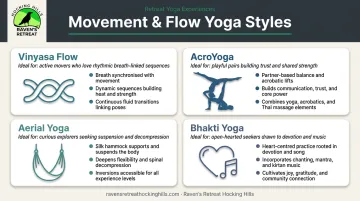
Vinyasa
Vinyasa links movement with breath, as Yoga Journal defines it, weaving inhalation and exhalation through flowing sequences. Workshop formats often explore themed flows — seasonal practices, emotionally guided sequences, or specific transitions. It suits all levels but especially resonates with people who respond to rhythm and want a physically engaging, meditative experience.
AcroYoga
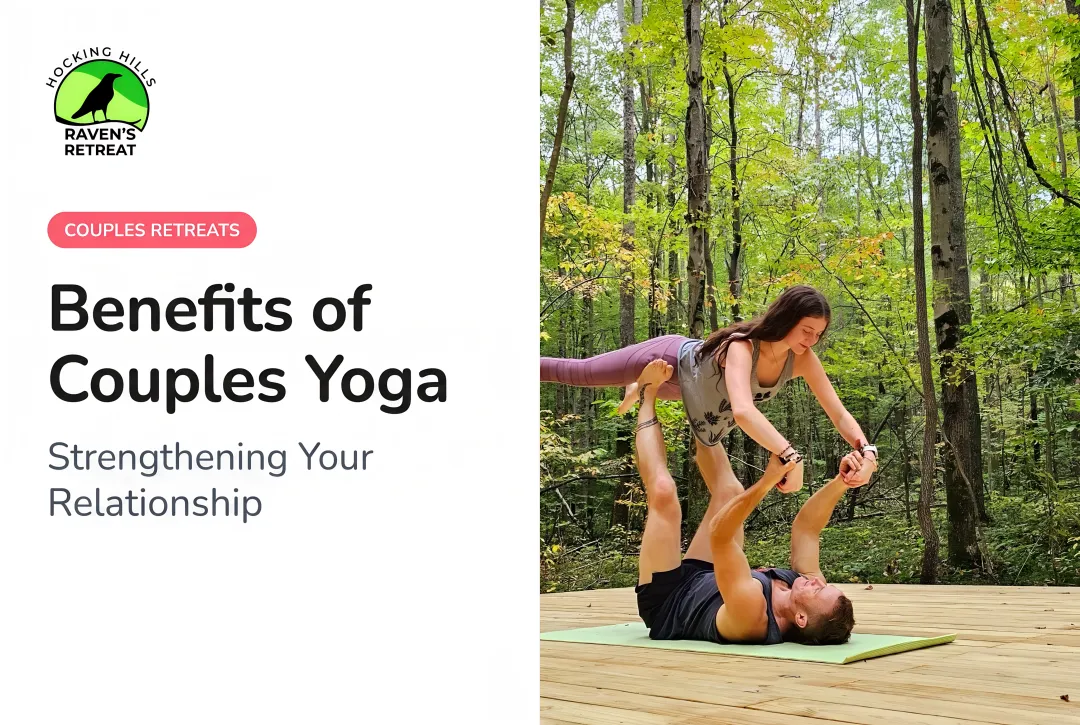
AcroYoga blends yoga, acrobatics, and Thai massage in a partner-based format involving three roles: base, flyer, and spotter. AcroYoga was co-founded in 2003 by Jason Nemer and Jenny Sauer-Klein, and workshops build trust, communication, and genuine community. It's especially popular for team settings or groups wanting a playful, social challenge — though safety screening and proper spotting are essential.
Aerial Yoga
Aerial yoga uses fabric hammocks suspended from the ceiling to support and deepen poses. ACE-sponsored research found a 50-minute aerial yoga session averaged 320 calories, with a 6-week program improving VO2max by roughly 11%. Workshops focus on inversions, core engagement, and exploring movement in three dimensions — particularly useful for those who want supported inversion practice without the fear factor.
Bhakti Yoga
Bhakti is devotion in motion — chanting, mantra recitation, kirtan, and expressive movement. It prioritizes heart-centered connection over physical rigor, making it ideal for those drawn to yoga's philosophical or spiritual dimensions.
A 2022 study across 456 participants found associations between chanting, altered states, and quality of life measures — though Bhakti workshops are best understood as community and meaning-making experiences rather than clinical interventions.
Rest, Stillness, and Restoration Styles
These styles support deep nervous system recovery — suited to anyone dealing with chronic stress, fatigue, injury, or burnout.
Restorative Yoga
Restorative yoga uses props — bolsters, blankets, blocks, straps — to hold the body in passive poses for several minutes at a time. No muscular effort is required. The entire practice is about letting go, making it ideal for high-stress individuals, those recovering from burnout, or anyone new to stillness. This is not Yin yoga — the distinction matters, and it's explained below.
Yin Yoga
Yin holds floor-based poses for 3–5 minutes or longer, targeting deep connective tissue — fascia, ligaments, and joints — rather than muscles. Unlike restorative yoga, Yin intentionally applies mild stress to connective tissue, making it more focused on flexibility and joint health. It works well for athletes, high-achievers, or anyone craving a contemplative counterbalance to an active lifestyle.
Yoga Nidra
Yoga Nidra — sometimes called "yogic sleep" — is a guided meditation that systematically leads participants through layers of consciousness into a deeply relaxed, hypnagogic state. A 2022 review reports increased alpha and theta EEG activity and a 65% endogenous dopamine-release finding, though research samples remain small. What's clear: it requires minimal physical exertion, making it one of the most accessible formats regardless of mobility or experience level.
Chair Yoga
Chair yoga adapts poses to be performed seated or with a chair for support. A 2023 study of 85 women aged 65+ with knee osteoarthritis found that a 12-week twice-weekly chair yoga program significantly improved functional fitness and daily activity scores. It's the most universally accessible style — ideal for older adults, limited mobility participants, and corporate wellness settings where floor-based yoga may feel inaccessible.
Breath, Energy, and Spiritual Styles
These styles work with breath, internal energy, or devotional practice — best for those ready to explore the subtler dimensions of yoga.
Pranayama
Pranayama is the formal practice of yogic breathing and the fourth limb of Patanjali's eight-limb system. Workshops teach specific techniques — Ujjayi, Nadi Shodhana, Kapalabhati, Bhramari — to influence energy, mental clarity, and emotional regulation. While breath appears in all yoga styles, Pranayama workshops isolate it as the sole practice. One practical note: forceful techniques like Kapalabhati need careful screening for beginners or those with certain health conditions.
Kundalini Yoga
Kundalini workshops combine dynamic postures (kriyas), rhythmic breathwork (Breath of Fire at roughly 2–3 cycles per second), chanting, and meditation. The goal is to awaken and move energy up the spine. This is among the most intense and spiritually oriented formats — it attracts practitioners ready to work at the energetic and psychological level and can produce cathartic experiences. Not recommended as a first yoga workshop.
Kundalini Dance
Kundalini Dance builds on Kundalini principles but replaces structured kriyas with free-form, music-driven movement. There are no prescribed sequences — the practice creates space for emotional release and creative embodiment. The evidence base is thin compared to Kundalini Yoga, but as an expressive movement workshop, it offers genuine value for those seeking embodiment and emotional liberation through dance rather than structured practice.
Chakra Yoga
Chakra yoga workshops structure practice around the body's seven energy centers — Muladhara through Sahasrara.
Each session may focus on one or multiple chakras, pairing poses, breathwork, mantras, and visualizations with each center's qualities: root stability, heart opening, creative expression. Treat the chakra framework as a yoga-philosophy model rather than biomedical anatomy — it works best as a lens for self-inquiry and emotional exploration, not a clinical map.
Mindfulness and Grounding Styles
These styles prioritize present-moment awareness and connection — well-suited for those navigating mental overload or wanting to integrate yoga with meditation.
Grounding Yoga
Grounding yoga workshops build around rooting postures — standing poses, forward folds, seated holds — combined with mindful breathwork and sensory awareness exercises. The explicit intention is cultivating stability and earth connection, making it particularly beneficial for anxiety, restlessness, or overwhelm.
Outdoor settings amplify this significantly. Nature-based mindfulness research supports natural environments for psychophysiological stress recovery, and running a grounding yoga session in a forest setting produces measurably different outcomes — deeper calm, stronger sensory engagement — than the same session in a studio.
Meditation Yoga
Meditation yoga fuses asana practice with formal mindfulness or contemplative meditation, dedicating equal time to both. A 2020 systematic review found workplace yoga interventions reduced perceived stress among employees — a finding that reflects what these workshops do well at any level. They work best for those who want to deepen a meditation practice, build focus, or transition from physical yoga toward a more inward, mind-body integrated approach.
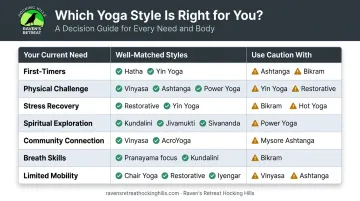
How to Choose the Right Yoga Workshop Style for You
The right style starts with an honest question: am I seeking physical challenge, deep rest, spiritual exploration, or emotional release? What you need matters more than what sounds interesting.
| --- | --- | --- |
| Your Current Need | Well-Matched Styles | Use Caution With |
|---|---|---|
| First yoga experience | Chair, Restorative, Yoga Nidra, Vinyasa | Kundalini, deep Yin holds, AcroYoga |
| Physical challenge and coordination | Vinyasa, Aerial, AcroYoga | Fast flows if injured or new |
| Stress recovery or burnout | Restorative, Yoga Nidra, Grounding, Meditation Yoga | Overpromising medical outcomes |
| Spiritual or energetic exploration | Bhakti, Kundalini, Chakra Yoga | Intensity without foundational experience |
| Community and social connection | AcroYoga, Bhakti, Chakra group circles | Acro without proper spotting |
| Breath and nervous system skills | Pranayama, Meditation Yoga, Kundalini | Forceful breathing for beginners |
| Limited mobility | Chair Yoga, Restorative, Yoga Nidra | Floor-heavy workshops without adaptations |
A practical note: high-intensity spiritual styles like Kundalini work best when you already have some foundational practice. Without it, the experience can overwhelm rather than open. The workshops that tend to land hardest are the ones that meet you where you actually are — physically and emotionally — rather than where you'd like to be.
Why Setting Matters: The Power of Immersive Yoga Environments
Where a workshop happens shapes how deeply it lands. Indoor studio settings offer familiarity and structure. But taking workshops into natural environments — forests, open fields, nature preserves — deepens the grounding, restorative, and mindfulness-based styles by removing sensory distractions and connecting participants to the rhythms of the natural world.
Research on nature-based mindfulness supports this: a 2023 qualitative study found that a 5-day residential nature-based mindfulness program supported self-regulation among participants with moderate to severe stress. Outdoor immersion engages the nervous system differently — the sensory input of wind, birdsong, and uneven terrain actively supports the regulation that these practices are designed to cultivate.
For yoga instructors and wellness providers looking to host workshops in this kind of environment, Raven's Retreat Hocking Hills offers a purpose-built setting on a 58-acre private nature preserve near Laurelville, Ohio. The property includes:
- A 24×24-foot elevated forest yoga platform set into the oak and maple canopy — suitable for full group flows, Vinyasa, Restorative, Yoga Nidra, and more
- The Shala, a dedicated indoor movement space with sculpture, natural materials, and intentional design for year-round practice
- Two designated forest meditation zones, including a deep-forest area by the creek for contemplative practice
- Over a mile of private wellness trails and functional fitness stations
- Wellness add-ons including sound bathing, forest bathing, somatic breathwork, and massage — pairable with most workshop styles
The retreat accommodates up to 20 guests for day retreats and up to 18 overnight. Yoga instructors receive full planning support — yoga mats and blocks, schedule consultation, on-site collaborator coordination, and chef-curated catering — so the focus stays on teaching rather than event management.
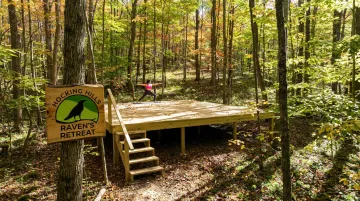
That support extends across seasons. Spring and autumn offer the most temperate outdoor conditions for extended practice, though the indoor Shala keeps workshops viable year-round regardless of weather — making the setting as flexible as the styles it hosts.
Frequently Asked Questions
What is the difference between a yoga workshop and a regular yoga class?
A yoga workshop is a deeper, more focused event — typically 2–8 hours — dedicated to a specific style, skill, or theme. A regular class is a recurring, general session. Workshops tend to be more educational, often one-time or short-series events rather than ongoing drop-ins.
Which yoga workshop style is best for complete beginners?
Restorative, Chair, Grounding, and Vinyasa workshops are all strong starting points. All four welcome beginners — they involve accessible movement or fully supported poses and require no prior yoga knowledge.
How long does a typical yoga workshop last?
Most workshops run between 2 and 4 hours. Some intensive formats — like Kundalini or full-day Yoga Nidra immersions — can span an entire day or extend into multi-day retreat formats. Duration varies by facilitator and subject depth.
Can yoga workshops be held outdoors or in non-studio settings?
Yes. Grounding, Vinyasa, Restorative, and Bhakti styles translate especially well to outdoor and retreat settings, where natural surroundings can deepen the sensory and emotional experience.
What should I bring to a yoga workshop?
Standard items to bring:
- Yoga mat
- Comfortable layered clothing
- Water bottle
- Personal props (blocks, strap, blanket) if you have them
Most workshops supply basic props, but confirm in advance — Restorative and Yin styles typically require several.
Are yoga workshops suitable for people with physical limitations or injuries?
Chair Yoga and Restorative Yoga are specifically designed for limited mobility or injury recovery. Most facilitators can offer modifications for other styles too. Always communicate any physical conditions to the instructor before the session begins.