Introduction
Picture this: a project launch goes sideways because two team members assumed someone else had communicated the timeline change. Sound familiar? Poor workplace communication isn't just frustrating — it's expensive. According to Grammarly's 2024 State of Business Communication Report, miscommunication costs U.S. businesses an estimated $1.2 trillion annually, and 41% of workers report it directly lowers their productivity.
Another slide deck won't fix this. Real communication skills develop through practice — in shared experiences where teams actually talk, listen, and work through friction together, not by watching someone else model it.
This guide breaks down specific, proven team-building activities organized by the communication skill they target: verbal clarity, active listening, trust-building, and creative self-expression. Whether your team struggles with unclear instructions, unspoken tensions, or people who never speak up in meetings, you'll find targeted activities here — plus guidance on how to choose the right one.
Key Takeaways
- Poor communication costs U.S. businesses $1.2 trillion annually ; structured activities address root causes, not just symptoms
- Match activities to a specific gap — clarity, listening, trust, or expression — for better results
- Every activity needs a structured debrief to convert experience into lasting behavior change
- Off-site immersive settings reduce defensiveness and open the door to more honest engagement
- Consistency matters more than duration: short monthly sessions outperform occasional all-day events
Why Team Communication Breaks Down (and How Activities Help)
Communication problems at work rarely stem from one cause. They compound.
The most common root causes:
- Different communication styles clashing without awareness
- Hierarchy-driven silence — people filter opinions to avoid judgment from managers
- Lack of psychological safety, where speaking up feels risky
- The "everyone knows" assumption — critical context never gets stated aloud
Left unaddressed, these patterns harden. Teams route around the problem instead of fixing it — and the gaps widen over time.
Why Passive Training Doesn't Stick
A 2025 systematic scoping review identified what practitioners have long observed: soft-skills training — including communication workshops — frequently fails to produce lasting behavior change at work. Researchers called this the "soft skills transfer problem."
Structured team-building activities work differently. They create shared experiences that build both behavioral habits and interpersonal trust. When teammates navigate a communication challenge together, the lesson sticks because it came from doing, not listening.
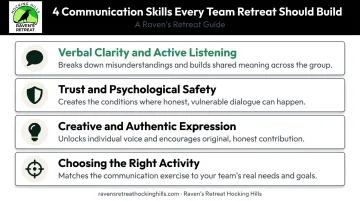
That's the framework this guide is built around. It covers four communication skill areas:
- Verbal clarity and active listening — for teams where messages get lost or misinterpreted
- Trust and psychological safety — for teams where people don't speak up or share honestly
- Creative and authentic expression — for teams in creative ruts or stiff professional dynamics
- Choosing the right activity — a decision framework for matching activities to actual gaps
Team Building Activities to Sharpen Verbal Communication and Active Listening
Back-to-Back Drawing
Two people sit back-to-back. One holds an image (a simple shape or diagram) and describes it verbally. The other draws based solely on those instructions — no peeking.
When they compare drawings to originals, the results are often wildly different. That gap is the lesson.
The activity targets two skills at once: the speaker learns to give precise, complete instructions; the listener learns to ask clarifying questions rather than assume. The debrief question, "What did you leave out?", is where the real communication insight lands.
The Telephone Game
The classic chain exercise where a message gets whispered from person to person works because distortion is inevitable. By the time the final person announces what they heard, the original message is often unrecognizable.
For workplace relevance, use a realistic scenario: a project status update, a client request, or a policy change. Seeing how a concrete work message distorts over five or six people makes a compelling case for closed-loop communication and confirmation practices.
Active Listening Pairs
One person speaks on a topic for 2-3 minutes. Their partner must summarize back, accurately and completely, without inserting their own opinion. Then roles switch.
This activity directly challenges one of the most common listening failures: most people listen to respond, not to understand. When participants try to summarize and realize they missed key points, the lesson is immediate and personal. It's one of the most practical activities you can run in a regular team meeting with zero materials required.
Shift Story Chain
One person starts a story with a single sentence. Each subsequent person adds exactly one sentence, but only after they've processed everything that came before. No hijacking the narrative, no ignoring prior contributions.
This builds two underrated professional skills:
- Careful listening — you can't contribute meaningfully without tracking what's already been said
- Narrative coherence — each addition has to connect, not redirect
Teams that regularly talk over each other or lose the thread in meetings find this activity uncomfortably revealing.
"Can You Hear Me Now?"
A scaled-up version of Back-to-Back Drawing for larger groups. One team member describes an object or image in detail while the rest, who cannot see it, attempt to draw or recreate it independently.
The comparison at the end shows how even small word choices produce strikingly different outcomes across the group. "A rectangle" becomes eight completely different objects. The debrief question, "What language would have been more precise?", translates directly into clearer workplace instructions.
Team Building Activities to Build Trust and Psychological Safety
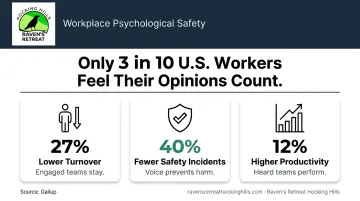
Trust is a performance driver, not a soft skill. Google's Project Aristotle identified psychological safety as the first of five team-effectiveness dynamics. And according to Gallup, only 3 in 10 U.S. workers strongly agree their opinions count at work. Moving that ratio to 6 in 10 could produce 27% lower turnover, 40% fewer safety incidents, and 12% higher productivity.
Teams without psychological safety filter their speech to avoid judgment. That filtering kills honesty and shuts down real communication improvement.
Each activity below creates a concrete situation where trust gets tested, built, or revealed — often more directly than any workshop exercise could.
The Minefield
One team member is blindfolded and must navigate an obstacle course using only their partner's verbal guidance. No touching — just words.
The guide must be precise. The navigator has no fallback except their partner's words. This makes it an unusually direct experience of communication trust — teams with top-down communication dynamics find this particularly revealing.
Elephant in the Room
Team members anonymously write unspoken workplace tensions or concerns on sticky notes. Notes are then shared and discussed as a group — without attribution.
This creates a structured format for candid dialogue. Bravely's research found 70% of employees avoid difficult conversations with bosses, colleagues, or direct reports.
The anonymous format removes the personal risk that blocks these conversations naturally — while still surfacing the issues that silently damage team communication.
Two Truths and a Lie
The classic icebreaker earns more credit than it typically gets. Sharing personal statements in a low-stakes format builds interpersonal familiarity that makes future communication feel less transactional. Particularly effective for:
- Teams with newly added members who don't yet know each other
- Teams with siloed roles where people rarely interact informally
- Remote or hybrid teams where relationships are thin
Human Knot
The team stands in a circle, each person grabbing two random hands across the circle. The challenge: untangle into a standing circle without letting go of anyone's hands.
What makes this valuable isn't the puzzle — it's what the puzzle reveals. Who takes initiative? Who listens? Who talks over others? Who withdraws? The debrief conversation after is often the most useful communication activity of the entire session.
Blind Drawing (Team-Guided)
One person draws while the entire team guides them verbally. The artist cannot see the image the team is describing.
Unlike the one-on-one version, this shifts the communication challenge to the group. The team must coordinate their instructions, avoid contradiction, and reach consensus in real time — without confusing the person holding the pen. That coordination mirrors exactly what collaborative workplace communication requires.
Creative and Outdoor Activities That Unlock Authentic Team Communication
Research from McKinsey shows that nature supports attention, creativity, and team connection. Off-site settings remove the status cues and daily work triggers that cause people to stay guarded. When teams step into unfamiliar physical spaces — in nature, through art, outdoors — they tend to communicate more freely and honestly.
A 2023 study of off-site graduate retreats found they effectively promoted team building, collaboration, and communication skills. Novel environments lower defensive communication and increase authentic engagement.
Nature Scavenger Hunt
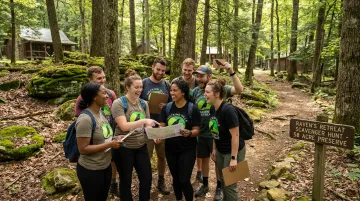
Teams split into small groups and navigate the property together, solving puzzles and locating clues distributed across the terrain. The outdoor setting removes office hierarchies — no head of the table, no assigned seating, no implied status. Communication tends to level out.
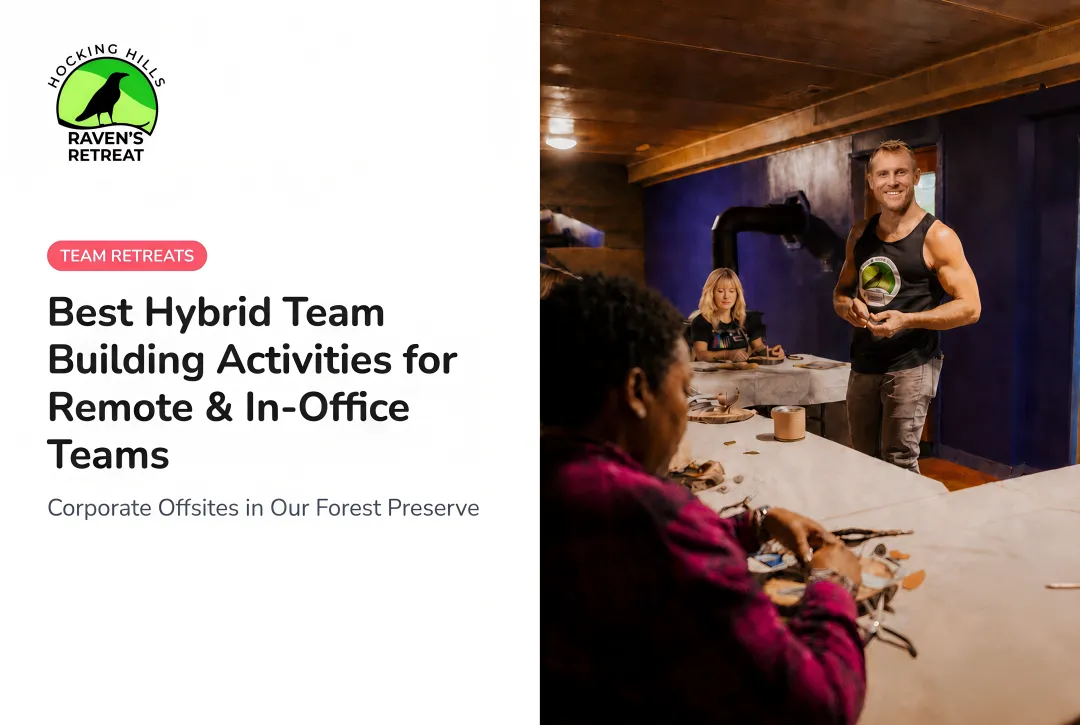
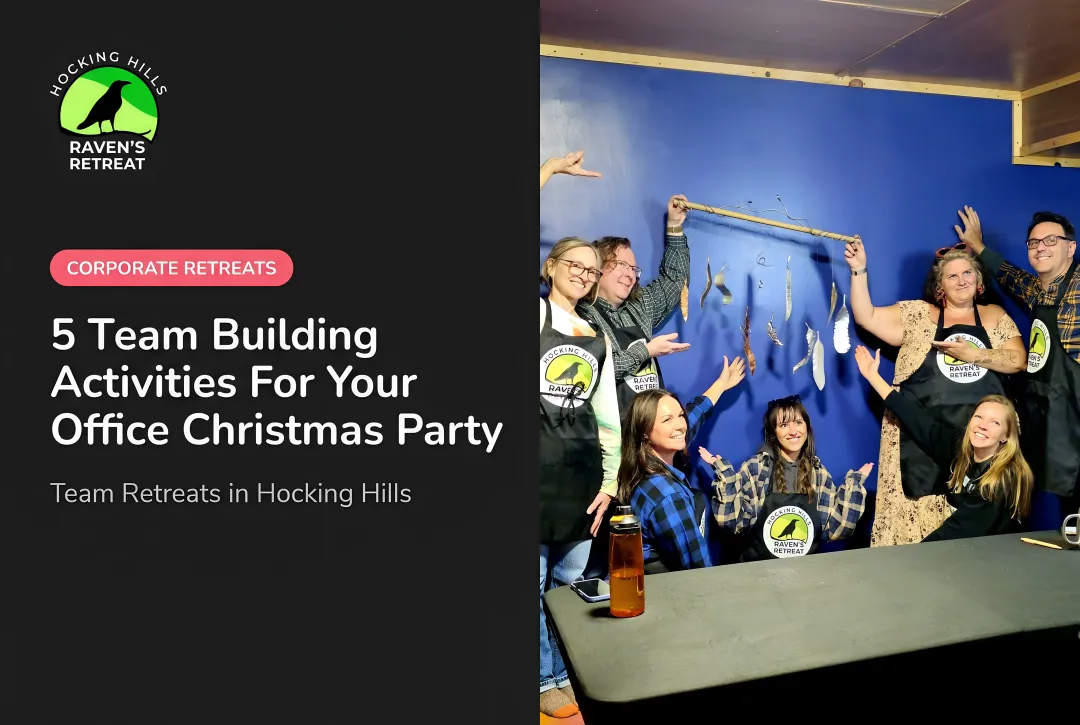
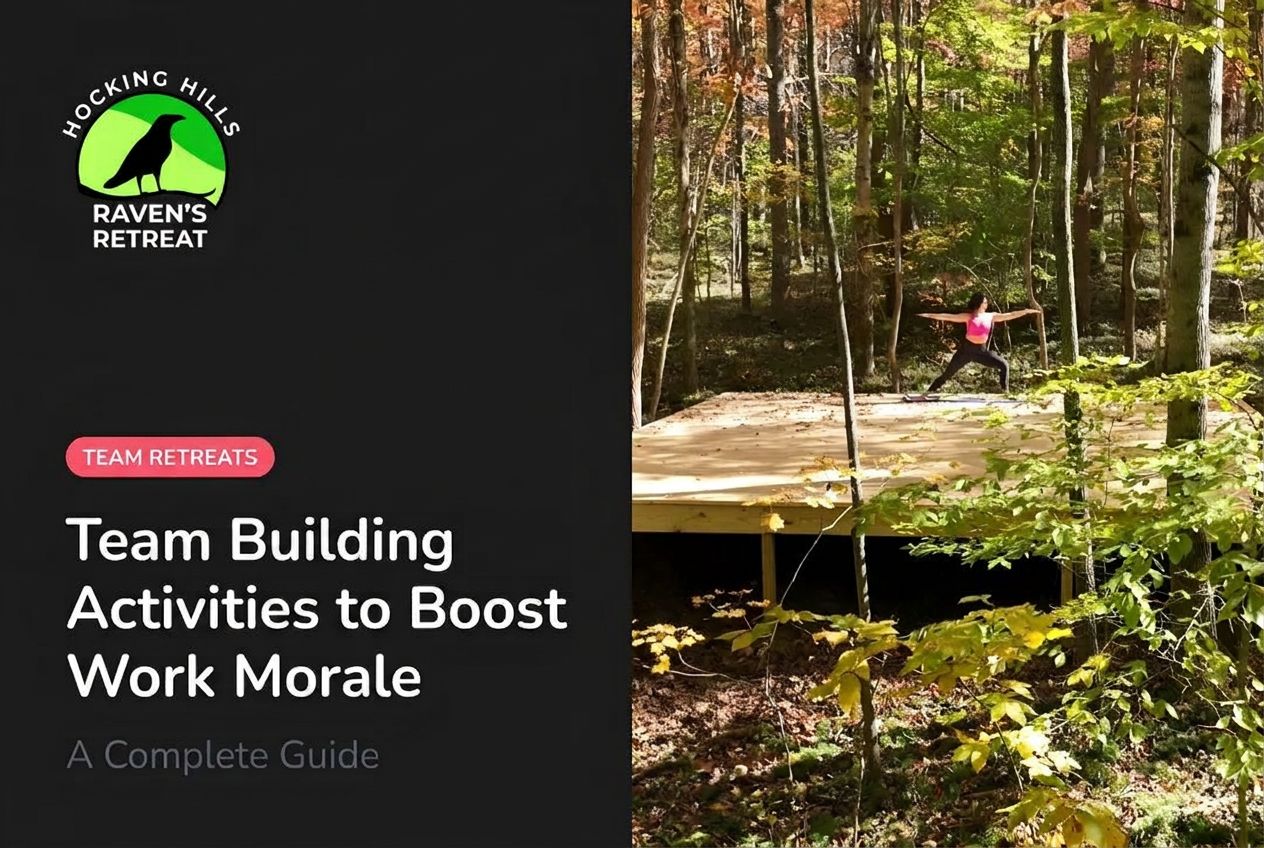
At Raven's Retreat Hocking Hills, the scavenger hunt is designed specifically to leverage the 58-acre preserve's diverse landscape — over a mile of private trails, forest platforms, and natural terrain features that create natural waypoints across the challenge. Quieter analytical team members often excel at solving the logic components; creative thinkers spot clues hidden in wordplay or visual elements. The activity naturally surfaces different strengths across the team.
Desert Island Survival Discussion
The team receives a list of 15-20 items and must collectively agree on only 5 to keep for survival on a desert island. No individual answer is correct — the group must negotiate their way to genuine consensus.
The activity forces specific communication behaviors:
- Quieter members must advocate for their reasoning
- Natural leaders must listen rather than default to authority
- Everyone negotiates toward shared consensus, not individual wins
The debrief question — "whose ideas got heard, and why?" — often surfaces honest reflection that teams rarely have permission to voice in normal meetings.
Collaborative Improv Storytelling
Each person builds on the previous person's contribution using only "yes, and..." — accepting what came before and adding to it. Redirecting or contradicting breaks the exercise.
Improv-based methods have shown benefits for communication, teamwork, and listening in professional training contexts. For workplace teams, the most applicable effect is this: it trains people to build on others' ideas rather than dismiss or redirect them — a pattern that plagues team meetings and brainstorming sessions more than most teams realize.
Creative Observation and Expression Activities
Art-engagement activities create a rare space where there are no wrong answers. When a team observes a sculpture together and each person shares what they see or feel, the usual performance pressure disappears. People communicate what's genuinely true for them rather than what sounds correct or professional.
Raven's Retreat Hocking Hills offers exactly this through live sculpture performances by co-founder and master sculptor Dustin Weatherby. Over a few hours, corporate teams watch a raw log transform into a finished sculpture — a real-time demonstration of creative problem-solving, patience, and adaptation. The immersive art installations within the property (hand-forged sculptures, wood carvings, and tile murals) provide ongoing focal points for guided interpretation tours and facilitated team discussion throughout the retreat.
Leadership groups and intact teams can book a full property buyout — exclusive access to the entire 58-acre preserve with overnight lodging for up to 18 guests, creating the kind of undistracted environment where real communication breakthroughs tend to happen.
How to Pick the Right Activity for Your Team's Communication Gap
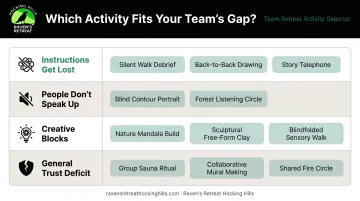
Use this decision framework to match activities to your team's actual problem:
| Communication Problem | Recommended Activities |
|---|---|
| Instructions get lost or misinterpreted | Back-to-Back Drawing, Telephone Game, "Can You Hear Me Now?" |
| People don't speak up or relationships feel surface-level | Elephant in the Room, Two Truths and a Lie, Human Knot |
| Creative blocks, stagnation, or rigid dynamics | Scavenger Hunt, Improv Storytelling, Creative Observation |
| General trust deficit affecting all communication | Minefield, Blind Drawing, Desert Island Survival |
Logistics and Group Size
Group size shapes which activities actually work — a Minefield exercise lands differently with 8 people than with 40.
- Small teams (6–15): Human Knot, Active Listening Pairs, Minefield
- Mid-size groups (15–30): Story Chain, "Can You Hear Me Now?", Scavenger Hunt
- Larger groups (30+): Desert Island Survival, Scavenger Hunt, group improv formats
If logistics are the bottleneck, an all-inclusive format removes the friction. Raven's Retreat Hocking Hills offers full-day team retreats for groups of up to 20, bundling meals, creative workshops, wellness experiences, and structured activities into one coordinated experience on a 58-acre nature preserve in Hocking Hills, Ohio.
Always Debrief
A 2013 meta-analysis of 46 samples (N=2,136) confirmed that debriefs improve team effectiveness. Without one, the activity is entertainment. With one, it becomes a behavior shift.
Effective debrief questions:
- Where did communication break down?
- What did you assume your partner understood that they didn't?
- How does this show up in our actual work?
- What's one thing you'll do differently in your next meeting?
Tips for Making Communication Improvements Stick
Build Consistency Into the Calendar
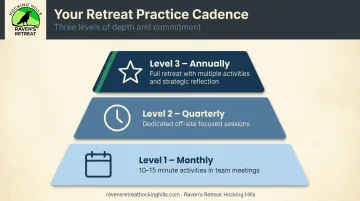
A single session creates awareness. Repeated practice changes norms. Spaced practice shows a meaningful advantage over massed practice — and the same principle applies to communication skill development. The structure that tends to work:
- Monthly: 10-15 minute activities embedded into existing team meetings
- Quarterly: Deeper, dedicated sessions — ideally off-site — focused on a specific skill area
- Annually: A full retreat that combines multiple activities, creative experiences, and strategic reflection
Leaders Have to Participate Visibly
Research by Nembhard and Edmondson found that leader inclusiveness — actively inviting and valuing others' contributions — directly affects psychological safety and team improvement efforts. When managers engage in vulnerable activities like Elephant in the Room instead of facilitating from the side, it signals that honest communication is genuinely valued from the top.
A 2022 multilevel study of 356 employees across 90 teams confirmed this directly: inclusive leadership predicts both psychological safety and innovative performance. Leaders who model the communication behaviors they want will consistently get more of them.
Bridge the Activity to Real Work
After any session, ask the team to identify one specific communication habit they'll practice in their next project or meeting. Make it concrete:
- "I'll ask one clarifying question before assuming I understood the brief."
- "I'll summarize what I heard before responding in our next difficult conversation."
- "I'll wait for three seconds of silence before filling it in team discussions."
Without this step, even the best session stays in the room. With it, the behavior has a chance to travel back to Monday morning.
Frequently Asked Questions
What are the 10 communication team-building activities?
Ten high-impact communication activities covered in this guide include: Back-to-Back Drawing, Active Listening Pairs, Telephone Game, Shift Story Chain, "Can You Hear Me Now?", The Minefield, Human Knot, Elephant in the Room, Desert Island Survival, and Collaborative Improv Storytelling. Each targets a specific communication skill rather than communication in general.
What are the 7 C's of communication activities?
The 7 C's framework (Clear, Concise, Concrete, Correct, Coherent, Complete, and Courteous) describes the qualities of effective communication. Activities like Back-to-Back Drawing and "Can You Hear Me Now?" help teams internalize these principles through direct practice. The gap between intent and result becomes immediately visible — which is far more instructive than theory alone.
How often should teams do communication-focused team-building activities?
Short activities work well monthly, embedded into regular team meetings. Deeper dedicated sessions are most effective quarterly. Frequency matters more than duration — consistent practice over time changes communication norms in a way that one-off events cannot.
What makes an off-site team-building retreat more effective than in-office activities?
Off-site settings remove the status cues and daily work triggers that keep people guarded. Nature-based environments have been shown to improve attention, creativity, and interpersonal connection. Immersive settings like art-centered nature preserves deepen this effect by placing teams in unfamiliar, creative contexts that naturally lower defensive communication.
How do you measure whether communication team-building activities actually worked?
Use pre- and post-activity reflection prompts to establish a baseline. Track specific behaviors in subsequent meetings — fewer interruptions, more clarifying questions, more honest disagreements aired early. Run a brief team survey 4-6 weeks after a session to assess whether communication patterns have genuinely shifted.