Introduction
Most adults now spend roughly 90% of their time indoors, according to the EPA — and that's before factoring in screens. When leisure hours default to passive consumption, the body stays locked in a low-grade stress response that accumulates quietly over weeks and months.
Forest therapy offers a different path. Rooted in Shinrin-yoku (coined in 1982 by Japan's Forest Agency), it's a research-backed approach to restoring well-being through intentional sensory immersion in nature. Unlike hiking, the goal isn't distance — it's presence. You might spend an hour within a quarter mile.
A 2019 University of Michigan study found that just 20 minutes of nature contact significantly lowered cortisol levels — with measurable reductions in blood pressure and reported mood improvements as well.
This guide covers 10 forest therapy activities — from breathing and grounding to nature art and reciprocity — that anyone can practice solo or in a group. Each activity works in any wooded setting, whether that's a backyard, a local trail, or a dedicated nature preserve.
Key Takeaways
- Forest therapy is slow and sensory-focused — the goal is presence, not mileage
- Research links time in forested environments to reduced cortisol, lower blood pressure, and improved mood
- The 10 activities below range from breathwork and grounding to creative expression and reciprocity
- Sessions can be self-guided; a private natural setting deepens the experience considerably
- A dedicated forested preserve gives you uninterrupted space to move through a full session without distraction
What Is Forest Therapy?
Forest therapy is a structured, nature-based wellness practice rooted in Shinrin-yoku ("forest bathing"), developed in Japan in 1982. It uses multi-sensory engagement with a natural environment to activate the parasympathetic nervous system (the body's rest-and-digest state) and reduce the physiological markers of stress.
Forest Bathing vs. Forest Therapy
The terms are related but distinct:
- Forest bathing (Shinrin-yoku): Self-guided, restorative time in nature. Informal and accessible to anyone
- Forest therapy: Often facilitated by a certified guide (such as those trained through the Association of Nature and Forest Therapy), using structured sensory "invitations" that may serve clinical or wellness goals
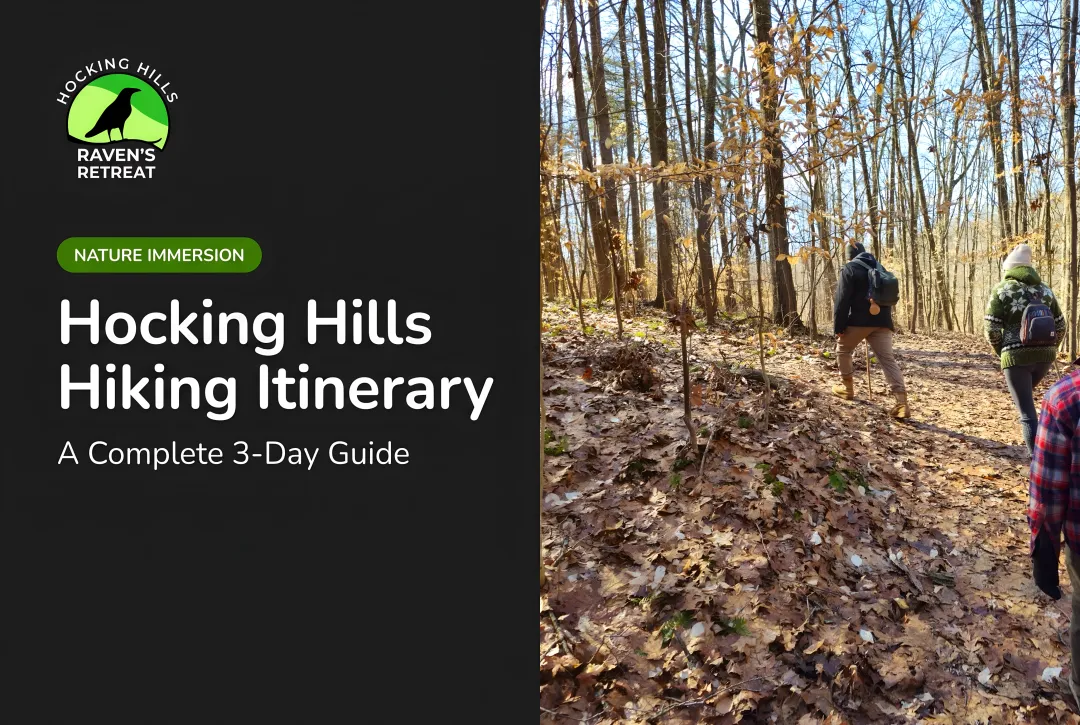
Both approaches are worth exploring. What sets either apart from a standard hike: a guided forest therapy session typically covers less than one mile over 2–4 hours, with the emphasis on embodied awareness rather than physical achievement.
All 10 activities below are designed for self-guided practice — no certification or guide required.
10 Forest Therapy Activities for Nature Connection & Wellness
These practices can be used individually, combined into a full session, or adapted for groups. They're ordered loosely — from settling and grounding first, to more expressive and relational practices toward the end.
1. Mindful Forest Breathing
Before entering a walk, certified guides often use a 2:1 breathing technique to downregulate the nervous system. Here's how:
- Inhale slowly for a count of 4
- Exhale slowly for a count of 8 (twice as long)
- Repeat for 5–10 breath cycles before beginning your walk
This pattern activates the vagus nerve and signals safety to the body.
There's an added layer to forest breathing: trees release phytoncides, airborne antimicrobial compounds like alpha-pinene and beta-pinene. Research by Dr. Qing Li found that exposure to these compounds was associated with increased natural killer (NK) cell activity and elevated anti-cancer proteins, with effects lasting more than 30 days after a 3-day forest stay.
Conifer-dense forests tend to have higher phytoncide concentrations, making them particularly well-suited for this practice.
2. Sensory Awakening
This is the foundational "arrival" practice in most guide-led forest therapy sessions. It redirects attention outward through each sense in turn.
Work through each sense slowly — allow 2–3 minutes per sense:
- Sound: What's the nearest sound? The farthest?
- Touch: Place your hand on bark, soil, or a leaf. What's the texture, temperature?
- Smell: Breathe through your nose. What scents emerge?
- Taste: Notice the quality of air on your tongue
- Sight: Only now open your gaze. What moves? What's still?
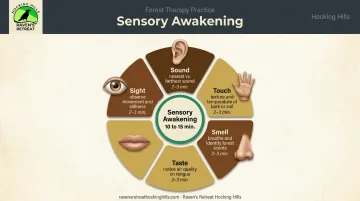
Done over 10–15 minutes, this practice shifts the nervous system from scanning for threat to open receptivity. Don't rush it.
3. Slow Walking with Intention
Cover as little ground as possible (half a mile or less). Pause frequently to notice:
- Branches swaying in wind
- Birds landing or taking flight
- Insects moving through undergrowth
- How light shifts through the canopy
A practical anchor: synchronize breath with footsteps. Try five steps per inhale, five per exhale. This rhythm keeps attention in the body and prevents the walk from becoming ordinary exercise. If your mind wanders to a to-do list, return to the breath-step count.
4. Sit Spot Practice
Choose one location and sit in stillness for at least 20 minutes. What happens is sometimes called the "slow reveal" : the longer you sit, the more the environment opens up. Shy wildlife appears. Subtle sounds emerge. Inner stillness deepens.
What makes a good sit spot:
- Partial shade (reduces sensory fatigue from direct sun)
- Proximity to natural water if possible
- Minimal human-made noise
- Somewhere you can return to repeatedly across seasons
The last point matters more than most people expect. Returning to the same spot over months creates a relationship with place : you begin to notice change, and the spot becomes familiar in a restorative way.
5. Tree Bonding
Select a single tree that draws your attention. Spend time with it through touch, observation, leaning, and quiet reflection. Notice the texture of the bark, the spread of branches, the way it moves in wind.
This practice cultivates attention, slows the nervous system, and builds what forest therapists describe as a felt sense of kinship with the living world.
Deepening variations:
- Meditate with the tree, focusing on the shared breath cycle (you exhale CO₂; the tree absorbs it)
- Sit with your back against the trunk for 10 minutes with eyes closed
- Silently share a thought, question, or intention with the tree as a non-judgmental presence
6. Grounding (Barefoot Earthing)
Remove your shoes. Make direct contact with soil, grass, or a forest floor. Stand, walk slowly, or lie down.
A 2015 review in the Journal of Inflammation Research found preliminary evidence that direct skin contact with the earth may influence inflammation markers, immune response, and autonomic balance. A 2023 review cited in Biomedical Journal also noted possible effects on cortisol rhythm and heart-rate variability.
The evidence is preliminary ; this isn't a prescription. But as an entry point for first-time forest therapy participants, 10–15 minutes of barefoot contact on safe ground reliably produces a noticeable shift in physical tension.
At Raven's Retreat Hocking Hills, the private trails wind through natural soil and forest floor , the kind of terrain that makes barefoot earthing both accessible and unhurried.
7. Forest Sound Bathing
This is a listening meditation structured in three expanding rings:
- Close: Identify every sound within arm's reach
- Middle: Expand awareness to sounds 20–50 feet away
- Far: Reach for the most distant audible sound
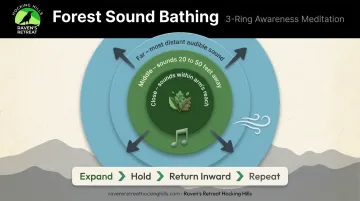
Hold attention there for a moment, then gently return inward. Repeat the sequence.
The research on this is notably consistent. A 2024 study in PLOS One found that natural soundscapes (birdsong, water, wind) produced significantly lower self-reported anxiety and stress than traffic noise ; a a 2010 study in IJERPH found faster physiological stress recovery with nature sounds versus environmental noise.
Quality of the acoustic environment matters. A forest with birdsong, water, and wind isn't just pleasant : it's doing measurable work on the nervous system.
8. Nature Journaling
Bring a small notebook. Record observations, sensory impressions, quick sketches, or short phrases. The act of recording slows perception : you start noticing things you'd have walked past.
Practical guidance:
- No artistic skill required. This isn't an art project
- Use whatever format invites you: words, rough sketches, pressed leaves, one-line poems
- Commit to short, regular entries rather than elaborate occasional ones
- Note the date, season, and location ; reviewing entries across seasons reveals surprising patterns
Nature journaling creates a growing personal record of both the environment and your inner experience within it. Over months, patterns emerge that no single visit could show you.
9. Nature Art & Creative Expression
Collect fallen leaves, stones, seed pods, and sticks. Arrange them on the ground into a pattern, mandala, or small sculpture. Use only what's already on the ground ; never disturb living plants.
The practice bridges forest therapy and creative expression. The arrangement will scatter when you leave. That's intentional : making without attachment.
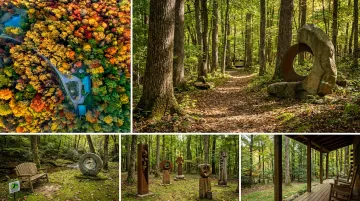
At Raven's Retreat, this relationship between art and nature is built into the property itself. Master sculptor Dustin Weatherby's installations are scattered across the forested trails: steel sculptures, wood carvings, and site-specific pieces crafted from salvaged materials.
Works like Howling Nails (a giant coyote sculpted from recycled nails) or Steel Black Locust (a floor-to-ceiling metal tree) sit alongside natural forms in a way that invites guests to see art and nature as continuous rather than separate.
10. Gratitude and Reciprocity Practice
This is a natural closing practice. Pause before leaving the forest and name what you've received. A particular tree whose shade you rested in. The creek sound that slowed your breathing. The unexpected stillness.
Then offer something in return:
- A song or spoken word of thanks
- A gesture, a bow, a moment of stillness
- A written note tucked into the earth
- A quiet promise to return with care
This isn't performative. It's a shift in orientation, from nature as backdrop to nature as relationship.
This practice is rooted in indigenous worldviews and increasingly recognized in ecotherapy as essential to building lasting nature connection. It reframes the forest visit from passive consumption to genuine exchange.
How to Get the Most from Your Forest Therapy Practice
Frequency matters more than duration. Research suggests that regular, repeated time in the same natural environment deepens the therapeutic effect over time — even 20-minute sessions several times a week produce cumulative benefits.
How you prepare shapes how deeply you arrive.
Three Preparation Principles
- Leave devices behind (or switch to airplane mode). A fitness tracker counts steps; forest therapy asks you to stop counting.
- Dress for comfort, not performance. Layers, sturdy shoes (or bare feet if the ground allows). Skip anything that signals "exercise mode."
- Come with one intention: slow down. Resist the pull to accomplish anything during the session.
Building a Full Session Arc
Combining practices creates a more complete, restorative experience. A simple sequence:
- Breathing — settles the nervous system before you enter the forest
- Sensory awakening — opens perception to what's around you
- Slow walk through the environment, moving with presence rather than purpose
- Sit spot — deepens stillness and receptivity
- A closing gratitude practice to end with intention
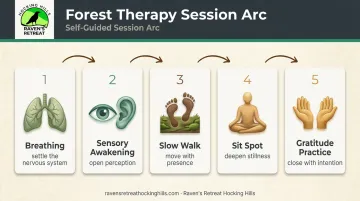
This arc mirrors what certified guides use in structured sessions. You can execute it entirely on your own.
Why a Private Retreat Setting Makes Forest Therapy More Transformative
Forest therapy can be practiced in any green space. But environment quality matters significantly. Traffic noise, other visitors, and digital interruption all raise the nervous system's activation threshold — they work directly against the physiological shift forest therapy is trying to create.
A private, acoustically clean natural environment removes that friction. The nervous system doesn't have to filter out interference before it can settle.
Raven's Retreat Hocking Hills, set on a 58-acre private preserve near Laurelville, Ohio, provides exactly this kind of environment. The preserve is exclusively available to booked guests, with no public access or outside visitors permitted.
The acoustic environment reflects that commitment: birdsong, creek water, wind through a mature hardwood canopy, and night choruses of crickets and frogs, all actively protected as part of the retreat's biodiversity conservation mission.
The property is designed to support every stage of a forest therapy session:
- Designated meditation areas along the creek for quiet, water-side sitting practice
- Over a mile of private trails with 220 feet of elevation change for immersive walking
- Dustin Weatherby's art installations throughout the forest as contemplative focal points
- Certified forest bathing sessions with ANFT-certified guide Mark Bucha
- Curated wellness sequences customizable around forest therapy goals
Accommodation options range from solo stays in the Sculptor's Art Bungalow to small-group gatherings in the Sculptor's Art Lodge (up to 16 guests), with add-on experiences tailored to your retreat intentions.
The Hocking Hills region extends the experience beyond the property itself. Old-growth sandstone gorges, moss-covered trails, and waterfall landscapes at Old Man's Cave and Conkle's Hollow are 6–14 miles away.
Frequently Asked Questions
What are forest therapy techniques?
Forest therapy techniques are structured sensory practices designed to deepen immersion in a natural environment and activate the body's relaxation response. Common practices include breathwork, slow walking, sit spot, sound listening, and nature art. Unlike hiking, the goal is presence and awareness — not movement or distance.
Is forest therapy legit?
Yes. Peer-reviewed research from Japan and South Korea shows measurable reductions in cortisol, blood pressure, and anxiety, plus improvements in immune markers. Meta-analyses in BMC Complementary Medicine and IJERPH support these findings, though effect sizes vary across studies.
What is the difference between forest therapy and hiking?
Hiking is goal-oriented physical exercise focused on covering distance or reaching a destination. Forest therapy is a slow, sensory practice that typically covers less than a mile over 2–4 hours, with the emphasis on awareness and relationship with the environment rather than fitness or achievement.
How long should a forest therapy session last?
Guided sessions typically run 2–4 hours to allow the nervous system time to settle into the environment. Research also shows 20–30 minutes of intentional, unplugged nature contact produces meaningful cortisol reduction, making shorter regular sessions worthwhile too.
Can I practice forest therapy activities on my own?
Yes. Breathing, grounding, sit spot, sound bathing, and nature journaling are all fully accessible for solo self-guided practice. A certified guide adds depth, structure, and sequencing — but significant benefits are available without one.
What should I bring to a forest therapy session?
Keep it minimal: comfortable weather-appropriate clothing, sturdy shoes (or the willingness to go barefoot on safe ground), a journal and pen if you journal, and water. Leave headphones, fitness trackers, and phones behind — or at least on airplane mode. The most important thing to bring is the absence of an agenda.