Introduction
Remote colleagues joining a Zoom call while their in-office teammates bond over lunch — that gap is familiar to most hybrid team managers, and a forced icebreaker rarely closes it.
The problem isn't effort. It's design. Hybrid team building fails when activities are built for one context and awkwardly adapted for the other. According to Microsoft's 2022 Work Trend Index, 43% of remote employees and 44% of hybrid employees don't feel included in meetings — and only 27% of organizations had even created hybrid meeting etiquette at the time of the study.
Gallup reports that 52% of U.S. remote-capable employees now work hybrid, which makes designing for both contexts a core management skill — not a nice-to-have.
This guide covers hybrid team building activities across four formats: quick energizers, collaborative problem-solving, creative expression, and immersive in-person anchor experiences for teams ready to invest in something that lasts.
Key Takeaways
- Remote participants need equally meaningful roles, not just camera access to an in-person activity
- Strong hybrid activities fall into three categories: icebreakers, problem-solving, and creative expression — each suited to a different time budget
- A periodic in-person retreat creates shared emotional memory that regular virtual check-ins can't replicate
- Clear roles and structured facilitation matter more than which platform or tool you use
- Consistency beats intensity — short weekly rituals build stronger teams than infrequent elaborate events
Why Hybrid Team Building Is Uniquely Challenging
Hybrid facilitation is harder than either purely virtual or purely in-person formats. The reason isn't technology: it's that you're designing three simultaneous experiences at once: what in-person participants feel, what remote participants feel, and how those two groups interact.
Most activities only solve one of the three.
The Two Most Common Failure Modes
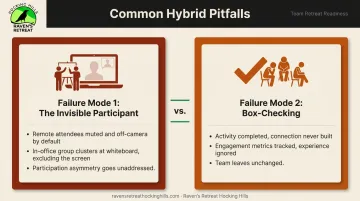
Failure Mode 1: The invisible participant. The in-person group naturally gravitates toward each other — side conversations, shared whiteboards, body language cues. Remote participants end up watching rather than contributing. After 20 minutes, they've disengaged.
Failure Mode 2: Box-checking that backfires. Generic icebreakers signal to the team that leadership checked a box rather than thought through their actual experience. Participants comply without connecting, and trust takes a small but real hit.
These aren't hypothetical concerns. Microsoft found that 43% of remote leaders identified relationship-building as the greatest challenge in hybrid work — and that only 37% of in-person employee comments about necessary in-office time were about social and team-building activities. The appetite exists. The design usually doesn't match it.
Why It Matters Now
Hybrid work isn't a temporary accommodation. Gallup's 2025 data shows hybrid arrangements holding steady at roughly 51-52% among remote-capable workers, with no meaningful retreat in sight.
For the average manager, that means their team's daily experience is split between two contexts, indefinitely. Activities that only work in one context aren't team building. They're in-group bonding with a live audience.
Best Hybrid Team Building Activities for Remote & In-Office Teams
Every activity below meets the same bar: remote and in-person participants carry equal weight, tech overhead stays low, and the skills practiced show up in real collaboration afterward.
Quick Icebreakers and Energizers
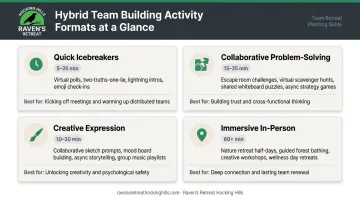
Hybrid Scavenger Hunt (15–20 minutes)
Divide participants into mixed teams — pair at least one remote member with one in-person member per team. In-office players hunt for physical objects around their workspace; remote participants search for digital equivalents (images, short videos, trivia). Teams combine both finds to score points.
The format works because it doesn't pretend both contexts are identical — it treats the differences as advantages. Your existing video platform is all you need.
Object Challenge / Touch Blue (5–10 minutes)
Give a prompt: "Find something that represents a recent win" or "Hold up something older than you." Remote participants search their home workspace; in-office attendees explore their environment. The facilitator uses the gap between what each group finds as a genuine conversation starter about context, environment, and what shapes how people work.
No materials. No setup. Works inside any meeting that needs a reset.
Collaborative Problem-Solving Activities
Consensus Challenge (15–25 minutes)
Present the whole team with a ranking exercise — survival scenario items, product feature priorities, or budget allocation. Remote participants collaborate on a shared Miro board or Google Doc; in-office participants work at a physical whiteboard.
Both groups must converge on a single team ranking within a time limit.
The debrief question matters as much as the activity itself: What communication strategies actually worked across formats? This is where real collaboration insight surfaces.
Innovation Tournament (25–35 minutes)
Form mixed-format teams of 3–4 (at least one remote, at least one in-person). Each team gets 10 minutes to brainstorm a real team challenge. Two-minute presentations follow, with the full group voting via a polling tool. Run two rounds for a tournament structure.
What makes this format work: the problem is real, the pressure is brief, and the mixed-format teaming forces people to adapt their communication style on the spot — which is exactly what hybrid collaboration requires every day.
Creative Expression and Connection Activities
Collaborative Storytelling (20–30 minutes)
Start a shared story: "It was the day our team finally cracked [Project X]..." Pass it around the full group, alternating between remote and in-person participants. Remote members type their sentence in a shared doc; an in-person scribe adds spoken contributions. The resulting story usually reveals team values and inside references in a way that feels earned rather than forced.
Blind Drawing (10–15 minutes)
Pair a remote participant with an in-person participant. One describes an image without naming it; the other draws. Swap roles. The debrief question: Was it harder or easier to give instructions across formats — and what does that tell us about how we actually communicate day to day?
Use this to open a quick conversation about communication norms across your hybrid setup — five minutes is enough to surface something useful.
Activities like Blind Drawing and Collaborative Storytelling also translate well when a team moves an activity format into a full in-person setting — like a creative retreat where the constraints of split-screen communication drop away and the focus shifts entirely to the work in the room.
Immersive In-Person Activities to Anchor Your Hybrid Team Retreat
Microsoft found that 85% of employees would be motivated to go into the office to rebuild team bonds, and 84% cited socializing with coworkers. That motivation points at something real: periodic in-person experiences create a kind of shared emotional memory that video calls can't manufacture.
One well-designed retreat becomes a reference point the team draws on for months. It changes how people communicate remotely, because they now have a real shared experience to anchor their mental model of each other.
Nature-Based Team Experiences
Guided Paired Walks with Discussion Prompts
Send in-person attendees on structured paired walks with a conversation prompt — "What has this project taught you about how we work together?" — while remote teammates join one-on-one via phone for a parallel walking chat with a paired colleague.
The outdoor, informal setting opens conversations that structured meetings can't reach. At Raven's Retreat Hocking Hills, the 58-acre private nature preserve offers over a mile of trails with 220 feet of elevation change, dedicated wellness paths, forest meditation zones, and guided forest bathing led by certified ANFT-trained practitioners.
The secluded Hocking Hills setting naturally reduces distraction. Job titles fade, and genuine conversation becomes easier.
Sensory Observation Exercise (20 minutes)
In-person participants spend 20 minutes sketching, photographing, or quietly noticing details of the natural environment. Remote participants do a parallel version — sketching their own surroundings or selecting three images that represent their current mental state. Teams then share and compare.
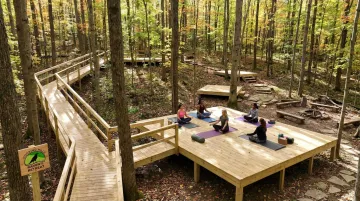
The juxtaposition of environments — a forest creek bed versus a home office — generates genuine curiosity rather than performed interest. Few exercises build empathy between cohorts as directly as this one. Raven's Retreat's deep-forest meditation areas and elevated forest platform provide ideal settings for the in-person side of this experience.
Art-Inspired Team Activities
Live Sculpture Performance as Shared Creative Experience
Bring in a live artist to demonstrate their process in front of the in-person group while streaming to remote participants. Both groups submit questions in real time and reflect afterward on how the creative process — the patience, adaptation, and problem-solving — mirrors their own team dynamics.
Raven's Retreat co-owner and master sculptor Dustin Weatherby offers live sculpture performances as a signature retreat experience, transforming a raw log into a finished piece over a few hours. With over 25 years of professional work and credits including Disney+ and the History Channel, his performances are built specifically for team audiences.
What makes this format valuable is what it models: creative risk-taking, iteration under pressure, and the patience to let something unfinished become something complete — exactly the qualities leadership teams say they want to cultivate. Teams can commission the finished piece and take it home as a permanent retreat memento.
The property's Wi-Fi (300+ Mbps) supports streaming for remote participants to join portions of the experience in real time.
Collective Art-Making or Mosaic Activity
Assign each participant — remote and in-person — a small section of a shared visual prompt representing a team value, milestone, or aspiration. Contributions take three forms:
- In-person participants work with physical materials (paint, metal, wood, or found objects)
- All pieces combine into one shared physical installation
Raven's Retreat offers sculpting, painting, and creative activation workshops led by Dustin Weatherby, specifically structured as team-building experiences rather than art classes. The finished piece gives the team something concrete to point back to — a visual record of where they were and what they built together.
Tips to Run Hybrid Team Building Activities That Actually Stick
Design for Equal Access First
Before choosing any activity, ask: Can a remote participant contribute as meaningfully as someone in the room? If the answer is no, modify the format before you choose the tool.
Assign specific roles to prevent passive participation:
- Remote note-taker or timer
- In-person scribe for digital-first outputs
- Hybrid reporter who bridges both groups during debrief
Name Both Groups and Set Norms Explicitly
Acknowledging both cohorts at the start — and stating clear norms like "remote participants unmute before in-person participants respond" — directly improves remote engagement. Calling remote participants by name and giving them structured leadership moments — not just participation rights — makes a measurable difference in how included they feel.
Consider using distinct cohort names (anything other than "the room" and "remote") to avoid inadvertently creating in-group language.
Build a Three-Tier Rhythm
Naming norms sets the tone — but sustaining that tone requires consistent practice, not just annual effort. Structure connection at three levels:
| Tier | Frequency | Duration | Format |
|---|---|---|---|
| Weekly ritual | Every team meeting | 5 minutes | Quick energizer or check-in |
| Monthly session | Once per month | 30 minutes | Structured bonding activity |
| Anchor event | 1–2 times per year | Full day or multi-day | Immersive in-person retreat |
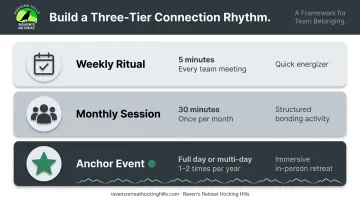
HBS research confirms that team rituals fortify bonds and create shared meaning — but the key word is ritual. Consistency creates the effect. A single well-designed event sparks connection; a consistent rhythm builds it.
How to Choose the Right Activity for Your Team
Match the activity format to where your team actually is in its development.
| Team Stage | Best Formats |
|---|---|
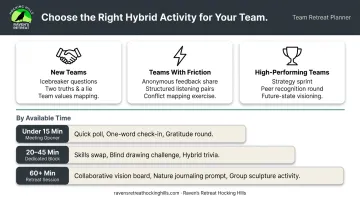
| New or recently assembled | Object Challenge, Blind Drawing, Hybrid Scavenger Hunt — low-stakes, get-to-know-you |
| Established teams with friction | Consensus Challenge, Innovation Tournament — surfaces real decision-making and communication patterns |
| High-performing teams | Live art experiences, themed collaborative storytelling, sensory reflection exercises |
Time-based decision guide:
- Under 15 minutes → Meeting opener energizer (Object Challenge, Touch Blue)
- 20–45 minutes → Dedicated team building block (Consensus Challenge, Storytelling, Innovation Tournament)
- 60 minutes or more → Retreat or quarterly planning session (Sculpture demo, nature walks, collective art-making)
For hybrid teams of 16 or more, parallel small-group formats with full-group reporting consistently outperform single-group activities. The larger the group, the more passive any given participant becomes.
Planning the in-person anchor event for your hybrid team? Raven's Retreat Hocking Hills offers a 58-acre private nature preserve in Hocking Hills, Ohio, with full property buyout for day retreats and overnight accommodations for up to 18 guests, customizable wellness and creative programming, and Wi-Fi (300+ Mbps) to keep distributed teams connected. Reach out at stay@ravensretreathockinghills.com or call 614-783-6143 to discuss corporate retreat availability.
Frequently Asked Questions
What are some fun hybrid team building activities for work?
The Hybrid Scavenger Hunt, Blind Drawing, Collaborative Storytelling, and Consensus Challenge are among the most effective options. What separates genuinely good hybrid activities from awkward adaptations is role design. Remote and in-person participants need equally active, meaningful contributions — not just the same task viewed through different cameras.
What are the 5 C's of team building?
Gallup's practitioner framework identifies five elements of effective teamwork: Common Purpose, Connection, Communication, Collaboration, and Celebration. In hybrid contexts, each one faces a distinct pressure — connection and communication are most visibly strained when teams split between remote and in-office work environments.
What is the 20 Questions game for team building?
One person thinks of a person, place, or object; the team asks up to 20 yes/no questions to identify it. It requires no materials, works equally well over video, and runs in under 10 minutes — making it a solid quick energizer for established teams who need a low-effort way to start a meeting on a lighter note.
How do you make hybrid team building feel fair for remote employees?
Assign active roles to remote participants before the activity begins — not as an afterthought. Use shared digital tools so remote employees are collaborating alongside in-person participants, not watching. Name both cohorts explicitly at the start, and set a norm that remote participants respond first in any debrief or discussion round.
How often should hybrid teams do team building activities?
A tiered approach works better than any single frequency: a 5-minute ritual weekly, a 30-minute structured session monthly, and a full immersive experience once or twice a year. Consistency matters more than duration. Brief weekly contact builds stronger cohesion over time than an elaborate annual event with nothing in between.