
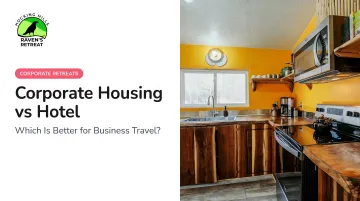
The right accommodation depends on three things: how long the trip is, what the traveler needs to do while there, and whether one person or a team is going. Get those right, and the choice becomes straightforward.
This article breaks down what corporate housing and hotels actually offer, how costs compare across different stay lengths, and a practical framework for choosing — plus a third option worth knowing about when the goal is team transformation rather than just a place to sleep.
Key Takeaways
- Hotels win for trips under two weeks — especially when flexibility, location, and loyalty points matter
- Corporate housing typically costs less than a hotel after 30 days, with far more space and livability
- The two-to-four-week window is a gray zone where individual needs should drive the decision
- For teams, shared accommodations in one location improve cohesion more than scattered hotel rooms across different floors
- When the goal is strategic planning or leadership renewal, a purpose-built retreat setting outperforms both
Corporate Housing vs. Hotel: At a Glance
| Factor | Corporate Housing | Hotel |
|---|---|---|
| Minimum stay | 30 days (industry standard) | No minimum — nightly bookings |
| Cost structure | Flat monthly rate, utilities included | Per-night rate, costs scale linearly |
| Space and layout | Full apartment or home, 700–1,200+ sq ft | Standard room, typically ~300 sq ft |
| Amenities included | Full kitchen, in-unit laundry, living area | Daily housekeeping, on-site dining |
| Flexibility | Low — monthly commitments | High — cancel or extend easily |
| Best for | Assignments of 30+ days, teams, extended work | Short trips of 1–7 days, conferences |
| Booking lead time | Days to weeks in advance | Same-day to days |
The right choice depends entirely on the trip. A consultant on a 10-week project has completely different needs than a sales rep flying in for a two-day client meeting. Trip duration, daily routine, and whether you're traveling solo or with a team all determine which option delivers more value.
What Is Corporate Housing?
The Corporate Housing Providers Association (CHPA) defines corporate housing as professionally managed, fully furnished, temporary residential-style accommodation — typically apartments, condos, or single-family homes — for stays of 30 days or more, inclusive of furniture, housewares, utilities, high-speed internet, and kitchens.
"Furnished accommodation" can mean a lot of things. Corporate housing means a full kitchen — not a microwave and mini-fridge — plus in-unit laundry, a separate living area and workspace, and a real bedroom. For someone on a 60- or 90-day assignment, that's the difference between feeling settled and living out of a suitcase.
How It Differs from Extended Stay Hotels
Extended stay hotels, think brands in the Marriott or IHG portfolio, occupy a middle ground. They're hotel-managed environments with kitchenettes, slightly more space, and weekly housekeeping. But a kitchenette isn't a kitchen. It's a two-burner cooktop and a compact fridge, not a setup where someone can realistically cook for themselves over three months.
Corporate housing provides a genuine residential feel with more square footage per dollar. CHPA notes that corporate housing units can be double the square footage of hotel rooms and suite hotels, without the hotel-corridor atmosphere that makes extended stays feel transient. Demand for this category is growing, too. CHPA's October 2024 forecast projects rising need for extended business stays, particularly in tech and healthcare, with cities like Phoenix, Denver, and Las Vegas expecting growth of up to 6%.
When Corporate Housing Makes Sense
Corporate housing fits a specific set of scenarios:
- Extended project assignments of 60–90+ days where stability matters
- Employee relocation transitions before permanent housing is secured
- Multi-month consulting engagements in a single market
- Traveling healthcare or government professionals who need consistency
- Small project teams who can share a unit and maintain a shared working rhythm
On cost: using GSA FY2024 Atlanta lodging rates ($173–$199/night) versus Furnished Finder's Atlanta monthly average ($1,900/month), the difference becomes clear across stay lengths:
| Stay length | Hotel cost (excl. taxes) | Corporate housing cost |
|---|---|---|
| 7 nights | $1,211–$1,393 | $1,900 |
| 14 nights | $2,422–$2,786 | $1,900 |
| 30 nights | $5,190–$5,970 | $1,900 |
| 60 nights | $10,380–$11,940 | $3,800 |
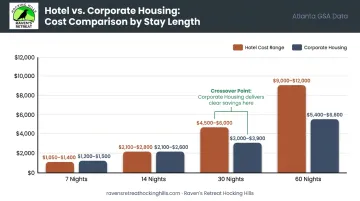
The hotel is cheaper at seven nights. By two weeks, the numbers are nearly even. Beyond 30 days, the gap becomes hard to justify.
Hotels for Business Travel: What You're Actually Getting
Hotels make sense for the majority of business trips. GBTA data shows that 40% of business trips are three-to-five-night stays and 32% are two nights. For those trips, the hotel value proposition is clear:
- No minimum commitment — book tonight, leave tomorrow
- Daily housekeeping and on-site dining without any coordination
- Proximity to urban business districts and conference venues
- Loyalty programs, which GBTA research shows influence 82% of business travelers' booking decisions
For short, logistics-intensive trips, those advantages are real.
Where Hotels Fall Short
The limitations show up fast on anything beyond a week:
- Space: SiteMinder reports the average U.S. hotel room is ~300 sq ft — a standard room offers no separation between sleeping, working, and relaxing
- No cooking: Three meals a day in restaurants or room service compounds costs and disrupts any attempt at a normal routine
- Linear cost scaling: A $180/night rate doesn't get cheaper at night 20 or night 40
- Mental fatigue: A hotel environment is designed to feel transient, which works fine for two nights but becomes taxing over two months
Hotels are the right call for:
- Trips of one to seven days
- Conference attendance where venue proximity matters
- Last-minute bookings
- Any scenario where flexibility and same-day check-in outweigh space and cost efficiency
Corporate Housing vs. Hotel: How to Choose
Trip Duration
The general rule: hotels make sense under two weeks, corporate housing starts to deliver clear value at 30 days and beyond. The two-to-four-week gray zone requires a closer look at the remaining factors below.
Cost Comparison
The Atlanta cost table above illustrates the pattern. At seven nights, corporate housing costs more. By 30 nights, it costs roughly one-third of a comparable hotel stay. For a 60-day assignment, the difference is over $6,000–$8,000 — in a single market, for a single traveler. Multiply that across a team or a full year of extended assignments, and the savings become a meaningful line item on any travel budget.
Lifestyle and Productivity
GBTA research found 87% of travelers believe the quality of their travel directly impacts business results — and that almost 75% of staff in a World Bank study reported high or very high stress from business travel. Accommodation quality isn't separate from performance; it's part of it.
Travelers who need to:
- Cook meals to manage diet, budget, or health needs
- Do laundry without using a hotel service or laundromat
- Hold video calls without hallway noise or a bed as the background
- Maintain any semblance of a normal routine
...will find corporate housing meaningfully more livable over a month-plus assignment. Small daily frictions add up fast — and so does the relief of not having them.
Group vs. Individual Travel
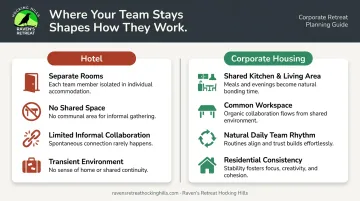
Hotel blocks distribute team members across different rooms and floors. The informal collaboration that builds project momentum — quick check-ins, shared meals, working through a problem at the end of the day — disappears when everyone retreats to separate rooms.
Corporate housing addresses this directly. A shared kitchen, common workspace, and consistent daily rhythm keep small teams connected in ways a hotel hallway never will. On a 60-day project engagement, that cohesion has real operational value.
Choose a Hotel If...
- The trip is seven days or fewer
- Location flexibility or last-minute booking is essential
- Loyalty points and on-site dining are priorities
- It's a solo traveler attending a conference in a specific venue district
Choose Corporate Housing If...
- The stay is 30 days or longer
- A team of two or more people is traveling together
- Cooking, laundry, or a quiet dedicated workspace is required
- Budget management over a full month matters
When Your Team Needs More Than a Room
Hotels and corporate housing solve the same basic problem: a place to sleep and work while away from home. But neither is built for what teams actually need from a high-stakes offsite — strategic realignment, creative breakthroughs, or the kind of leadership renewal that requires a genuine break from the everyday environment.
Harvard Business Review notes that remote and hybrid work has made it significantly harder for employees to build meaningful connections, and frames offsites specifically as tools for connection and collaboration. Emburse's 2025 corporate offsites report found that 85% of employees say offsites strengthen organizational connections — and high-performing companies host an average of 2.8 offsites annually versus 2.4 for underperforming ones.
A hotel conference room doesn't change what the meeting feels like. It's still fluorescent lighting, rectangular tables, and the same cognitive environment teams operate in every day.
What a Dedicated Retreat Venue Provides
A purpose-built retreat venue serves a different function entirely:
- Shifts thinking through environment design, not just shelter
- Natural surroundings that reduce cortisol and restore mental clarity
- Indoor and outdoor spaces built for workshops, not just presentations
- Wellness programming that supports recovery alongside strategic work
- Lodging, food, facilitation, and activities coordinated in one place
A peer-reviewed PLOS ONE study found that four days of nature immersion increased performance on creative problem-solving tasks by 50%. That's the kind of outcome a hotel conference room can't produce.
Raven's Retreat Hocking Hills
For teams in the Midwest or within driving distance of Ohio, Raven's Retreat Hocking Hills represents this category well. Set on a 58-acre private nature preserve near Laurelville, Ohio, the retreat accommodates corporate teams in the Sculptor's Art Lodge — a 4,000-square-foot, handcrafted space sleeping up to 16 guests across six bedrooms.
The distinction from a hotel offsite goes well beyond location:
- Full property buyout available for groups up to 30 (18 overnight on-site)
- High-speed Wi-Fi (300+ Mbps) with presentation screens and conference setup
- Flexible indoor and outdoor meeting spaces — including a 24×24-foot elevated forest yoga platform and the Shala gathering space inside the lodge
- Customizable wellness programming — guided meditation, forest bathing, somatic breathwork, NLP coaching, sound healing
- Live sculpture performances by master sculptor Dustin Weatherby, where teams watch a raw log transform into finished art — a direct, visible demonstration of creativity, problem-solving, and adaptation
- Plant-based chef catering coordinated for the full team
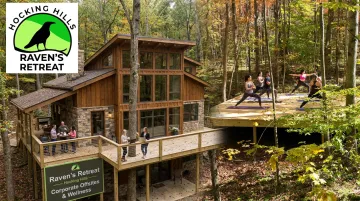
One corporate retreat guest summarized it: "We held a 2-day small corporate retreat. Planning was easy and our team left feeling recharged, focused, and more connected than ever."
When the goal is team connection and strategic clarity rather than just logistics, the venue itself becomes part of the work.
Conclusion
There's no universal winner. Hotels are the right call for short, city-based trips where flexibility and convenience come first. Corporate housing takes over for extended assignments — 30 days and beyond — where cost, livability, and space efficiency matter. And when the purpose of the trip is team transformation rather than task completion, neither of those options is designed for the job.
Accommodation is a strategic decision, not just a logistical checkbox. Where employees sleep, eat, and work during a business trip shapes how they perform, how they recover, and whether they come back ready to lead — or just relieved to be home. The teams that get this right don't pick an accommodation and hope for the best. They match the environment to the outcome they're actually trying to create.
For corporate groups focused on that third category — offsite leadership development, creative reset, or culture-building — places like Raven's Retreat Hocking Hills offer what hotels and corporate apartments don't: a dedicated environment designed around transformation, not transit.
Frequently Asked Questions
How does corporate housing work?
Corporate housing is booked through a provider or platform for stays of 30 days or more, with all furnishings, utilities, and amenities included in a monthly rate. For business travel, employers or HR teams typically arrange it as part of a project assignment or relocation.
What does corporate housing look like?
Corporate housing typically looks like a fully furnished apartment, condo, or single-family home — with a real kitchen, living area, bedroom(s), dedicated workspace, and in-unit laundry.
Is corporate housing cheaper than a hotel?
For stays of 30 days or more, yes. A monthly corporate housing rate bundles all utilities and amenities, while hotel costs compound nightly with no discount for extended stays. In Atlanta, for example, 30 hotel nights at GSA rates can cost over $5,000 versus roughly $1,900 for a furnished unit.
Who pays for corporate housing during business travel?
Employers typically cover corporate housing as a travel or relocation expense for project assignments, consulting engagements, or relocation transitions. Individuals pay out-of-pocket for personal needs like home renovations or medical stays.
How long do people typically stay in corporate housing?
The minimum stay is typically 30 days. The Corporate Housing Providers Association (CHPA) puts the average stay at approximately 78–86 nights — roughly two to three months — though assignments can extend to 12 months.
What is the difference between corporate housing and an extended stay hotel?
Extended stay hotels offer kitchenettes and a hotel-style environment. Corporate housing provides a full residential setup — complete kitchen, in-unit laundry, separate living spaces — with more square footage at a better cost per night for stays of 30 days or more.