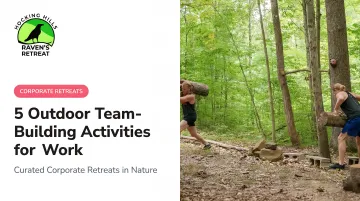
Natural environments lower the psychological barriers that offices create. When people step away from their desks, conversations open up, leadership emerges differently, and connection happens more authentically. Research on nature exposure consistently links time in natural settings to reduced cortisol, lower anxiety, and increased social engagement — all conditions that make team-building actually land.
The business case is real, too. Gallup's Q12 meta-analysis of over 100,000 teams found that highly engaged business units show 23% higher profitability and 18% higher sales productivity than lower-engagement counterparts. While engagement is multi-factorial, purposeful shared experiences are a meaningful lever.
This post covers five outdoor team-building activities — a nature scavenger hunt, guided yoga or mindfulness walk, collaborative nature art challenge, team hiking with a reflective debrief, and campfire storytelling — plus a practical framework for choosing the right one for your group.
Key Takeaways
- Outdoor activities reduce psychological barriers that office settings create, making real connection easier
- Nature exposure measurably cuts stress hormones and boosts creative thinking, so the setting itself accelerates what your team can accomplish
- The five activities here balance physical engagement, creative thinking, and emotional connection — all with minimal equipment
- A structured debrief after any activity increases what teams retain and carry back to work
- Where you go shapes what's possible — a private nature preserve with designed trails and immersive surroundings deepens every activity's impact
Why Outdoor Team Building Works for Corporate Teams
The Psychology of Getting Outside
Office settings carry implicit hierarchy. The conference table, the PowerPoint deck, the performance review sitting somewhere in the background — all of it shapes how people talk to each other. Remove those cues, and rank flattens. People stop performing for the room and start actually engaging with it.
Attention Restoration Theory explains part of this: natural environments restore directed attention by engaging effortless, involuntary focus. Employees who spend their days in sustained cognitive effort — managing priorities, reading emails, sitting in meetings — arrive in nature already a little restored before the first activity even begins.
The social dimension matters, too. Nature exposure is linked to increased social engagement and a stronger sense of community, which creates a better foundation for everything from brainstorming to honest feedback.
What Outdoor Team Building Actually Develops
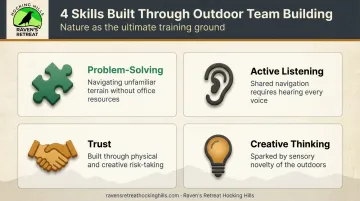
The goal isn't entertainment — it's skill development in a context that makes those skills easier to practice. Specifically:
- Problem-solving in unfamiliar terrain, without standard office resources
- Active listening, because navigation and shared challenges require it
- Trust, built through physical or creative risk-taking alongside colleagues
- Creative thinking, supported by the sensory novelty of being outdoors
Open space, natural materials, and no screens reduce the friction that structured icebreakers are designed to overcome. The conditions for connection already exist. What matters is matching the activity to what the team is actually missing — whether that's trust, communication, or just the chance to think differently together.
5 Outdoor Team-Building Activities for Work
These five activities were selected because they balance physical engagement, creative thinking, and emotional connection — while remaining achievable in a natural outdoor setting with minimal equipment.
1. Nature Scavenger Hunt
How it works: Teams split into small groups and receive a list of clues, challenges, or items to find across a natural setting — a forest property, state park, or open outdoor venue. Clues can be tied to observable elements in nature (specific trees, sounds, landmarks) or creative prompts that ask teams to photograph or collect something they've found.
The key is structure that requires teams to communicate, make decisions together, and navigate unfamiliar terrain rather than just race to a finish line.
Team-building benefits:
- Builds problem-solving and decision-making in real time
- Surfaces natural leadership tendencies as group members negotiate routes and responsibilities
- Requires active listening — different team members will notice different things
- Works well for groups of 8–25 people; runs approximately 1.5–2.5 hours
At Raven's Retreat Hocking Hills, scavenger hunts are part of the core team retreat programming. The 58-acre preserve — with four creeks, varied forest terrain, and over a mile of private trails — provides a natural setting where analytical and creative team members alike find ways to contribute.
Organizer tip: Customize clue themes around a team goal or company value. Ask teams to find something in nature that represents "resilience" or "collaboration." That reflective layer is what connects the activity back to the workplace.
2. Guided Outdoor Yoga or Mindfulness Walk
How it works: Led by a trained facilitator, the team participates in either a gentle outdoor yoga session on a forest platform or a guided mindfulness walk through a wooded trail. Participants are encouraged to observe, breathe, and engage their senses — with no performance pressure and no competitive element.
This creates shared calm rather than shared adrenaline. That distinction matters more than it sounds.
Team-building benefits:
- Lowers cortisol and reduces physical stress markers — creating a calmer, more open group dynamic
- Removes hierarchy and performance pressure, which builds psychological safety
- Creates a shared non-competitive experience that conference rooms simply can't replicate
- Especially valuable for high-stress teams, leadership groups, or as a retreat reset
A 2019 Frontiers in Psychology study found that a nature experience produced a 21.3% per hour drop in salivary cortisol beyond the normal daily decline, with 20–30 minutes being the most efficient duration. A separate small study found a 20-minute woodland walk reduced cortisol by an average of 53%.
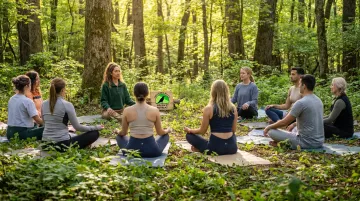
When a team experiences stillness together, something shifts in group dynamics that doesn't happen around a conference table. Harvard Business Review frames psychological safety as the foundation of high-performing teams — and shared mindfulness practices create exactly that kind of unguarded, non-hierarchical environment.
At Raven's Retreat, guided yoga is offered both on the 24-by-24-foot elevated forest platform surrounded by hardwood forests and within a dedicated yoga shala inside the Art Lodge, with certified yoga instructors and forest bathing guides available as add-ons. Guided forest bathing is led by facilitators with specific experience helping groups discover how a forest can provide mindful healing.
3. Collaborative Nature Art Challenge
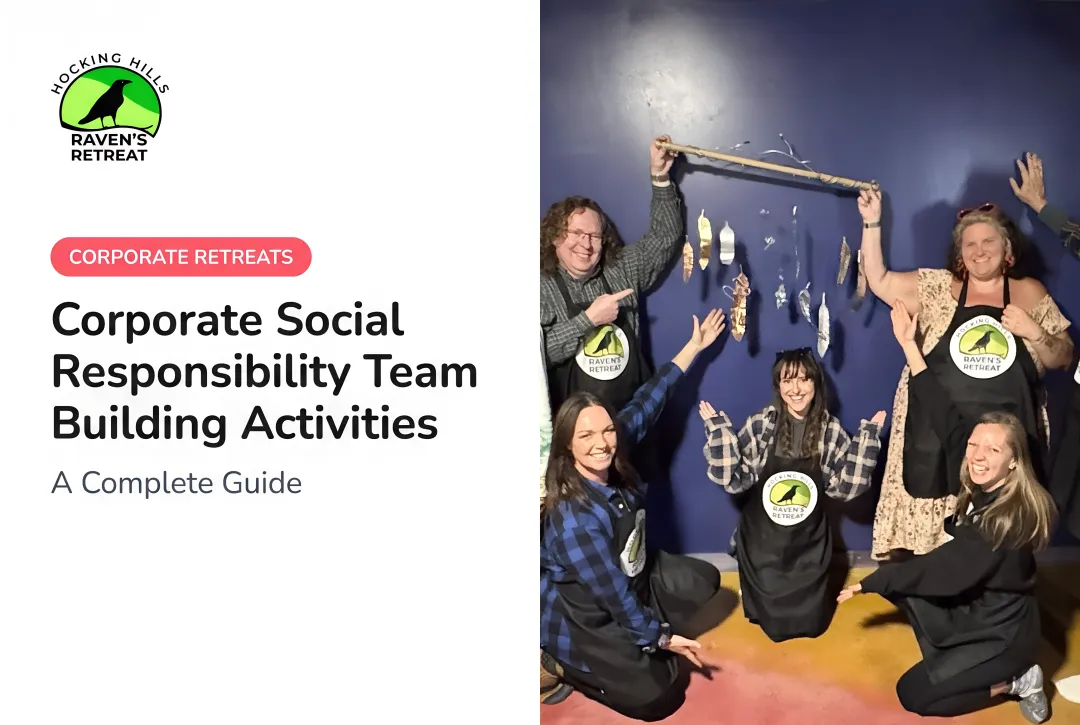
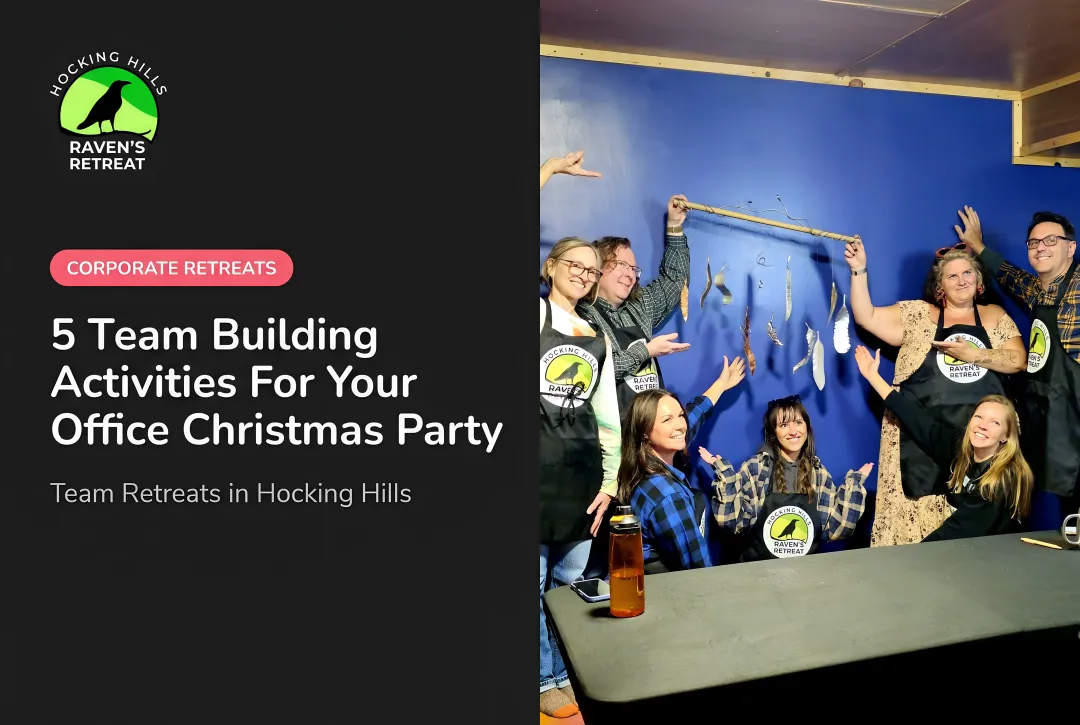
How it works: Teams are given 45–90 minutes and asked to use only natural materials found in their environment — sticks, stones, leaves, pinecones, moss — to build a collective art installation, sculpture, or land art piece. Each team then presents their creation and explains the concept behind it.
This can run competitively (judging criteria like "most cohesive" or "most inventive") or as a purely shared creative expression, depending on group culture.
Team-building benefits:
Collaborative art-making requires deliberation — who generates ideas, who builds, who refines, who leads the presentation. These are the same dynamics at play in any workplace project, but here the stakes are low and the feedback is immediate. A 2018 systematic review found that 81% of included studies on creative arts interventions reported significant stress reduction for participants.
Research also supports the nature-creativity link: a PLOS ONE study found that four days of immersion in nature improved creative reasoning by 50% — with reduced technology exposure likely a contributing factor alongside nature itself.
The Raven's Retreat property makes this activity particularly vivid. The 58-acre preserve contains hardwood forests, natural springs, creek stones, moss, and abundant forest materials. Co-owner and master sculptor Dustin Weatherby also offers live sculpture performances that can serve as a creative catalyst before teams begin their own installations — watching a raw log become a finished sculpture in real time reframes what "making something together" can look like.
Organizer tip: Have teams photograph their installations. The debrief question — "What did the creative process reveal about how we work together?" — is where the real insight happens.
4. Team Hiking with a Reflective Debrief
How it works: The team embarks on a guided or self-guided hike — a gentle 1–2 hour walk or a more demanding half-day route depending on fitness level and goals. The key differentiator from casual hiking is intentional structure.
Assign rotating trail roles: navigator, observer, storyteller, timekeeper. Include deliberate pause points where the group responds to a reflective question tied to their work — "Where have we felt like we were navigating uphill together?" or "What's a trail we haven't explored as a team yet?"
Team-building benefits:
The cognitive research on hiking is consistent. University of Michigan research found that walking in a natural arboretum improved short-term memory by 20%, while a 2015 Stanford study found that a 90-minute natural walk reduced self-reported rumination and corresponding neural activity compared to an urban walk.
Physical shared challenge also creates trust in ways that facilitated exercises don't — it's earned through effort rather than manufactured through instruction.
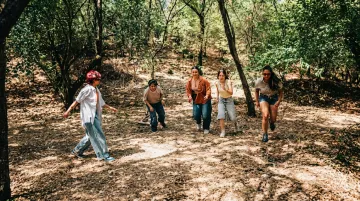
The Hocking Hills region of Ohio is one of the Midwest's premier hiking destinations, with trails through gorges, waterfalls, and ancient rock formations — including Ash Cave, Old Man's Cave, Cedar Falls, and the 6-mile Grandma Gatewood Trail. Corporate groups staying at Raven's Retreat have on-site access to over a mile of private trails with 220 feet of elevation change, plus easy driving access to the broader state park system just 6–16 miles away.
Planning tip: Offer both a shorter and longer route within the same outing so participants self-select based on fitness level. Pair the hike with a group meal or reflection circle afterward to transition from physical activity into meaningful conversation.
5. Campfire Storytelling and Team Reflection
How it works: As the day winds down, the group gathers around a fire pit for a structured storytelling circle. Each participant shares a brief story in response to a shared prompt. Examples:
- "A time I relied on someone else to get through something hard"
- "A moment at work that genuinely surprised me"
- "Something I want our team to do differently"
A facilitator guides the flow, ensures everyone has a voice, and may close with a group intention-setting exercise.
Team-building benefits:
- Builds empathy through personal narrative — deeper than discussion-based formats
- Removes hierarchy: around a fire, titles don't carry the same weight
- Creates an emotional anchor to the shared experience that participants carry back to the workplace
- Works especially well as a closing ritual for a full-day or overnight retreat
When people share real experiences away from notifications and org charts, barriers break down fast. Storytelling activates oxytocin release in listeners and can genuinely shift attitudes and beliefs — effects that abstract team exercises rarely produce.
A 2020 meta-analysis of After-Action Reviews found that structured debriefs produced an average 25% improvement in performance over controls — and campfire storytelling functions as exactly that kind of structured reflection.
At Raven's Retreat, the stone fire pit with Adirondack chairs and benches seats up to 16 people, set within the forest preserve. It's a purposefully designed gathering space — not an afterthought.
What makes it work: Craft prompts in advance. Pair the activity with light food and a comfortable outdoor setting to signal that this is a space for openness, not performance.
How to Choose the Right Outdoor Activity for Your Team
Not every team needs the same thing. Use these three factors to guide your decision:
| Factor | Questions to Ask |
|---|---|
| Team goal | Is this about trust, creativity, stress relief, communication, or a combination? |
| Energy level | How physically comfortable is your group with outdoor activity? |
| Time and logistics | Full day, half day, or a standalone 2-hour block? |
A quick reference by primary goal:
- Problem-solving and role clarity → Nature Scavenger Hunt
- Stress recovery and shared calm → Guided Yoga or Mindfulness Walk
- Creative collaboration → Collaborative Nature Art Challenge
- Shared challenge and relationship depth → Team Hiking with Reflective Debrief
- Empathy, trust, and meaning-making → Campfire Storytelling
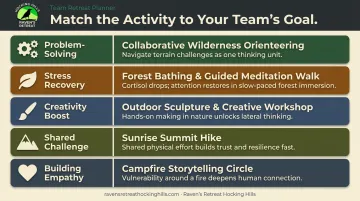
The venue matters as much as the activity. A private natural setting with dedicated spaces for movement, reflection, and gathering removes logistical friction so the experience can focus entirely on the people. Raven's Retreat Hocking Hills, for example, sits on a 58-acre preserve with a forest meditation zone, elevated yoga platform, and outdoor gathering areas — the kind of environment where team activities land differently than a rented conference lawn.
Always include a debrief. Even 10 minutes of guided reflection after any activity dramatically increases what teams retain and apply when they return to work. Without that structured pause, most of the insight stays in the woods.
Frequently Asked Questions
What are outdoor team-building activities for employees?
Outdoor team-building activities are structured group experiences held in a natural or open-air setting — such as scavenger hunts, guided hikes, collaborative art challenges, and mindfulness walks. They're designed to strengthen communication, trust, and collaboration among coworkers outside the normal work environment.
What are fun team-building activities that actually work?
"Fun" looks different for every team, but the most effective options feel experiential and low-pressure: scavenger hunts, creative challenges, group hikes, outdoor yoga, and campfire storytelling all fit that profile. The best activities build real skills while not feeling like training.
How long should an outdoor team-building activity last?
Most individual outdoor activities run 1–3 hours. A full corporate retreat combining multiple activities typically spans a full day or multi-day offsite, depending on team goals, energy levels, and whether activities are paired with meals or structured debriefs.
What makes outdoor team building more effective than indoor activities?
Outdoor environments reduce the psychological hierarchy of the office, increase openness and informal conversation, and provide sensory novelty — fresh air, natural materials, movement — that stimulates creative thinking and reduces stress.
How many people do you need for outdoor team-building activities?
Most activities work well for groups of 6–30 people, with adjustments for group size (dividing into sub-teams for scavenger hunts or art challenges). Activities like a mindfulness walk or campfire circle tend to be most intimate with 8–15 participants.
Outdoor team-building works not because it's a change of scenery, but because it shifts the conditions that make real connection possible: open space, presence, novelty, and a genuine break from the ordinary. The activities above all deliver on that — especially when chosen with intention and supported by a setting that amplifies the experience.
For Ohio-based corporate teams or those willing to make the drive, Raven's Retreat Hocking Hills offers exactly this kind of setting: a 58-acre private nature preserve with customizable wellness and creative programming, and full-property buyout options for small corporate groups. To explore what a corporate retreat day could look like for your team, reach out at stay@ravensretreathockinghills.com or call 614-783-6143.