Harvard professor Noam Wasserman's research found that 65% of startup failures trace back to people problems — co-founder tension, poor hiring decisions, and leadership breakdowns. Separately, CB Insights' analysis of 101 startup post-mortems found that 23% of failed startups cited "not the right team" as a contributing cause.
These aren't soft skills problems. They're survival problems.
This guide covers everything founders need to build a strong leadership foundation: which leadership qualities actually matter in high-pressure environments, how to construct and hire a startup team, what a scalable culture looks like, and how team-building activities create the kind of trust that holds teams together when things get hard.
Key Takeaways
- 65% of startup failures trace back to people problems: leadership gaps and team dysfunction, not product failures
- Effective startup leaders know their limitations and hire specifically to fill those gaps
- Balanced founding teams (business + technical) raise more money and grow faster than single-function teams
- Culture is built by behavior, not value statements — what your team watches you do daily sets the standard
- Investing in team cohesion early prevents expensive conflict and turnover down the road
Why Leadership Is the Foundation of Startup Success
In an early-stage startup, the founder doesn't just set strategy — they set the emotional temperature of the entire organization. How you handle a bad quarter, a missed deadline, or a team conflict becomes the behavioral template everyone else follows.
Gallup research across 2.5 million manager-led teams found that managers account for **at least 70% of the variance in employee engagement**. In a startup of 8 people, that's not an abstract HR statistic — it means the founder's mood, consistency, and clarity directly determines whether the team shows up energized or anxious.
The Hardest Leadership Transition Founders Face
Early founders wear every hat. They write code, close deals, handle customer service, and manage investor relationships simultaneously. That's necessary at the start.
The problem is that many founders never stop. They raise a seed round, hire a team, and then continue operating as though they're still a solo operator — reviewing every decision, rewriting every document, and attending every meeting.
This micromanagement pattern emerges from legitimate anxiety (the company is their responsibility), but it becomes a ceiling on growth. The shift from "I do everything" to "I build an environment where others do their best work" is the hardest and most consequential leadership transition a founder will make.
What Effective Startup Leadership Actually Looks Like
Effective founders at the early stage do four things well:
- Set tone and culture through consistent daily behavior, not slogans
- Create aspirational goals that connect individual work to a larger mission
- Absorb uncertainty so team members can operate without constant anxiety about the company's survival
- Secure buy-in from employees, investors, and partners through transparent, consistent communication
The behaviors that undermine this: approving every decision, hoarding context, avoiding difficult conversations, and projecting forced optimism when the team clearly senses something is wrong.
Essential Leadership Qualities Every Startup Founder Needs
Self-awareness is the starting point, not because it sounds good, but because it determines everything else. A founder who understands their natural leadership style (directive, collaborative, analytical, empathetic) can build a complementary team around their gaps rather than creating a team full of the same blind spots.
The 5 Core Qualities
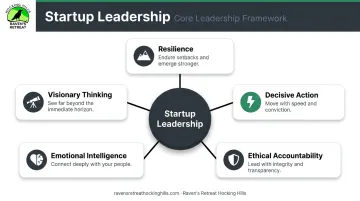
Visionary Thinking — Articulate a compelling picture of what the company could become, and align people to that future even when current circumstances don't support optimism. Teams follow leaders who make the destination feel real.
Resilience — Startups pivot, lose deals, miss projections, and lose key people. Leaders who model calm, adaptive problem-solving under pressure give their teams permission to handle difficulty without catastrophizing.
Emotional Intelligence — A 2023 review of 104 peer-reviewed studies confirmed that emotional intelligence predicts leadership effectiveness, team commitment, and conflict management. In a startup, where close quarters amplify team relationships, the ability to read your team and manage your own reactions is a functional advantage.
Decisive Action — Startups rarely have perfect information. Leaders who wait for certainty create bottlenecks. The ability to make a clear, timely decision, then adjust if wrong, keeps momentum alive.
Ethical Accountability — How founders behave when self-interest conflicts with doing the right thing sets the ethical standard the entire company will follow. Teams mirror what they see, and culture starts at the top.
Transparency and Accountability in Practice
Leaders who ask for feedback and practice transparency create psychologically safe teams. Google's Project Aristotle identified psychological safety as the single strongest predictor of team effectiveness — teams where members felt safe to take interpersonal risks outperformed teams with higher average ability.
Transparency doesn't mean sharing every financial worry. It means being honest about what directly affects employees' work, priorities, and trajectory.
Taking ownership also means making hard calls: letting go of early hires who no longer fit, navigating payroll uncertainty openly, and resolving interpersonal conflict before it fractures the team. Avoiding those decisions isn't neutral. It's a form of poor leadership.
Quick Self-Audit for Founders
Ask yourself these four questions regularly:
- Are my stated values consistent with my actions this week?
- Am I communicating consistently, or only when things go wrong?
- Am I allowing others to succeed, or insisting on doing too much?
- Have I given anyone meaningful feedback in the last 30 days?
How to Build Your Startup Team from Scratch
Even a visionary founder with strong leadership instincts will underperform with a poorly constructed team. Team composition is the infrastructure of execution.
The Founding Team
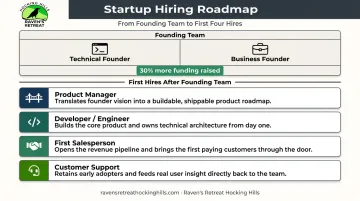
Startup Genome research reported by Steve Blank found that balanced founding teams — one technical founder, one business founder — raised 30% more money, had 2.9x more user growth, and were 19% less likely to scale prematurely than single-function teams. Solo founders, by contrast, took 3.6x longer to reach scale.
The lesson: co-founders should be chosen for genuine complementarity, not convenience. Test the working relationship on smaller projects before committing. A co-founder is a long-term business partner, not a hire who fills a skill gap for the next 18 months.
First Key Hires After the Founding Team
Once the founding team is established, the priority hires typically follow this sequence:
- Product manager — bridges technical development with user and market needs
- Developer/engineer — if the founding team doesn't have this covered
- First salesperson — ideally someone who can sell with minimal process; highly-seasoned enterprise reps often struggle in early-stage environments where there's no playbook yet
- Customer support — the earliest signal system for what's actually breaking
At this stage, generalists who can flex across multiple functions are more valuable than deep specialists. The specialization comes later, when problems are defined enough to require it.
Equity Structure and Executive Sequencing
Equity splits should reflect actual contribution and risk, not early enthusiasm. Mismatched equity expectations are consistently cited as a top source of co-founder conflict. Establish equity pools early as a budgeting mechanism, not an afterthought.
For executive hires, sequence based on your current growth bottleneck:
- Chief Commercial Officer or VP of Sales — creates more immediate value than a CFO at early stage; revenue clarity comes before financial optimization
- CFO or finance lead — hire once revenue is consistent and financial complexity justifies it
- Each executive hire should solve a specific, defined problem — if you can't articulate that problem clearly, you're not ready for the hire
Hiring Strategy: Building an Efficient Process
The Lean Founder-Led Hiring Process
Keep it simple and high-signal:
- Define the role clearly before posting — even generalist roles need defined outcomes, not just responsibilities
- Limit rounds to 2-3 interviews — more rounds slow momentum and signal indecisiveness to strong candidates
- Include founding team members in final interviews to verify vision alignment — cultural fit can't be outsourced to a recruiter who doesn't live the mission
Creative Sourcing for Resource-Constrained Startups
Most early-stage teams can't compete on salary alone. Work around it:
- Lean into your network — the best early hires often come through direct referrals, not job postings
- Use startup-specific communities like accelerator networks and YC's job board, which surface candidates who want to build — not just collect a paycheck
- Consider fractional or contract roles for non-core functions : legal, finance, and design rarely need full-time headcount in year one
- Offer meaningful equity for key early hires — Carta data shows median first-hire equity around 1%, declining quickly for later hires
Hiring Mistakes That Cost Founders Early
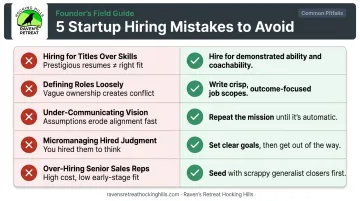
- Hiring for titles over skills — a VP title doesn't mean someone can sell into an undefined market
- Defining roles loosely and assuming smart people will self-organize
- Under-communicating the vision during interviews — candidates who don't understand the mission won't carry it
- Micromanaging people hired for their judgment signals mistrust and accelerates turnover faster than almost any other leadership failure
- Over-hiring senior sales reps too early — early sales requires founder-led discovery, not an enterprise-style playbook
Creating a Startup Culture That Scales
Culture is not a mission statement. It's not a ping-pong table or unlimited PTO. It's the behavioral norms that leaders model daily.
How long you take to respond to a struggling team member, how you handle a bad board meeting, whether you admit mistakes publicly — that's your culture. Perks and policies can support culture, but they can't create it.
The Building Blocks
Three things form the foundation of a culture that can scale:
- Shared values (not rituals — those will evolve as the company grows)
- Individual motivation mapping — understanding whether each team member is driven by mission, financial upside, learning, or ownership changes how you lead them
- Psychological safety — teams that can flag problems early, before they compound, outperform teams where people wait to see which way the wind is blowing
Stanford GSB research confirms that early people-management behavior shapes startup prospects — how founders treat their teams in the first 18 months sets patterns that persist long after the company grows.
When Culture Needs a Reset
What works with 5 people rarely works with 50. The signals that something needs intentional attention:
- Rising interpersonal conflict that gets smoothed over instead of addressed
- Communication breakdowns across functions
- Team members who seem disconnected from where the company is heading
When those signals appear, the structural work starts with the founder — getting honest about what's changed, naming it clearly, and deciding what the operating model needs to look like next. An offsite or intentional reset can accelerate that work, but only if the underlying honesty is already in place.
Team-Building Activities That Actually Strengthen Startup Teams
Most team-building fails because it's treated as entertainment rather than infrastructure. The research is clear: a 2009 meta-analysis found team building produced meaningful positive effects on team outcomes, with particularly strong effects on affective and process outcomes — trust, communication, and how people work together.
The best team-building activities don't just feel good in the moment. They create conditions for honest communication and trust that carry directly back into daily work.
Activity Types That Work for Startup Teams
- Problem-solving workshops — shared cognitive challenge with real stakes
- Creative challenges — hands-on making, not competitive games
- Outdoor and nature-based experiences — physical shared challenge that removes hierarchy naturally
- Facilitated reflection sessions — creating space to articulate what's working and what's not
- Leadership retreats — extended offsite time focused on strategy and team alignment
The common ingredient in all of these: they move people out of task-execution mode and into genuine human connection.
Why Offsite Matters — Especially in Nature
Taking a startup team out of the office changes what's possible in a conversation. Stanford research found that walking increased creative output by an average of 60%, and outdoor walks produced high-quality creative thinking in twice as many participants as seated indoor sessions.
University of Michigan research found that just 20-30 minutes in nature produced significant cortisol reduction — the physiological shift that allows people to think more clearly and engage more openly.
That's the environment Raven's Retreat Hocking Hills is built around. Situated on a 58-acre private nature preserve near Laurelville, Ohio (about an hour from Columbus), the property accommodates startup teams and mastermind groups up to 18 overnight, with full property buyout available for complete privacy.

Programming goes well beyond lodging. Teams can access:
- Structured strategy sessions in the Art Lodge (300+ Mbps Wi-Fi, presentation screen, collaborative seating)
- Forest bathing and guided meditation on private trails
- Creative workshops, including live sculpture performances by master sculptor Dustin Weatherby
One guest, Zack, who organized a two-day corporate retreat there, put it simply: "Planning was easy and our team left feeling recharged, focused, and more connected than ever."
For startup teams navigating pressure and rapid change, that combination of nature, creative challenge, and genuine disconnection from daily operations is what makes the difference between a retreat that gets forgotten and one that actually shifts how a team works.
Frequently Asked Questions
What is the 80/20 rule for startups?
The 80/20 rule (Pareto Principle) suggests roughly 80% of results come from 20% of efforts, customers, or products. For founders, that means identifying your highest-leverage activities — a specific customer segment, product feature, or team capability — and concentrating resources there rather than spreading effort thin.
What are the 4 P's of startup?
In a marketing context, the 4 P's are Product, Price, Place, and Promotion. For early-stage operations, a common framework shifts this to People, Product, Process, and Purpose. Most experienced founders and investors treat People as the foundation — without the right team, the other three rarely succeed.
What are the most important leadership qualities for startup founders?
Self-awareness, decisiveness, emotional intelligence, and resilience matter most. Effective startup leaders understand their own strengths, hire deliberately to cover their gaps, and make clear decisions without waiting for perfect information.
How do you build team culture in an early-stage startup?
Start with shared values, not perks or slogans. Culture is modeled daily through founder behavior, and it requires knowing what motivates each person individually. As the company grows, intentional maintenance becomes essential — what works at 5 people rarely holds at 25 or 50 without deliberate effort.
When should a startup invest in team-building activities?
Before problems arise, not after. Natural investment points include onboarding new team members, after a period of rapid growth, and when leaders sense communication or trust starting to fray. Proactive investment costs far less in time, morale, and momentum than rebuilding trust after a team breaks down.
What is the best team structure for an early-stage startup?
A lean founding team with balanced business and technical representation, followed by a commercial-first hire (VP Sales or CCO) to address the revenue gap most early teams hit. Early employees should be generalists who can flex across functions. Specialists earn their place once problems are well-defined enough to require focused depth.