Introduction: Why CSR Team Building Is More Than Just a Feel-Good Activity
Most companies treat team building and CSR as separate line items—a ropes course in Q2, a charity drive in Q4, and never the two shall meet. Forward-thinking organizations are rethinking that split.
When you merge the two into a single, purposeful experience, something shifts. Teams aren't just completing an obstacle course—they're building bikes for kids who've never owned one, or creating murals that end up on school walls. Those stakes change how people show up.
Gallup's State of the Global Workplace report found global employee engagement at just 21%—a signal that conventional engagement tactics aren't working. That's not a rounding error.
This guide covers what CSR team building actually is, why it outperforms standard team building on every metric that matters, the best activity formats by category, and how to plan an experience that creates lasting cultural impact—not just a good afternoon.
Key Takeaways:
- CSR team building delivers community impact and team development simultaneously
- Purpose-driven activities outperform competitive or recreational formats on engagement
- Younger employees weigh a company's social values when deciding where to work
- Multi-day, nature-based formats produce deeper team transformation than single-day events
- A structured debrief turns a great experience into lasting cultural change
What Is CSR Team Building?
Corporate social responsibility team building combines purposeful group work with measurable community benefit. Teams don't just bond—they produce something that creates real value for a cause, community, or ecosystem while simultaneously strengthening their own collaboration, communication, and culture.
How It Differs from Standard Volunteering
Standard volunteering tends to be one-directional. Employees show up, complete a task, and go home. The experience is often passive and loosely structured.
CSR team building takes a more intentional approach:
- Activities are designed around team dynamics, not just task completion
- Cross-functional problem-solving is built directly into the format
- Both the community impact and the team development goals are measured after the fact
Common CSR Pillars
Most CSR team building programs fall under one of these focus areas:
- Environmental stewardship (conservation, sustainability, habitat restoration)
- Community support (food drives, hygiene kits, infrastructure projects)
- Education and youth development (school supplies, tutoring, makeovers)
- Health and wellness (prosthetics, accessible equipment builds)
- Arts and culture (murals, instrument drives, creative programming)
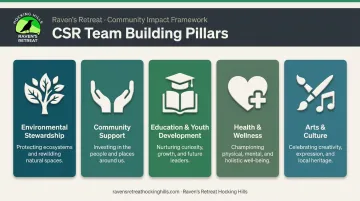
The right pillar depends on your company's existing values. Programs that mirror what employees already care about tend to generate stronger participation and more lasting team cohesion.
Why CSR Team Building Benefits Your Entire Organization
The case for CSR team building isn't just philosophical. There's solid evidence across purpose, retention, talent acquisition, and external brand perception.
Engagement and Purpose
McKinsey's 2021 research found that 70% of employees say their sense of purpose is defined by their work—and those who don't find that purpose are significantly more likely to consider leaving. CSR activities don't solve that problem alone, but they do create visible, tangible proof that the organization's work connects to something larger.
Shared purpose also activates a different kind of team bond than trivia nights or trust falls. When a team hands over a finished bicycle to a child who's never owned one, that emotional memory becomes a permanent reference point for what they're capable of together.
Hidden Leadership—Revealed
Low-stakes environments surface authentic behavior. During a charity build or habitat restoration project, you'll see who steps up under constraint, who coordinates across departments without a title to lean on, and who defaults to empathy when the plan falls apart. That visibility is useful—both for identifying future leaders and for strengthening existing team dynamics.
Talent Acquisition and Retention
The workforce has shifted its evaluation criteria. Deloitte's 2025 Gen Z and Millennial Survey found that 44% of Gen Zs and 45% of millennials have left a role because it lacked purpose. Around 40% of both groups have rejected an employer or assignment that didn't align with their values.
Consistent CSR programming sends a clear signal to candidates: this is how the organization actually operates. That's a retention tactic and a recruitment advantage in one.
External Brand and Community Reputation
What happens inside a CSR team event doesn't stay inside. Documented community outcomes become content that shapes how the company is perceived by clients, partners, and the broader public:
- Bikes donated to kids who've never owned one
- Trees planted and ecosystems restored
- Classrooms rebuilt or stocked with supplies
Internal culture-building and outward brand perception aren't separate efforts when CSR is the vehicle.
Top CSR Team Building Activities by Category
Community Giveback Activities
Build-a-Bike Programs Teams assemble bicycles collaboratively under time pressure, then donate them directly to children in underserved communities. The physical handoff moment—when a child receives a bike they'll actually use—creates an emotional payoff that no competitive team activity can replicate. Few formats pair urgency, coordination, and a tangible result as effectively.
Hygiene Kit and School Supply Assembly Challenges Teams race to pack kits for shelters, food banks, or under-resourced schools. When gamified—bonus items unlocked through trivia, puzzles, or inter-team challenges—the energy stays high without losing focus on the cause. It also scales cleanly: the same structure works for 10 participants or 500, with minimal adjustments to logistics.
Environmental and Sustainability Activities
Tree Planting and Reforestation Divide teams by department, assign each a designated planting area, and track the saplings over time. The ongoing stewardship element—receiving updates about "their" trees months after the event—extends the team experience well beyond a single day and creates a living record of the group's impact.
Upcycling and Eco-Innovation Workshops Give teams discarded materials and a time limit to build something functional or beautiful. The constraint is the point: it surfaces resourcefulness, challenges problem-solving, and makes sustainability tangible in a way no workshop presentation can.
What to expect from a well-run session:
- Creative output that varies wildly between teams (and sparks genuine comparison)
- Natural conversations about material waste and design choices
- A finished product that can be donated, displayed, or auctioned for a partner cause
Arts and Education CSR Activities
Instrument Donation Drives with Creative Workshops Teams participate in a shared creative activity—songwriting, painting, sculpting—and the output or proceeds are tied to donating supplies or funding to underfunded school arts programs. The activity creates a direct link between the team's creative experience and the access they're providing for students.
Classroom Makeover and Mural Projects Teams paint, design, and install art in partner school spaces, combining physical labor with creative expression. This format consistently draws in employees who aren't energized by purely competitive or athletic activities—a critical consideration for diverse groups.
Humanitarian Build Projects
Build-a-Hand® Programs Teams assemble functional prosthetic hands or assistive devices for amputees in developing countries. The precision required—these devices need to actually work—makes the activity unusually focused and memorable. Teams typically learn about specific recipients beforehand, which shifts the dynamic entirely — this stops feeling like a team exercise and starts feeling like something that matters.

Community Infrastructure Projects For organizations seeking a longer-format, field-based experience: constructing shelters, water access points, or play structures in partnership with established NGOs. These projects require more planning and typically span multiple days, but the scale of impact creates a proportionally stronger team narrative.
Nature-Based and Retreat-Style CSR Activities
Single-day CSR events create impact. Multi-day, nature-immersive retreats create something different: the time, space, and sensory environment needed for genuine behavioral change to take root.
Why Nature Amplifies the CSR Experience
Research supports what experienced retreat planners already know: natural environments reduce stress at a biological level. A 2019 Frontiers in Psychology field study found that salivary cortisol dropped at 18.5% per hour beyond normal diurnal decline after nature exposure, with the most efficient stress-relief window occurring at 21–30 minutes. A complementary 2022 review in Environmental Health and Preventive Medicine confirmed that forest bathing reduces stress hormones including cortisol.
When teams are physiologically less stressed, they communicate differently. Guard comes down, creativity increases, and the emotional experiences created during CSR activities land more deeply.
CSR Activities Native to Natural Retreat Settings
Nature-based retreat settings open up formats that aren't available in a conference room:
- Guided forest conservation walks focused on biodiversity and land stewardship
- Habitat restoration work (invasive species removal, native planting)
- Pollinator garden creation and maintenance
- Eco-art installations using natural and reclaimed materials
- Sustainable land stewardship under the guidance of conservation practitioners
- Wildlife observation with a focus on species protection and habitat corridors
Working with land—actually touching it, changing it, learning to read it—creates a sense of shared responsibility that extends well past the retreat. Teams who plant, monitor, and reflect in natural settings often carry that language of care back into the office.
Raven's Retreat Hocking Hills
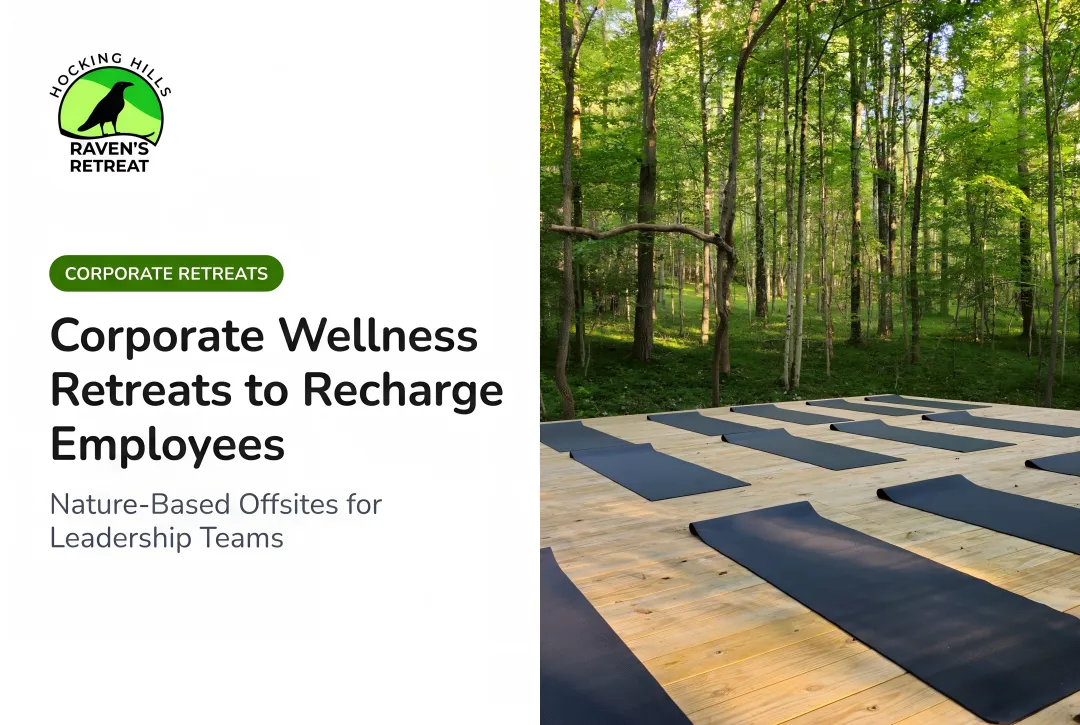
For Midwest organizations seeking this kind of immersive format, Raven's Retreat Hocking Hills offers a purpose-built setting on a 58-acre private nature preserve near Laurelville, Ohio. The property isn't a generic conference venue with a forest view—it's an actively stewarded nature sanctuary with wildlife corridors, a 1,600-square-foot pollinator garden, reforestation initiatives, and partnerships with Rural Action and the Ohio Department of Natural Resources.
Corporate teams can combine nature stewardship activities—tree-planting events, guided sustainability walks, interactive wildlife observation—with signature creative experiences led by master sculptor Dustin Weatherby. His live sculpture performances, where teams watch a raw log transform into finished art over a few hours, make abstract ideas like adaptation and creative problem-solving visceral and memorable.
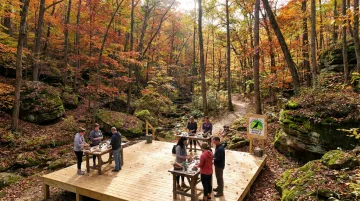
Teams frequently commission a custom piece as a lasting retreat memento.
The full-property buyout gives groups exclusive access to the entire 58-acre preserve, the Sculptor's Art Lodge (sleeps 16), and the Sculptor's Art Bungalow (sleeps 2), elevated forest platforms, outdoor wellness spaces, saunas, and hot tubs.
Retreat itineraries are custom-built around your CSR goals, with add-on options including forest bathing, yoga, sound healing, somatic breathwork, chef-prepared delicious, healthy meals, and NLP coaching.
The conservation work teams do here isn't a simulation. They're working within an ecosystem the property actively protects—which gives the CSR experience a credibility that staged activities rarely achieve.
How to Plan a Successful CSR Team Building Event
The gap between a CSR event that teams still talk about six months later and one that gets forgotten by Friday comes down to three things: clear intent, operational prep, and a structured follow-through plan.
Define Before You Design
Before selecting an activity, answer three questions:
- What's the CSR focus area? Environment, education, health, arts, or community support—pick one and commit.
- Does it align with existing company values? A company that has never mentioned sustainability loses credibility with a one-off tree-planting event. Employees notice the disconnect.
- What does the group look like? Size, physical ability range, travel availability, and time constraints should all shape the format before the activity is chosen.
Move from "Nice Event" to Lasting Impact
Most CSR events live and die on the day. To make them stick:
- Run a structured debrief right after: what did the team accomplish, who benefited, what carries back to work?
- Record the community outcome — kits assembled, trees planted, devices built — and share it with stakeholders
- Set follow-up touchpoints: quarterly cause updates, a second volunteer day, or tracked donations over time
- Collect participant reflections during the event for internal communication
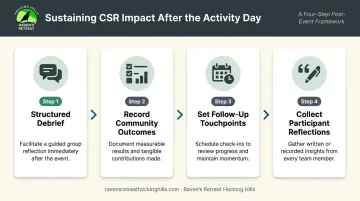
The 2021 team self-reflection meta-analysis published in Journal of Applied Psychology found a medium positive effect (g = .549) on performance outcomes when teams engaged in structured reflection. A CSR debrief is one of the most underused team development tools available.
Logistics Essentials
Don't overlook the operational basics:
- Vet nonprofit partners on capacity, mission fit, and safety — confirm the activity creates real value, not busy work
- Confirm materials lead times early, especially for build or assembly programs
- Choose a facilitator who can make the day feel intentional, not improvised
- Brief participants in advance on the cause, the format, and what to expect
- Produce a post-event summary for stakeholders that goes beyond a volunteer hour count
Frequently Asked Questions
What are team building activities for CSR?
CSR team building activities are structured group experiences designed to benefit a community, cause, or environment while simultaneously developing teamwork skills. Examples include charity bike builds, hygiene kit assembly, tree planting, mural projects, and nature-based stewardship retreats—where both the community impact and team development goals are intentional and measured.
What are some good corporate team building activities?
Strong CSR-aligned options include build-a-bike programs, hygiene kit drives, classroom mural projects, eco-innovation workshops, and nature-based retreat experiences. The best activity matches your team's size, physical ability range, and the social or environmental cause most aligned with your company's values.
What are some examples of CSR activities?
The main categories are: community giveback (food kits, hygiene kits, charity bike builds), environmental action (tree planting, habitat restoration, upcycling workshops), arts and education (school supply drives, classroom murals, arts funding workshops), and humanitarian builds (prosthetic hand assembly, community infrastructure construction).
How do CSR activities benefit employees?
CSR participation connects to improved engagement, stronger peer relationships, reduced stress, and a greater sense of purpose. Employees who find meaning in their work are more likely to stay, collaborate more authentically, and perform at a higher level long after the event ends.
How do I plan a CSR team building event?
Start by choosing a cause aligned with your company's values, then select a format suited to your group's size and physical range. Partner with a vetted NGO or venue, build in a structured debrief after the activity, and follow up with stakeholder reporting to sustain impact.
Can small teams benefit from CSR team building activities?
Small groups often get more out of CSR team building because the intimate setting deepens the emotional impact. Formats like eco-retreat experiences, art-for-donation workshops, sculpting collaboratives, and conservation projects work well for groups under 20 and can be customized for a depth that larger events rarely match.