Introduction
Effective teams don't appear by accident. They're built deliberately, by leaders who understand that aligning people around shared purpose requires far more than a good hire or a quarterly all-hands meeting.
Many leaders struggle with familiar friction points: team members pulling in different directions, motivation that fades after an initial burst of momentum, conflict that festers rather than gets resolved, and the quiet erosion of trust that happens when communication breaks down under pressure.
Gallup's research makes the cost of poor leadership concrete: 70% of the variance in team engagement traces directly back to the manager. That single number reframes where leadership improvement efforts actually belong.
This guide covers what it actually takes to lead well: the traits that define effective leaders, how those traits directly shape team dynamics, Tuckman's five-stage development model, and practical strategies for building teams that perform under real conditions — including conflict resolution, stagnation, and developing other leaders.
Key Takeaways
- 70% of team engagement variance comes from the manager — leadership is the primary lever
- Psychological safety is the single most important factor in team effectiveness, per Google's Project Aristotle
- Tuckman's five stages (Forming → Adjourning) give leaders a diagnostic tool to adjust their style
- High-performing teams need shared goals, clear roles, and consistent feedback
- Immersive offsite retreats — like nature-based sanctuaries — reset team dynamics and rebuild alignment away from daily distractions
What Is Leadership and Why Does It Matter for Teams?
Leadership is about more than holding a title. A title grants authority over tasks; it does nothing to earn trust or inspire effort. Modern leadership means creating conditions where every team member can contribute meaningfully — not directing from the top down, but building the environment that makes good work possible.
This shift has been well-documented. Research across 50 effect sizes from 3,198 teams found a consistent positive relationship between shared leadership and team performance. The move away from "heroic" individual leadership toward collaborative, distributed models isn't a trend. The evidence has been pointing in this direction for decades.
How Leader Behavior Shapes Team Climate
A leader's daily behavior functions as a template for the team. Leaders who model transparency create cultures where information flows freely. When leaders respond to mistakes with curiosity rather than blame, people feel safe enough to take initiative and surface problems early.
Edmondson's foundational research on psychological safety across 51 work teams found that when team members believe it's safe to take interpersonal risks — speaking up, surfacing problems, challenging assumptions — learning behaviors increase significantly. That safety starts at the top.
Managing vs. Leading
The distinction matters practically:
| Managing | Leading |
|---|---|
| Task and process focus | People and vision focus |
| Ensuring work gets done | Building capacity to do better work |
| Short-term coordination | Long-term team development |
| Responding to what's happening | Shaping what's possible |
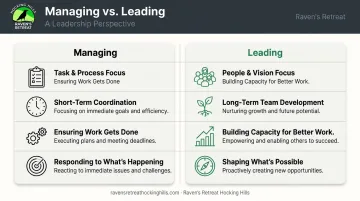
Most teams need both. But leaders who only manage — without investing in purpose, relationships, and development — produce compliance at best, rarely genuine commitment.
Key Traits of Effective Leaders
Leadership traits aren't fixed personality characteristics. They're practiced behaviors that, over time, become the foundation of a team's culture.
Empathy and Emotional Intelligence
Daniel Goleman's influential Harvard Business Review piece describes emotional intelligence as the non-negotiable quality that separates competent managers from genuinely effective leaders.
A 2023 review of 104 peer-reviewed studies confirmed positive relationships between leader emotional intelligence and team performance, cohesion, and conflict management.
Leaders who read both spoken and unspoken signals from team members can offer targeted support before small issues become significant ones.
Clear and Consistent Communication
McKinsey research shows that organizations with strong role clarity are over twice as likely to hold employees accountable and nearly five times more likely to be organizationally healthy. Gallup's first Q12 engagement element — "I know what is expected of me at work" — reflects the same finding: ambiguity is a performance killer.
Effective communicators:
- Define roles and responsibilities explicitly, not just in onboarding
- Share context behind decisions rather than just directives
- Create regular channels for questions and course correction
Vision, Adaptability, and Integrity
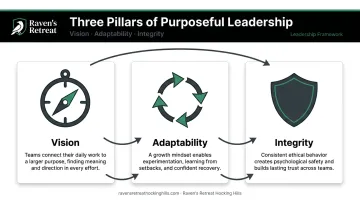
Three traits that reinforce each other — and compound over time:
- Vision: Teams perform better when they understand how their work connects to a larger purpose. Engagement rises when the mission feels real, not ceremonial.
- Adaptability: Leaders who model a growth mindset give teams permission to experiment and recover from setbacks. How a leader responds to failure sets the team's tolerance for risk.
- Integrity: Trust is earned through consistent, ethical behavior — not announced. Leaders with integrity create the psychological safety where honest dialogue can happen.
A meta-analysis of 112 studies across 7,763 teams found intrateam trust positively related to team performance (rho = .30) — a direct downstream effect of integrity modeled at the top.
The Role of Leadership in Team Building
Leadership is the single greatest variable in whether a team succeeds or struggles. More than team composition, budget, or tools, leaders create the conditions — trust, clear roles, shared goals, open communication — that make performance possible.
Establishing Norms and Values
The most effective leaders don't impose team norms — they co-create them. When team members help define expectations and working agreements, accountability shifts from external to internal. People follow rules they helped write with far more consistency than rules handed down.
Norms established in a team's first weeks tend to persist. Leaders who invest time upfront building shared agreements spend less time managing dysfunction later. Those agreements typically cover three areas:
- Communication: How the team shares information, raises concerns, and escalates decisions
- Decision-making: Who has authority, who provides input, and what requires consensus
- Feedback: How often it happens, what format it takes, and what's expected in response
Facilitating Collaboration
Many leaders default to solving problems themselves. It's faster, often feels more reliable, and avoids the friction of group decision-making. But this approach has a ceiling.
High-performing teams are led by people who:
- Delegate problem-solving to the group rather than providing answers
- Remove structural obstacles between team members
- Create consistent structures for communication (not just ad hoc check-ins)
- Ask questions that develop team thinking rather than demonstrate their own
Recognition, Feedback, and Strategic Alignment
Gallup and Workhuman's research found that well-recognized employees are 45% less likely to have left their organization two years later. Employees who receive valuable feedback are five times as likely to be engaged. These aren't soft outcomes — they're retention and performance metrics.
Recognition and feedback build the interpersonal foundation — but lasting cohesion also requires strategic alignment: shared clarity on objectives, decision-making frameworks, and each person's role. Teams that like each other but don't share direction still underperform. Strategic clarity, by contrast, gives teams the structure to work through interpersonal friction when it arises.
Stages of Team Development Every Leader Should Know
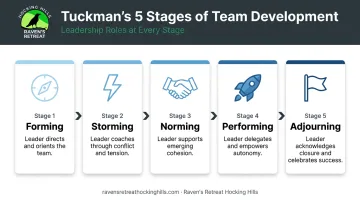
Bruce Tuckman's model (introduced in 1965, then expanded with a fifth stage in 1977) gives leaders a practical diagnostic tool. The key insight: teams don't skip stages, and the leader's job looks different at each one.
Forming and Storming
Forming is the orientation phase. Team members are polite, uncertain, and looking to the leader for direction. Anxiety is high; clarity is low. The leader's job here is to provide structure: define the purpose, establish expectations, and reduce ambiguity so people know where to put their energy.
Storming is where most teams stall. As members navigate differences in working style, priorities, and personalities, conflict emerges. Leaders who treat storming as failure miss the opportunity.
The job here is to coach, facilitate consensus, and help the team reframe disagreement as part of development — not a signal that something is broken.
85% of employees experience workplace conflict, according to the CPP Global Human Capital Report. Avoiding the storming stage doesn't eliminate conflict — it delays it and removes the leader's ability to shape how the team works through it.
Norming and Performing
Norming brings cohesion. The team has developed shared norms and begun to trust each other's contributions. The leader shifts from directing to supporting — encouraging team ownership, celebrating progress, and mentoring individuals.
Performing is the goal: high autonomy, results that genuinely compound across the team, and outcomes that exceed what any individual could produce alone. The leader's role here is to:
- Delegate with real authority, not just delegation in name
- Remove barriers rather than staying close to the work
- Continue investing in development rather than assuming the team can sustain performance without input
Once a team reaches Performing, the work isn't over — closure matters too. The Adjourning phase applies when projects conclude or teams restructure. Leaders who acknowledge and mark these transitions help team members process the change rather than bring unfinished patterns into their next team.
Proven Strategies to Build a High-Performing Team
Set Goals and Norms Collaboratively
Specific, difficult group goals outperform vague ones — a meta-analysis of 38 studies found effect sizes as high as d = 0.80. When setting those goals, involve team members in defining how success is measured and what working agreements will support it. The buy-in that comes from participation affects accountability in ways that top-down mandates rarely achieve.
Invest in Psychological Safety
Google's Project Aristotle studied 180 teams and identified five dynamics of effective teams. Of the five, psychological safety was the most important — and sales teams with high psychological safety exceeded revenue targets by 17%, while low-safety teams fell short by up to 19%.
Inclusive leadership practices directly build that safety. Leaders who signal openness, accessibility, and genuine appreciation of contributions foster environments where diverse perspectives emerge and creative problem-solving improves. Practical moves that reinforce this include:
- Rotating facilitation roles so one voice doesn't dominate
- Explicitly inviting quieter team members to contribute
- Responding to challenges with curiosity rather than defensiveness
Use Structured Check-Ins and Strategic Offsites Intentionally
Regular, structured team check-ins — on goals, blockers, and team health — build more sustained alignment than relying on occasional events alone. Immersive offsite experiences, though, serve a genuinely distinct purpose that check-ins can't replicate.
A well-designed offsite removes teams from daily operational pressure, loosens hierarchies that harden in office settings, and opens space for honest conversations that rarely happen at a desk. HBR notes that offsites can reset a leadership team's trajectory and rebuild alignment, particularly when hybrid work has weakened connection.
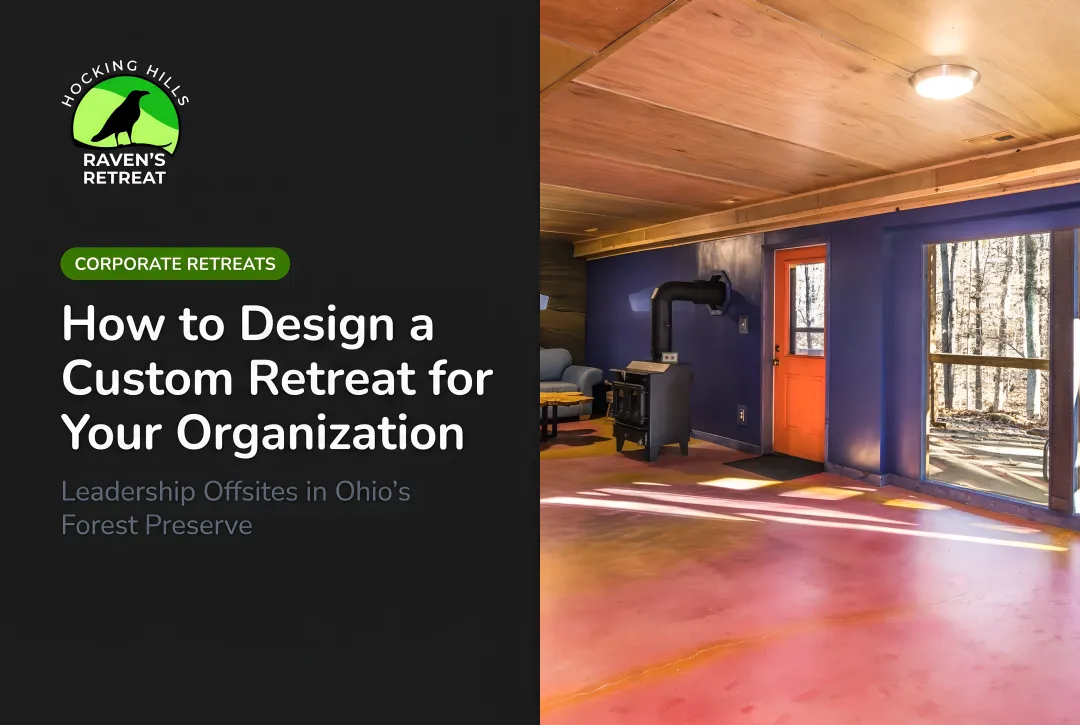
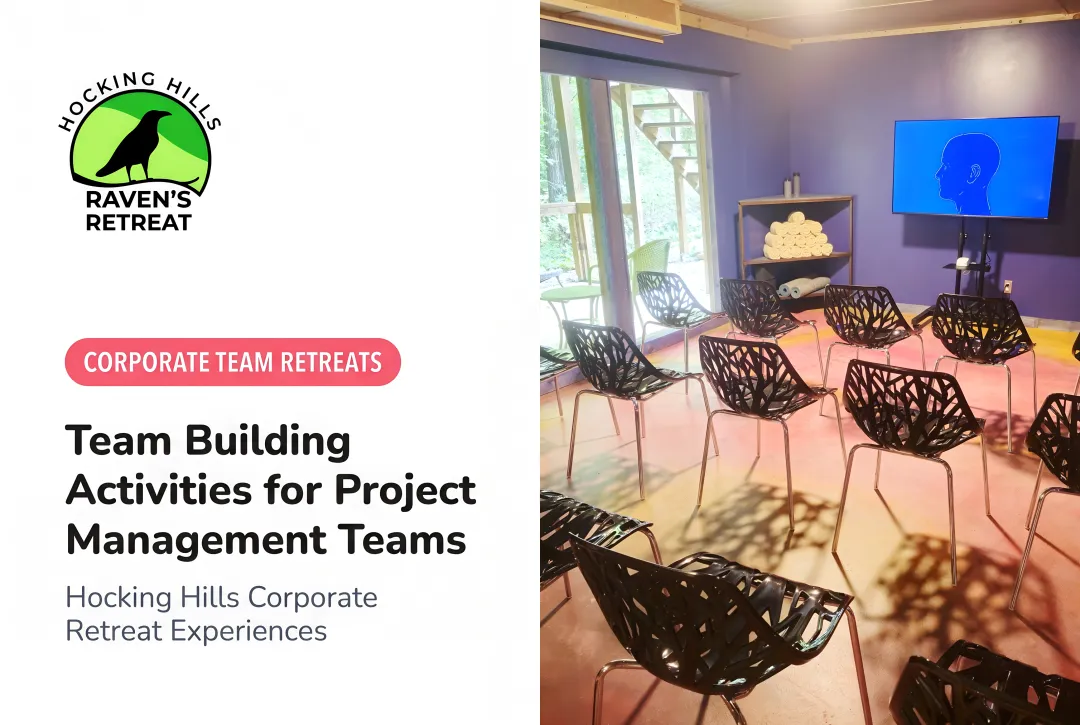
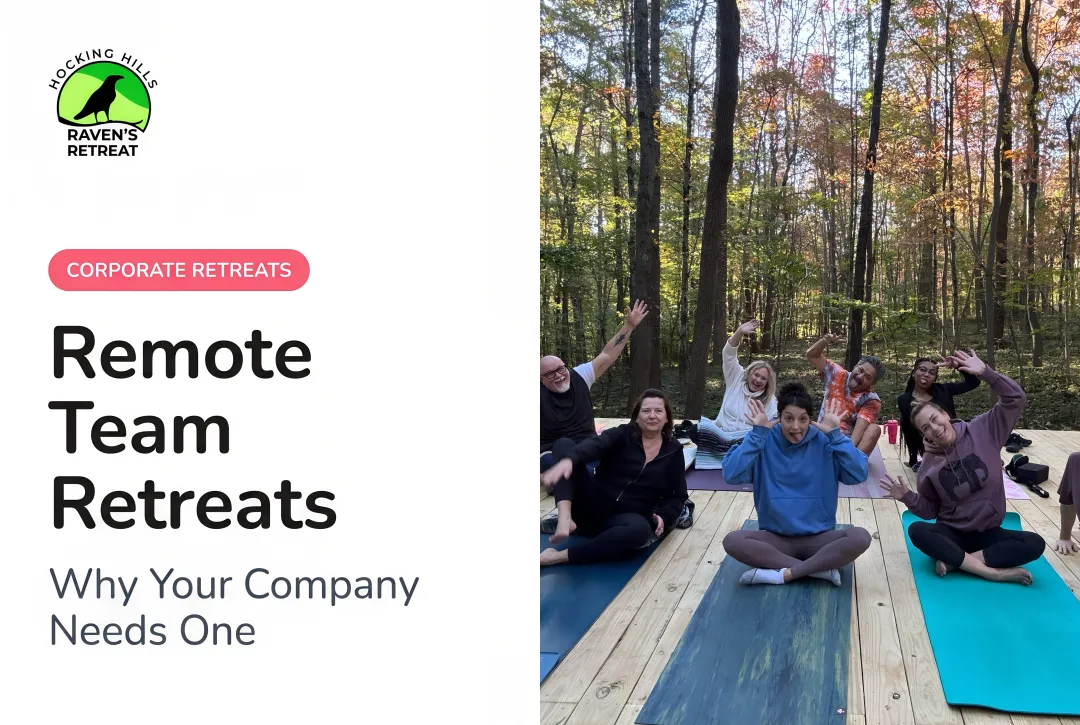
For corporate teams, mastermind groups, or leadership cohorts seeking that kind of reset, Raven's Retreat Hocking Hills offers a purpose-built environment on a 58-acre private nature preserve in Ohio. The Art Lodge accommodates up to 16 overnight guests with high-speed Wi-Fi, large open meeting spaces, and an elevated forest platform for group sessions. Add-on experiences — from NLP coaching and somatic breathwork to live sculpture performances by master sculptor Dustin Weatherby — are designed specifically to support team alignment, leadership reflection, and creative renewal.
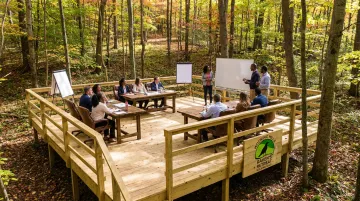
One corporate retreat guest put it plainly: "Our team left feeling recharged, focused, and more connected than ever."
How to Overcome Common Leadership and Team-Building Challenges
Managing Conflict Constructively
Conflict is a structural reality in any team — and when handled well, it strengthens performance by surfacing the assumptions and misalignments that quietly build up over time.
Before choosing a resolution approach, identify the source:
- Information gaps — people operating from different facts or context
- Values differences — genuine disagreement about what matters and why
- Style clashes — different communication or decision-making preferences
The Thomas-Kilmann Conflict Mode Instrument identifies five response modes: competing, collaborating, compromising, avoiding, and accommodating. Effective leaders don't default to one; they diagnose the situation and choose accordingly. The common trap is avoiding conflict entirely — it never resolves on its own.
Keeping Teams Motivated and Avoiding Stagnation
Gallup's 2026 State of the Global Workplace data is stark: global employee engagement fell to 20% in 2025 — its lowest level since 2020 — costing an estimated $10 trillion in lost productivity.
When motivation drops, the instinct is often to plan a new activity. The better move is revisiting purpose. Ask: does the team still understand why its work matters? Are goals still challenging and relevant? Has success gone unrecognized?
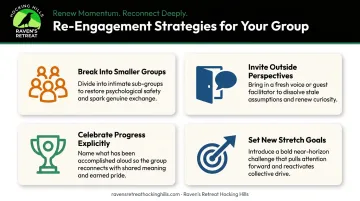
Practical re-engagement strategies:
- Break large teams into smaller working groups for specific initiatives — fresh dynamics often surface new energy
- Invite outside perspectives through guest speakers or cross-functional collaboration
- Celebrate progress explicitly — not just outcomes, but effort and milestones along the way
- Set new, stretch goals that make the current chapter feel distinct from the last
Developing Leadership Within the Team
The strongest leaders build other leaders. Teams that develop internal leadership become resilient rather than dependent on a single person at the top.
The GROW model (Goals, Reality, Options, Will) — developed by Sir John Whitmore and Performance Consultants in the late 1980s — provides a practical coaching conversation framework. A leader using GROW doesn't tell a team member what to do; they ask questions that help the individual work through a challenge and commit to action.
Beyond formal coaching, developing team leadership means:
- Delegating meaningful responsibilities, not just administrative tasks
- Creating opportunities for team members to lead specific initiatives with real authority
- Providing honest, specific feedback that accelerates development rather than just evaluates performance
Frequently Asked Questions
What is the role of leadership in team building?
Leaders create the structural and cultural conditions for team success — establishing trust, aligning members around shared goals, and modeling the communication behaviors they want to see. Without active leadership investment, even talented teams tend toward dysfunction over time.
What are the 5 C's of leadership?
Commonly cited as Competence, Confidence, Connection, Character, and Caring, the 5 C's describe the qualities that allow leaders to earn genuine trust. Frameworks vary by source — Kouzes and Posner's Five Practices offer a more research-grounded alternative focused on behavior rather than traits.
What are the stages of team development?
Tuckman's model identifies five stages: Forming, Storming, Norming, Performing, and Adjourning. Understanding where a team sits in this progression helps leaders shift their approach accordingly — from directive in early stages to delegative at peak performance.
How can a leader build trust within a team?
Trust is built through consistent, ethical behavior over time, not a single gesture. Transparent communication, following through on commitments, and acknowledging mistakes without deflection are the primary mechanisms. It accumulates slowly and can be damaged quickly.
How do leaders effectively resolve conflict within a team?
Start by identifying the source of the conflict before choosing a response. Facilitate open dialogue using "I" statements rather than blame language, and guide the team toward a mutually agreed resolution. Avoiding the conflict or forcing a fast resolution typically prolongs the root problem.
What makes an offsite leadership retreat effective for teams?
Effective offsites have a clear purpose, structured reflection alongside genuine relationship-building, and a follow-through plan that extends the work beyond the retreat itself. The environment matters too. Removing teams from familiar hierarchies and daily distractions creates conditions for the honest conversations that drive real alignment.