Introduction
U.S. employee engagement hit a 10-year low in 2024, with only 31% of workers actively engaged according to Gallup. Separately, SHRM found that 44% of employees felt burned out, and those workers were nearly three times more likely to be actively job searching.
Those numbers point to the same underlying problem: teams running on empty can't perform, collaborate, or retain good people. What they need isn't another meeting — it's a genuine reset. A change of environment lowers cortisol, breaks habitual thinking patterns, and creates space for real human connection that most offices simply can't provide.
Corporate wellness retreats address this directly. Done well, they're a measurable investment in the people who drive your organization forward — not a line-item luxury.
This article covers why retreats work, the best session ideas to include, how to plan one effectively, and what to look for in a venue that actually delivers results.
Key Takeaways
- Burnout and disengagement are measurable business risks tied directly to absenteeism, turnover, and lost productivity
- Effective retreats blend physical activity, creative exploration, and social connection — not just back-to-back sessions
- Start with clear goals, then build outward to venue, activities, and agenda
- Private, nature-immersive settings consistently produce deeper recovery and reconnection than conventional offsite venues
Why Corporate Wellness Retreats Matter
Burnout Is a Business Problem, Not Just a Personal One
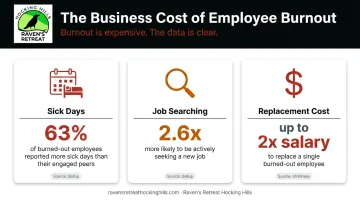
The numbers are hard to ignore. Gallup reports that burned-out employees are 63% more likely to take a sick day and 2.6 times as likely to be actively seeking another job. SHRM's 2024 data found burned-out workers job-searching at nearly triple the rate of their peers — 45% versus 16%.
Replacing an employee can cost up to twice their annual salary, according to McKinsey. Multiply that across even a small team experiencing high turnover, and the financial case for prevention becomes obvious.
The subtler cost is harder to quantify: disengaged teams make fewer creative leaps, avoid difficult conversations, and gradually withdraw from collective effort. That erosion compounds quietly — and does real damage.
What a change of environment actually does:
A 2025 Frontiers review of restorative environment research confirms that natural, off-site settings help people recover directed attention and improve cognitive performance — the mental reset that most employees desperately need. Leaving the work environment isn't symbolic. It's physiological.
The Business Case for Investing in Employee Wellness
Corporate wellness retreats sit at the intersection of two well-documented needs: stress reduction and team cohesion.
Research is clear that team-building interventions produce medium-effect improvements in trust, cohesion, and team outcomes — and that structured debriefs can improve performance by around 25%. Retreats give you both the intervention and the debrief in one structured experience.
What metrics can't fully capture is what happens to hierarchy. Away from org charts and status signals, people show up differently. New voices emerge. Long-held tensions surface in more productive ways.
The APA's 2024 Work in America survey found workers with higher psychological safety were nearly twice as likely to report high productivity — and retreats are among the most effective ways to build it. That shift happens through:
- Shared experiences that create common ground across seniority levels
- Unstructured time that surfaces informal relationships and trust
- Facilitated conversations that wouldn't happen in a conference room
The practical implication is this: a retreat isn't a perk. It's infrastructure for the team you're trying to build.
Corporate Wellness Session Ideas to Recharge Your Team
The strongest retreat agendas don't default to a single category of experience. The best ones layer physical, creative, reflective, and social moments — meeting employees where they are rather than prescribing a single path to recovery.
Nature-Based and Outdoor Activities
Spending time in nature is measurably effective for stress reduction. A 2019 Frontiers in Psychology study found that urban nature experiences produced a 21.3% per hour drop in salivary cortisol beyond normal daily decline, with the greatest stress-reduction efficiency at just 20–30 minutes. Forest bathing research consistently shows reductions in blood pressure, heart rate, and stress hormones alongside improvements in mood and vigor.
High-impact outdoor options for corporate groups:
- Guided forest bathing (shinrin-yoku) sessions focused on sensory immersion
- Group nature walks with facilitated reflection prompts
- Trail hiking with varying difficulty levels to keep it inclusive
- Outdoor functional fitness circuits integrated into the landscape
- Wildlife observation and quiet nature time
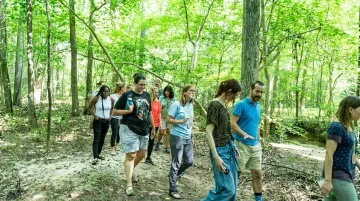
One important design note: inclusivity matters. Not every team member has the same fitness level or mobility. Offering tiered activity options — a challenging trail hike alongside a gentler forest walk — keeps the focus on shared experience rather than athletic performance.
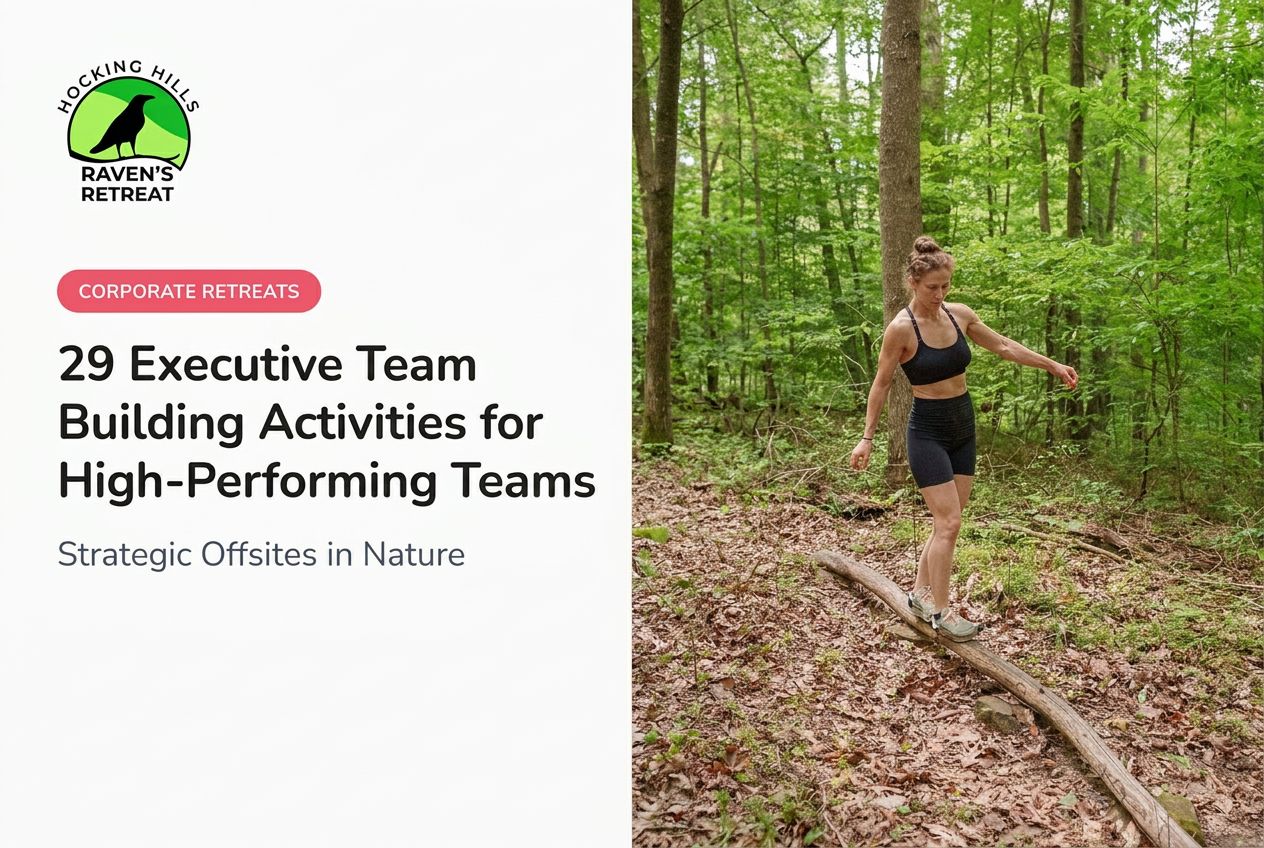
At Raven's Retreat Hocking Hills, the 58-acre preserve includes over a mile of private hiking trails with 220 feet of elevation change, designated forest meditation zones, and BioFit functional fitness stations nestled directly into the landscape.
Corporate groups frequently use the morning trail circuit — structured fitness stations woven through forest immersion — as a reset that carries energy into the rest of the day's agenda.
Mindfulness, Meditation, and Breathwork
A 2025 randomized clinical trial published in JAMA Network Open found that employees assigned to guided meditation showed significant improvements in stress, burnout, anxiety, and overall well-being at eight weeks. A separate 2019 evidence map reviewed 175 systematic reviews and confirmed consistent workplace mindfulness benefits for reduced distress.
The practical value of these sessions extends beyond in-retreat relief. The tools employees take home — a breathwork sequence, a grounding practice — are what make the benefit compound over time.
Effective mindfulness offerings for retreats:
- Guided meditation in dedicated outdoor or indoor spaces
- Breathwork sessions targeting somatic stress release
- Sound baths — immersive, passive, and highly accessible for teams with no prior meditation experience
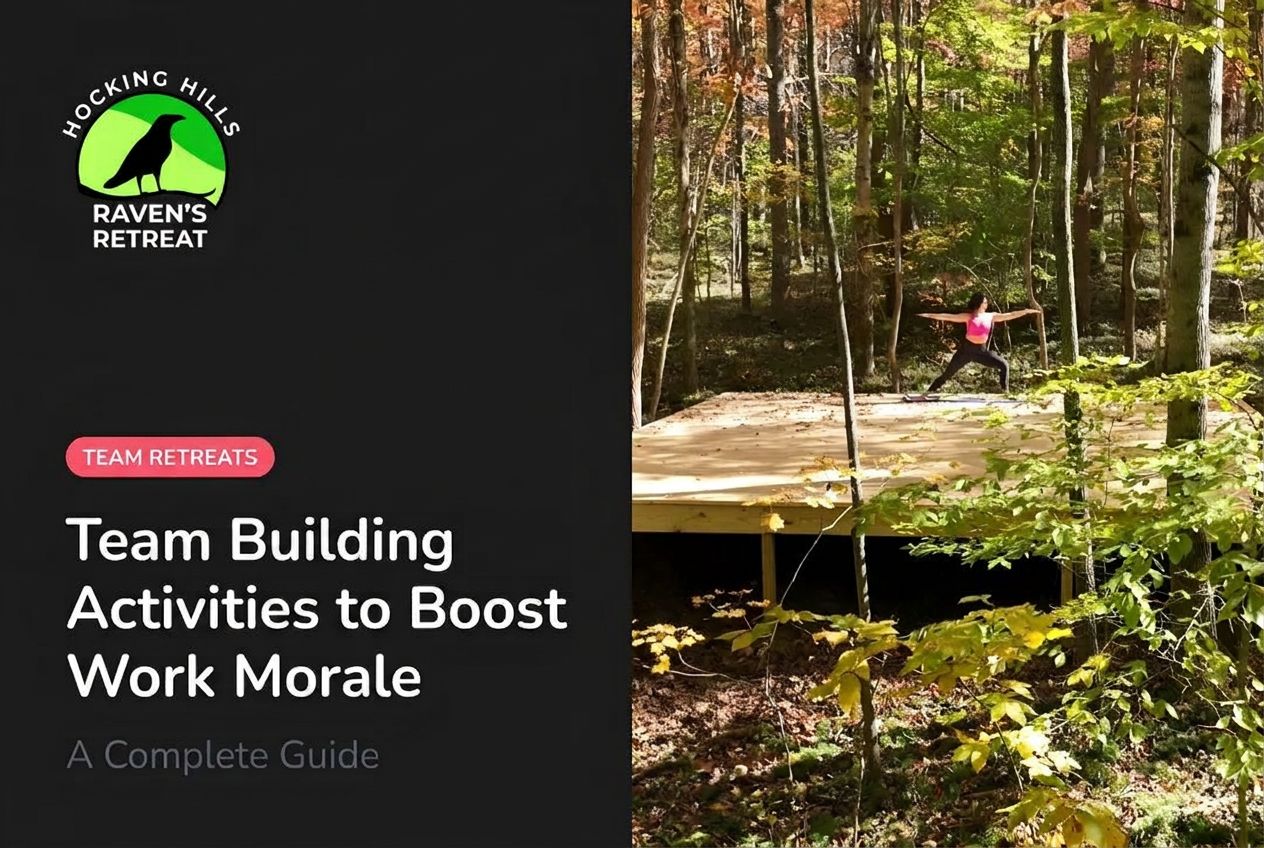
- Sunrise or sunset yoga on an elevated outdoor platform
Sound baths have gained traction as a corporate offering specifically because they require no prior skill. Employees who would resist a traditional meditation session often find sound healing deeply restorative, and the shared vulnerability of the experience builds unexpected team connection.
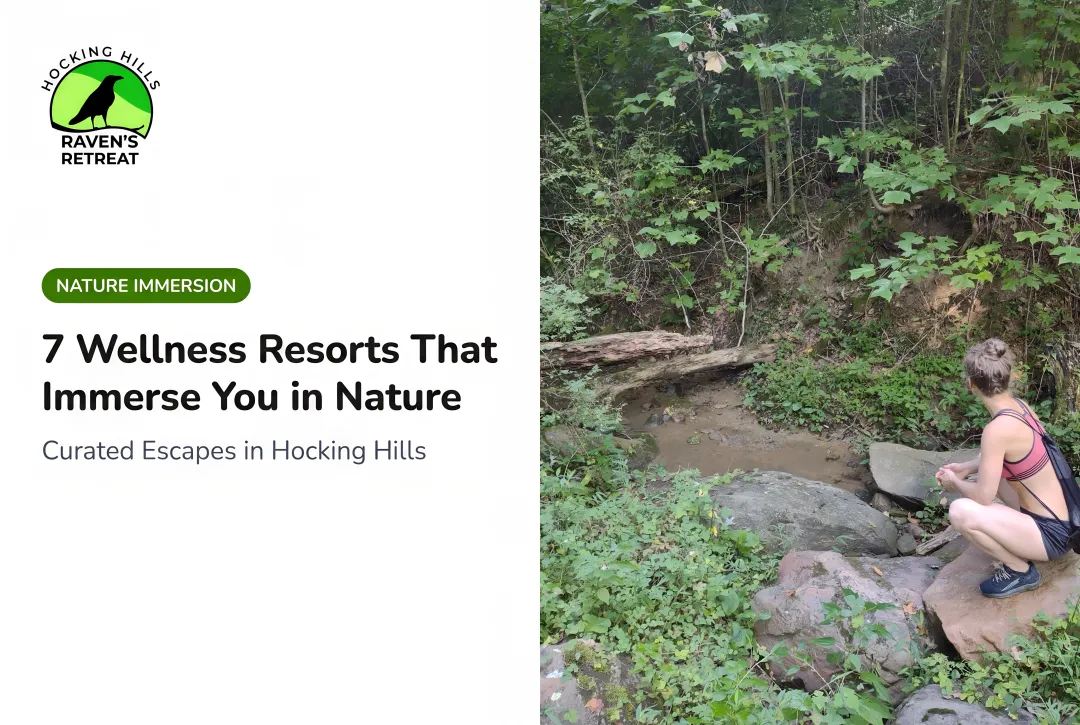
Raven's Retreat offers a 24-by-24-foot elevated forest platform for outdoor sessions, multiple designated forest meditation zones (including one beside a creek at the deepest point of the preserve), and an indoor Shala movement space for weather-protected practice. All mindfulness and breathwork sessions are delivered by certified practitioners coordinated through the retreat's wellness network, including co-founder Raven Morgan, who is herself a certified breathwork coach.
Creative and Art-Based Experiences
A peer-reviewed study found that 45 minutes of visual art-making reduced cortisol in 75% of participants — regardless of prior artistic experience. For corporate teams, creative sessions serve a specific purpose: they quiet the analytical, problem-solving mind and create a different mode of engagement that often unlocks fresh thinking.
Creative formats that work well for corporate groups:
- Guided painting, sculpting, or ornament-making classes
- Journaling and nature-inspired creative writing
- Art tours through immersive installations on the retreat property
- Live art performances as group experiences
Raven's Retreat Hocking Hills offers a particularly distinctive option: live sculpture performances by co-founder and master sculptor Dustin Weatherby, where corporate groups watch a raw log transform into finished sculpture in real time. These live sculpture performances typically run 3+ hours. Dustin Weatherby's sculpting work has also been featured on Disney+, the History Channel, and Extreme Makeover: Home Edition.
Unlike structured team-building exercises, these sessions are shared witnessing of craft and adaptation — something teams frequently describe as unexpectedly moving. Groups can also commission a custom piece to take home as a permanent reminder of the retreat.
Team Building and Reflective Workshops
Structured workshops address what nature and creativity cannot fully reach on their own: the specific workplace dynamics that have built up over months or years.
Workshop formats worth building into the agenda:
- Open dialogue sessions with psychological safety frameworks
- NLP (Neuro-Linguistic Programming) coaching for mindset and behavioral work
- Somatic coaching and authentic connection exercises
- Volunteer or community service activities that build collective purpose
The goal of these sessions isn't to resolve every organizational challenge in two days. It's to create conditions where honest conversation feels safer — and where team members leave with a different sense of each other than when they arrived.
How to Plan a Corporate Wellness Retreat
Set Clear Goals Before You Plan Anything
Every other planning decision (venue, duration, activities, budget) flows from one question: what does this team actually need right now?
Common corporate retreat goals:
- Stress reduction and burnout recovery
- Team bonding after remote work or rapid growth
- Creative recharge before a major strategic cycle
- Leadership alignment and culture building
- Strategic planning in a focused, distraction-free environment
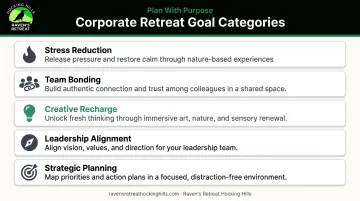
Getting specific here prevents the most common retreat failure: building a program that tries to do everything and accomplishes none of them well. Pick one or two primary goals. Let those drive the agenda.
Build a Balanced Agenda
The most common planning mistake is overscheduling. A packed itinerary signals that the organization doesn't trust employees to use unstructured time well — and it defeats the purpose of a wellness retreat.
Agenda design principles:
- Alternate structured sessions with genuine downtime (not "free time" that becomes informal work)
- Build in transition time between activities — people need to process
- Include at least one experience per day that has nothing to do with work goals
- Plan communal meals as connection time, not working lunches
Practical pre-retreat steps:
- Send a brief survey to understand preferences, energy levels, and any specific needs
- Collect dietary restrictions and accessibility requirements early
- Ensure remote employees have travel and lodging support confirmed before the agenda is finalized
Gather Feedback to Improve Future Retreats
One retreat can shift team energy. A recurring retreat program shapes culture over time. That shift only happens if you collect feedback and act on it.
Collect structured post-retreat data through a short survey that measures:
- Stress levels before and after
- Sense of team connection and psychological safety
- Which activities delivered the most value
- What participants would change
The CDC's Workplace Health Model treats this kind of evaluation as essential to any workplace wellness strategy. Tracking absenteeism, engagement scores, and retention trends before and after the retreat gives you concrete data to justify future investment and refine the program over time.
What to Look for in a Corporate Wellness Retreat Venue
The venue isn't just logistics — it's the first signal to your team that this experience is different. A standard hotel conference room with motivational posters doesn't create the psychological shift a retreat requires. The environment itself needs to communicate: this matters, and we're doing something different here.
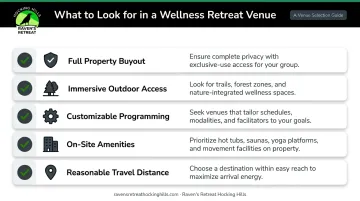
Key qualities to evaluate in a retreat venue:
- Full property buyout versus shared hotel facilities changes the entire psychological dynamic — privacy signals intention
- Immersive outdoor access — not just scenic views, but programming that supports guided forest bathing, trail walks, and outdoor sessions
- Customizable programming — Does the venue integrate your specific wellness goals, or are you choosing from a generic menu?
- On-site amenities — Gathering spaces, wellness infrastructure (saunas, hot tubs, movement spaces), and high-speed connectivity for hybrid work needs
- Reasonable travel distance — the best retreat is one people actually attend
Raven's Retreat Hocking Hills is a strong example of what this looks like in practice: a 58-acre private nature preserve near Laurelville, Ohio, offering full property buyout for exclusive use by your team. The property accommodates up to 18 overnight guests total — the Sculptor's Art Lodge sleeps 16 and the Sculptor's Art Bungalow accommodates an additional 2 — and sits within reach of several major Midwest cities, roughly one hour from Columbus, two from Cincinnati, and 2.5 hours from Cleveland and Pittsburgh.
The Art Lodge features an open-plan gathering space, a dedicated indoor movement studio (the Shala), high-speed Wi-Fi (300+ Mbps), and a presentation screen — so work sessions happen, but nothing feels like a conference room.
Customizable add-ons include:
- Certified yoga instructors and breathwork facilitators
- Guided forest bathing and sound healing
- Plant-based private chef catering
- Live sculpture performances by master sculptor Dustin Weatherby
- NLP coaching
Each element is intentional — built for teams that want the retreat to actually feel like one.
Frequently Asked Questions
What is the average cost for a corporate wellness retreat?
Costs vary significantly based on group size, duration, venue type, and programming. Key drivers include lodging, meals, facilitation, wellness add-ons, and travel. Private venue buyouts typically offer better focus and value than large hotel packages, where your group competes for space and attention.
What are the corporate wellness session ideas?
The main categories covered in this article are: nature-based activities (hiking, forest bathing, outdoor circuits), mindfulness and meditation (guided sessions, breathwork, sound baths), creative experiences (art workshops, live sculpture performances), and team-building workshops (NLP coaching, open dialogue, connection facilitation). See each section above for detail.
How long should a corporate wellness retreat be?
Even a single-day retreat produces measurable stress reduction and connection benefits. Multi-day retreats (two to three days) allow for deeper nervous system recovery, deeper engagement with wellness practices, and the kind of organic relationship-building that doesn't happen in a single session. For most teams, two days hits the sweet spot.
How do you measure the ROI of a corporate wellness retreat?
Track pre- and post-retreat employee surveys on stress, engagement, and psychological safety, alongside absenteeism rates, retention data, and job-search intent scores. The most meaningful results typically appear over weeks and months after the retreat, not immediately on return to the office.
What should be included in a corporate wellness retreat agenda?
A balanced agenda includes at least one group wellness activity, one team-building or reflective session, one creative or experiential moment, healthy shared meals, and built-in free time for rest and informal connection. Avoid scheduling every hour.
What makes a good corporate wellness retreat venue?
Privacy, direct access to nature, customizable programming, and an environment that feels genuinely different from daily work settings are the top factors. Smaller, dedicated properties — like a private nature preserve with full-buyout availability — consistently outperform large hotel venues for focus, immersion, and the psychological distance that makes real reset possible.