Introduction
The meetings still get run. The decisions still get made. From the outside, nothing looks broken.
But something has shifted. The work that once felt meaningful now feels mechanical — problems that used to generate energy now generate dread. A leader who built a career on clarity finds themselves cycling through options without landing anywhere.
This is executive burnout — not collapse, but a quiet erosion of the signal that made leadership feel worth doing.
Leadership burnout hit 56% in 2024, up from 52% the year prior, according to LHH research spanning 2,675 executives across 10 countries. Yet most leaders never name it burnout. They frame it as a performance problem — and go looking for performance solutions.
What actually happens when a leader decides to treat the root cause instead? That's what this article examines — the real work of burnout recovery coaching, from the first session audit to the environment where that work happens best.
Key Takeaways:
- Executive burnout shows up as reduced decision quality and emotional withdrawal long before it's named
- Burnout is a systemic mismatch, not a personal failure — the WHO classified it as an occupational phenomenon
- Effective coaching starts with an energy audit, not time management advice
- Recovery environment directly affects how quickly the process works
- Structured coaching has randomized-trial evidence for burnout reduction in high-pressure roles
What Executive Burnout Actually Looks Like at the Leadership Level
Executives rarely walk into a coaching engagement saying "I'm burned out." They say things like "I've lost my edge" or "everything takes longer than it used to" or "I don't care about things I used to care about."
They frame it as a performance problem. So they try performance solutions — better systems, tighter scheduling, stronger delegation frameworks. When those don't work, they try harder. That's when burnout deepens.
The Behavioral Patterns Worth Recognizing
Executive burnout has a distinct behavioral fingerprint that differs from ordinary occupational stress:
- Decision avoidance that looks like perfectionism — cycling endlessly rather than committing
- Emotional withdrawal that reads as professionalism — flat affect, reduced availability, fewer genuine conversations
- Over-scheduling as a defense mechanism — filling every hour to avoid the silence where the real problem lives
- Diminished care about outcomes that previously mattered — a reliable early signal that something has shifted
These patterns get misread because they often look functional. A withdrawn leader seems composed. An over-scheduled one seems productive. The behavioral disguise is part of what makes executive burnout so hard to catch early.
The Identity Layer
What separates executive burnout from general occupational stress is identity entanglement. When a leader's sense of worth becomes fused with their performance (a fusion that develops over years, not overnight), exhaustion stops being a professional problem — it becomes an existential one.
Reducing workload feels like self-erasure, delegating feels like admitting inadequacy, and resting feels irresponsible. These are the logical outputs of an identity built entirely around being the person who handles everything.
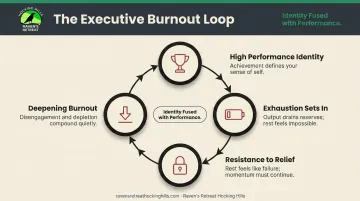
Until coaching reaches that identity layer, any productivity intervention will eventually collapse under the weight of the patterns driving it.
Burnout Is a System Problem, Not a Personal Failing
Before any useful coaching can happen, one framing shift has to occur: burnout is not a character flaw.
In 2019, the WHO updated its International Classification of Diseases to classify burn-out as an occupational phenomenon — not a medical condition, and not evidence of weakness. The WHO defines it as a syndrome resulting from chronic workplace stress that hasn't been successfully managed, with three dimensions: energy depletion or exhaustion, increased mental distance or cynicism toward the job, and reduced professional efficacy.
That last dimension matters for executives. Burnout doesn't just make you tired — it degrades the quality of your professional output. The exhaustion and the performance decline are two symptoms of a single, unresolved systemic pressure.
The Six Mismatch Factors
Leiter and Maslach's foundational research identifies six organizational conditions where misalignment predicts burnout:
| Factor | What Mismatch Looks Like |
|---|---|
| Workload | Demands chronically exceed capacity |
| Control | Limited autonomy over how work gets done |
| Reward | Effort isn't recognized or compensated fairly |
| Community | Isolation, conflict, or lack of support |
| Fairness | Inconsistent standards or perceived inequity |
| Values | Role requires compromising personal principles |
When two or three of these misalign simultaneously, burnout becomes a predictable outcome rather than a remote possibility. Personal resilience tactics can't fix a systems problem — they just delay it.
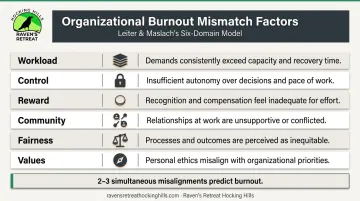
A good coach doesn't help an executive endure a broken system more gracefully. They help identify which parts of the system need redesigning.
What Happens Inside the Coaching Room: A Session-by-Session Breakdown
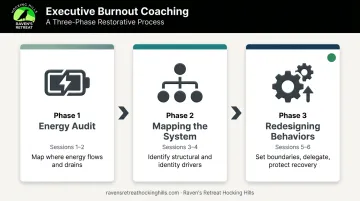
Executive burnout coaching doesn't start with time management frameworks or productivity hacks. It starts with careful listening — for what the executive isn't saying yet. The arc of a well-structured engagement typically moves through three phases.
The Energy Audit (Sessions 1–2)
Early sessions don't map calendar time. They map energy expenditure. The coach and executive trace where energy flows in versus where it drains across responsibilities, relationships, and tasks, identifying where meaning has eroded.
Most executives are surprised by what this audit reveals. The issue isn't volume — it's the cost of specific work. A 90-minute meeting with one person can be energizing; a 20-minute email thread with another can leave them depleted for hours.
The audit surfaces these patterns, often for the first time.
A common early insight: there's almost no genuine recovery time built into the week. Not rest disguised as a short break, but actual psychological detachment from work demands. Recovery literature identifies this detachment as central to the body's ability to unwind. Without it, the tank never refills.
Mapping the System (Sessions 3–4)
Mid-engagement sessions turn systemic. The coach explores whether the executive is carrying work that belongs to their team, compensating for structural gaps, or holding responsibilities out of identity rather than necessity.
The delegation question becomes a diagnostic tool here: not about control, but about identity. Many burned-out leaders built their careers on being the person who handles everything. Delegating feels risky not because they distrust their team, but because being indispensable is inseparable from how they understand their own value.
Recognizing this pattern (actually seeing it, not just intellectually acknowledging it) is often the critical turning point in recovery coaching. It's the difference between adjusting a schedule and redesigning a relationship with work.
Redesigning Behaviors (Sessions 5–6)
Later sessions produce concrete outputs:
- A clear delegation list tied to role priorities
- Specific boundary protocols: when email stops, which meetings can be declined without political cost
- A recovery plan built around the executive's actual life, not a generic wellness prescription
The key inflection point comes when the executive stops asking "How do I push through this?" and starts asking "What is this exhaustion telling me about how I'm working?" That shift, from endurance to self-awareness, is where burnout coaching earns its keep. The boundary protocols get set. The delegation list gets used. The recovery time actually gets protected.
The Tools and Techniques Used in Executive Burnout Coaching
A burnout coaching engagement draws from several distinct domains depending on what the executive needs.
Most engagements draw from five core areas:
- Values realignment: Maslach's research identifies values misalignment as one of the most significant burnout drivers. For executives, a values gap often sits quietly beneath years of "just getting on with it." When the role requires consistently compromising what matters, exhaustion accumulates faster than any workload change can offset.
- Boundary-setting as a skill: Coaches help executives develop specific communication norms, meeting structures, and exit strategies for responsibilities that are no longer theirs. These are behavioral scripts, not philosophical commitments — ones designed to hold up under organizational pressure.
- Somatic and mindfulness-based tools: Breathing practices and body-based awareness exercises help executives recognize stress signals earlier, before they show up as decision paralysis or emotional flatness. The goal is detection, not relaxation — building the internal vocabulary to catch "I'm at 30% capacity" before it becomes "I haven't slept properly in three weeks."
- Ongoing accountability: The organizational conditions that produced burnout don't pause during recovery. When old patterns reassert themselves (and they do), the coach holds the line on new behaviors across the full engagement.
- Knowing the coaching-therapy boundary: Coaching is behavioral, forward-focused, and aimed at redesigning how the executive works. Therapy addresses clinical conditions, trauma, or deeper psychological roots. Some executives benefit from both simultaneously. Good coaches recognize when to refer out and communicate that directly.
Why the Setting for Coaching Matters More Than You Think
Recovery work done in the same environment that produced the burnout faces a specific obstacle: the nervous system doesn't know it's supposed to be recovering.
Research confirms that acute stress can impair core executive functions — the prefrontal processes responsible for reflection, decision-making, and behavioral change. When familiar workplace cues are present, the body stays in a low-grade state of alert. Genuine reflection is harder. New behaviors feel more abstract. The coaching conversation happens, but less of it lands.
This is why environment is a strategic variable, not a preference.
What Immersive Settings Change
Nature-based settings reduce this baseline arousal in measurable ways. A 40-minute nature walk has been shown to enhance neural indices of executive attention — the same cognitive resources that burnout degrades. Combined with psychological detachment from work demands, leaders arrive at insights in concentrated retreat formats that might take weeks of weekly sessions to surface.
Leaders leave the stress-associated environment. Cue-triggered arousal drops. Attention restores. The uninterrupted time creates space to examine role design, identity, and values without the phone buzzing with another urgent request.
Raven's Retreat as a Recovery Environment
For executives and small mastermind groups seeking exactly this kind of container, Raven's Retreat Hocking Hills — a 58-acre private nature preserve near Laurelville, Ohio — offers full property buyouts specifically suited to intensive coaching engagements.
Raven's Retreat Hocking Hills has two reservable properties: the Art Lodge, which sleeps up to 16 guests overnight, and the Art Bungalow, which sleeps 2 - together accommodating a maximum of 18 guests. Both spaces are well-suited for structured coaching sessions, with open, comfortable working areas and high-speed Wi-Fi available throughout.
The outdoor environment is designed to support the recovery process between structured sessions:
- Designated forest meditation zones for unstructured decompression
- Elevated 24×24 yoga platform set into the forest
- Wellness trail with over a mile of private hiking
- Infrared cedar sauna for somatic recovery

Add-on experiences for executive groups include somatic breathwork, forest bathing with certified guides, sound healing, guided meditation, NLP coaching, and live sculpture performances by co-owner and master sculptor Dustin Weatherby.
The property is one hour from Columbus and accessible from Cincinnati, Cleveland, and Indianapolis. Custom retreat flows can be designed through a complimentary consultation with co-founder Raven, who works with groups to balance structured coaching work with intentional recovery time and nature immersion.
What Changes After Executive Burnout Recovery Coaching
The early changes tend to be practical and specific. Decision quality improves within the first two months. Emotional availability returns — team engagement scores shift, and people notice. Weekends start feeling like weekends rather than low-productivity extensions of the workweek.
A 2024 randomized clinical trial published in JAMA Network Open found that three months of coaching by professionally trained peers reduced overall burnout by 21.6% in physicians, compared to a 2.5% increase in the control group. Interpersonal disengagement dropped by 30.1%, while professional fulfillment increased by 10.7%. The study involved physicians rather than executives, but the population shares key characteristics — high-pressure, high-stakes professional roles where burnout represents both a personal and performance crisis.
A 2023 study in Frontiers in Psychology specifically examining executive coaching found it can move leaders toward more favorable burnout and vigor trajectories — supporting coaching as a meaningful intervention at the leadership level, not just in clinical populations.
The longer-term change is harder to quantify but more significant. Leaders describe a shift from leading through adrenaline — reactive, endurance-based, running on accumulated momentum — to leading through conscious choice.
That shift means knowing where their energy actually belongs, choosing what they take on, and treating recovery as a condition for sustained performance rather than a reward for surviving it. For most executives who've spent years delivering results on an empty tank, working with awareness of capacity turns out to be the more difficult skill to build — and the one that matters most.
Frequently Asked Questions
What is the average cost for an executive coach?
Executive coaching fees vary widely based on coach experience, engagement length, and whether the arrangement includes assessments or stakeholder interviews. Burnout-focused engagements tend to run higher than single-issue coaching given the depth of work involved. The ICF's Global Coaching Study is the most reliable source for current market benchmarks — and many employer wellness programs and EAPs now cover coaching costs, worth checking before engaging privately.
What is the 42% rule for burnout?
The "42% rule" appears in various wellness publications but doesn't map to a single authoritative research finding in executive burnout science. A related Gallup finding: employees who have meaningful choice over their tasks are 43% less likely to experience high burnout — suggesting that control over how work gets done is among the most protective factors leaders can build into their roles.
What is the 70/30 rule in coaching?
The 70/30 principle — the coach speaks approximately 30% of the time while the client speaks 70% — reflects core listening guidance published by the ICF. In burnout coaching specifically, this ratio matters: the executive needs space to surface their own insights rather than receive advice. Telling a burned-out leader what to do adds to the cognitive load — helping them hear themselves think is the actual work.
How long does executive burnout recovery coaching take?
Most executives experience meaningful shifts within 3–6 sessions over 6–12 weeks. Full behavioral change — where new patterns hold under organizational pressure — typically takes around six months. The timeline depends on how deeply burnout has set in and whether the work environment supports new patterns or actively undermines them.
How is executive burnout coaching different from therapy?
Coaching is behavioral, forward-focused, and aimed at redesigning how the executive works — including role boundaries, delegation, recovery habits, and values alignment. Therapy addresses underlying mental health conditions, trauma, or clinical symptoms. Both can be valuable simultaneously when burnout overlaps with depression, anxiety, or other clinical concerns that coaching alone isn't equipped to address.