A silent retreat sounds simple: stop talking, go somewhere quiet, come back refreshed. But anyone who has actually sat in sustained silence knows that removing sound doesn't automatically produce peace. The mind fills the vacuum with its own noise.
What separates a genuinely transformative silent retreat from an uncomfortable long weekend is design. Every element — the space, the soundscape, the schedule, the art on the walls — either deepens silence or quietly undermines it. This article explores what goes into building that kind of experience, and why the difference matters.
Key Takeaways
- Silence works through deliberate structure and curated environment, not just the absence of talking
- Natural soundscapes actively restore the nervous system — birdsong and water are functional, not decorative
- Removing decision-making from guests' days frees cognitive energy for inner work
- Art without verbal context becomes a direct channel for meaning and reflection
- First-day discomfort is normal and expected — a sign the experience has begun
More Than Quiet: What Defines a Truly Transformative Silent Retreat
There's a difference between a quiet afternoon and what meditation traditions call noble silence. According to the Goenka Vipassana Code of Discipline, noble silence means "silence of body, speech, and mind" — no gestures, no written notes, no devices. Every channel through which social signaling and information exchange normally flow gets closed.
Ordinary quietness still leaves the mind running its usual loops: planning, reviewing, rehearsing conversations. Noble silence, as a designed attentional container, interrupts those loops at the source.
The Shift Retreatants Describe
Most people arrive at a silent retreat in a state of low-grade restlessness. The first hours feel unproductive, even wrong. Experienced retreat teachers consistently describe an initial phase of discomfort — boredom, the urge to check a phone, fidgeting — before something begins to settle.
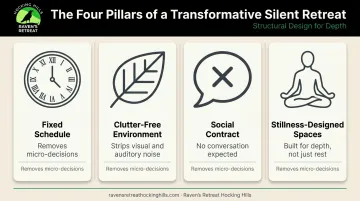
Structure is what makes that settling possible:
- A fixed schedule that removes constant micro-decisions
- An environment stripped of visual and auditory clutter
- A social contract where no one expects conversation
- Spaces designed specifically for stillness, not just rest
The retreat's structure holds the silence while the mind gradually releases its grip on busyness. Research published in PNAS supports this directionally — a 7-day Zen retreat study found measurable pre/post brain function changes in non-meditators after intensive residential practice. The shift takes time — and how well the retreat is designed determines how much of that time is spent struggling versus settling.
The Design Philosophy: Intentionality in Every Detail
Behind every well-designed silent retreat is a set of values that determines what gets included, what gets removed, and how a guest's day unfolds. That philosophy is what separates a pleasant property from one that actually changes something in the people who visit it.
Removing Decision Fatigue
Decision fatigue research — specifically a 2018 conceptual analysis from NIH — documents how repeated decisions degrade self-regulation and lead to avoidance behaviors. Pre-arranged meals, clear schedules, and curated spaces aren't luxury conveniences. They're cognitive load management.
When guests don't have to decide where to eat, what to do at 9am, or whether to turn left or right on a trail, that freed attention turns inward — which is the whole point.
Sensory Intentionality vs. Sensory Deprivation
A common misconception: silence retreats aim for sensory blankness. They don't. Research in restorative environments — including Swedish landscape architecture work on perceived sensory dimensions — shows that the right sensory inputs actively support psychological recovery. Removing all stimulation has the opposite effect. The goal is deliberate curation of what remains.
At Raven's Retreat Hocking Hills, co-creators Raven Morgan and master sculptor Dustin Weatherby have applied this philosophy across their 58-acre private preserve near Laurelville, Ohio. Their stated intention is deliberate: "We create every part of Raven's Retreat very intentionally." That includes:
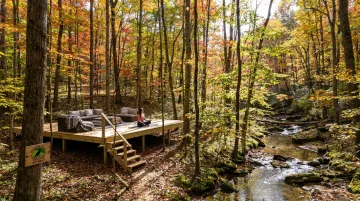
- Two dedicated meditation zones deep in the forest — one with ergonomic seating and a multi-canopy view, another at the lowest, most secluded point of the preserve beside a creek
- Wildlife-friendly lighting (yellow and green bulbs) that reduces glare and preserves the natural night environment
- The lodge bedrooms have no screens — no TVs, no monitors — creating a space where rest and presence come naturally
- Slow, winding trails designed to encourage wandering rather than purposeful movement
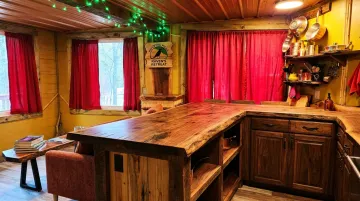
The eco-conscious design goes further. Dustin used reclaimed materials throughout, including black walnut salvaged from a tornado in the Hocking Hills, extending construction timelines so that every material choice aligned with the land's conservation mission.
Guests sense that care without being told about it. A space built with that level of restraint and consideration communicates something before a single word is spoken — and silence, to do its work, needs exactly that kind of ground.
Nature as the Foundation of Silence
Nature does active work in a silent retreat. The research supporting that is substantial.
What Natural Sounds Actually Do
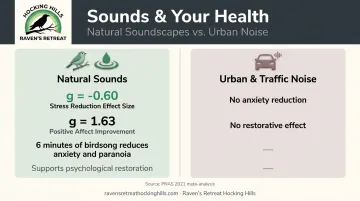
A 2021 meta-analysis in PNAS covering 18 publications found that natural sounds improved health and positive affect with an effect size of g = 1.63, and reduced stress with g = -0.60. Water sounds produced the strongest positive outcomes; birdsong most effectively reduced stress and annoyance.
Separately, a 2022 randomized experiment with 295 participants found that just 6 minutes of birdsong decreased state anxiety and paranoia. Traffic noise did not.
Natural soundscapes measurably shift physiological and psychological states — effects that engineered environments can't replicate. That distinction matters when designing a retreat around silence.
Immersion, Not Just Exposure
Raven's Retreat illustrates why a full preserve matters more than a garden. The 58-acre property contains four creeks, a pond, natural springs, dawn birdsong, and night choruses of crickets and frogs. Guests don't access nature on a schedule; they are continuously inside it. The retreat describes this as a "living sound bath" that teaches surrender into presence.
The movement component matters too. A 90-minute nature walk reduced rumination and subgenual prefrontal cortex activity versus an urban walk, according to research published in PNAS in 2015. Raven's Retreat provides over a mile of private hiking trails with 220 feet of elevation change — enough variation to support contemplative walking without becoming a fitness challenge.
What nature immersion provides in a retreat context:
- Natural acoustic environment that supports mental restoration and quiet attention
- Visual rest from advertisements, screens, and artificial light
- Sensory engagement through varied terrain, water features, and forest floor textures that anchor attention to the present
- Wildlife encounters that orient attention outward and interrupt rumination
Art as a Language Beyond Words
When language is removed, something else has to carry the weight of meaning-making. In a well-designed silent retreat, art fills that role.
How Silence Changes the Encounter
Museum research consistently shows that descriptive labels and contextual information alter aesthetic and emotional responses to artwork. When you remove that verbal mediation — no placard, no commentary, no social performance of having the right opinion — the encounter becomes different in kind, not just degree.
In silence, a sculpture doesn't prompt a conversation. It prompts a response. Whatever is arising internally — grief, clarity, resistance, wonder — finds the work and reflects back through it. That makes art in a silent retreat deeply personal in ways that gallery visits rarely are.
Art Woven Into the Environment
The distinction at Raven's Retreat is that art isn't housed in a gallery wing. It's everywhere — integrated into architecture, scattered across trails, growing out of the landscape itself.
Dustin Weatherby's installations throughout the property include:
- "Sally" — a giant sassafras wood carving greeting guests at the lodge entrance
- "Howling Nails" — a coyote sculpture made from recycled nails and screws
- "Steel Black Locust" — a floor-to-ceiling metal tree in the king bedroom
- Trail installations placed throughout the forest, designed specifically as meditation focal points
- The Black Walnut Weatherby Kitchen — an entire kitchen crafted from tornado-salvaged walnut, functioning simultaneously as functional space and artistic statement
Research on the "Handmade Effect" supports what guests intuitively feel: handmade objects are perceived as "made with love," increasing their perceived value through inferred care. Dustin's handcrafted environment communicates, at a level below conscious thought, that someone cared deeply about making this place.
A 2023 study also found that exposure to wooden rooms produced measurable reductions in stress and anxiety — which helps explain why guests so often describe the lodge as immediately calming the moment they walk in.
Live sculpture performances by Dustin are available as an optional silent retreat add-on. Guests watch him transform raw material into finished form over a few hours — no narration, no explanation. The creative process itself becomes the meditation object.
How to Prepare for a Silent Retreat Experience
Preparation shapes the experience before it begins. Spirit Rock Meditation Center notes that retreat practice starts the moment the intention to attend arises, and that logistical and emotional obstacles surface early. Practical preparation reduces friction so arrival feels like landing rather than scrambling.
Before You Arrive
- Reduce digital stimulation in the two to three days before arrival — less scrolling, fewer notifications, earlier evenings
- Set a clear intention — not a goal or outcome, but a quality of attention you want to bring ("openness," "rest," "honesty with myself")
- Inform close contacts that you'll be unreachable — this transforms disconnection from anxious into chosen
What to Bring and What to Leave
Raven's Retreat's packing guidance is instructive: bring a journal, a cushion, layered clothing, and natural toiletries. If you can, leave behind laptops, tablets, and unnecessary electronics. The retreat's philosophy is direct: "While not a physical item, your mindset is just as important as what you pack."
Most well-designed silent retreats — including Vipassana centers, which require phones to be surrendered entirely — ask guests to set aside devices because the reflexive reach for distraction is precisely what prevents the deeper settling that makes silence worth pursuing.
Normalize the First Hours
The early hours of a silent retreat are often the hardest. Expect to encounter:
- Restlessness that has nowhere to go
- Boredom arriving before stillness does
- A strong impulse to speak, check in, or fill the quiet
These aren't signs that silence is wrong for you. They're the surface layer the retreat is designed to move through — and moving through them is how the deeper work begins.
Guest experiences at Raven's Retreat reflect this honestly: many people arrive still tethered to devices, checking emails before bed. By the second day, something shifts. Phones stay in rooms. Time expands. Presence deepens.
Frequently Asked Questions
How do you prepare for a silent retreat?
Reduce screen time and social stimulation in the days before arrival. Set a clear personal intention — a quality of attention rather than a specific outcome. Inform close contacts you'll be unreachable so that disconnecting feels deliberate rather than stressful.
Can you talk during a silent retreat?
Most silent retreats limit speech to brief necessary exchanges — a logistical question for staff, a check-in with a teacher. Social silence among participants is maintained throughout, allowing the deeper layers of mental quieting to occur that ordinary conversation continuously disrupts.
Can a silent retreat improve mindfulness?
Yes. The sustained continuity of silence removes the mental momentum that conversation creates. A 2021 study found meditation retreats were associated with greater increases in mindfulness, lower fatigue, and higher well-being compared to non-meditation vacations. The silence removes the resets that daily life constantly triggers.
How long should a silent retreat be for beginners?
A weekend — two to three days — gives beginners enough time to move through initial discomfort and reach a genuine shift in awareness. Established formats range from Spirit Rock's multi-day programs to Vipassana's 10-day structure; start shorter and build from there.
What is the purpose of a silent retreat?
Not simply to stop speaking, but to create conditions in which the mind can rest deeply, uncover what ordinary busyness conceals, and reconnect to a felt sense of clarity and inner resource. The silence is a method, not the destination.