Marriages don't usually drift apart in dramatic moments. They drift in the quiet ones — the dinners scrolled through on phones, the milestones marked and forgotten, the slow accumulation of ordinary days where love gets assumed rather than expressed. A vow renewal interrupts that drift on purpose.
Unlike the original wedding, which most couples plan amid a rush of logistics and family opinions, a vow renewal belongs entirely to the two people in it. No paperwork. No legal requirements. Just a deliberate decision to stop, look at each other clearly, and recommit with full knowledge of what that commitment actually costs and what it's worth.
This article breaks down why couples choose to renew their vows, what the research says about the psychological and relational significance of doing so, and how to make the experience genuinely meaningful rather than ceremonially empty.
Key Takeaways
- A vow renewal has no legal standing — it exists purely as an act of deliberate, chosen recommitment
- Common motivations include milestone anniversaries, healing after hardship, creating the ceremony they never had, and building recommitment as an ongoing practice
- Intentional recommitment rituals are linked to higher relationship satisfaction and stronger emotional bonds over time
- There is no required timeline: couples renew vows at one year, twenty-five years, or any point that feels meaningful
- Where you renew matters — a private, nature-immersed setting deepens the emotional weight of the ceremony
What Is a Vow Renewal Ceremony?
A vow renewal — sometimes called a vow reaffirmation — is a ceremony in which a married couple chooses to restate or rewrite their promises to each other. As The Knot explains, it is not legally binding and requires no new marriage license, because the couple is already married. The ceremony exists entirely for meaning, not procedure.
That distinction matters. It removes the bureaucratic pressure of a first wedding and replaces it with something rarer: a completely voluntary act.
What a Vow Renewal Can Look Like
The format is as flexible as the couple wants it to be:
- A private exchange between two people, witnessed by no one but each other
- An intimate forest ceremony with a handful of close friends
- A weekend gathering for family and close community
- An annual ritual, practiced quietly and regularly as a relationship checkpoint
Couples hold renewals on beaches, in forests, in back gardens, at retreat venues, in living rooms. There's no template to follow — and that freedom is what makes the ceremony feel personal in a way a first wedding rarely can.
What It Isn't
Vow renewals carry an undeserved reputation as a crisis response. In reality, couples at every stage of marriage use them: to mark a milestone, to step back into their commitment with fresh eyes, or simply because they want to. The ceremony is an intentional act of relationship investment — not a repair, but a choice.
Top Reasons Couples Choose to Renew Their Wedding Vows
Couples cite many different motivations, and none is more valid than another. What drives the decision is personal — but certain reasons surface again and again.
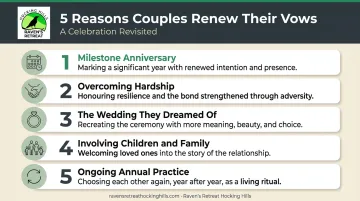
To Celebrate a Milestone Anniversary
Milestone anniversaries — the 10th, 25th, 50th — are among the most common occasions for a vow renewal. They give couples a ceremonial way to honor how far they've come and publicly acknowledge the commitment they've sustained.
These ceremonies often become deeply personal. Couples might:
- Revisit music from their original wedding or return to a meaningful place
- Invite the people who've witnessed their marriage through its seasons
- Write new vows that reflect who they've actually become — grounded in real experience rather than early promise.
To Recommit After Overcoming a Difficult Period
Some couples choose a vow renewal after navigating serious hardship — illness, loss, financial strain, infidelity, or relational struggle. The ceremony marks a new chapter: not erasing what happened, but standing in it honestly and choosing each other again on the other side.
These renewals are often the most emotionally powerful. A 2015 meta-analysis on dyadic coping found that how partners cope with stress together — rather than in isolation — is strongly associated with relationship satisfaction, with perceptions of partner support being especially significant. A renewal ceremony can give that shared survival a name, a ritual, and a forward direction.
To Have the Wedding They Always Dreamed Of
Many couples — particularly those who married young, on a tight budget, or in a ceremony shaped more by family expectations than personal preference — use a vow renewal to finally create the experience they actually wanted.
A renewal removes the external pressures that tend to dominate original wedding days. No seating chart politics. No timeline anxiety. Just the couple, a setting they chose, and words that are entirely their own. For some, this is the ceremony that finally feels like them.
To Involve Children or Extended Family
Children born after the original wedding have no memory of it. A vow renewal changes that — giving kids a chance to witness their parents' commitment firsthand. They can serve as witnesses, offer readings, carry rings, or simply stand there as the family marks something real together.
Some couples use the occasion differently — to thank the community around them. Friends and family who've shown up through the hard years, celebrated the good ones, and quietly supported the relationship deserve to be acknowledged. A renewal can become that acknowledgment.
To Recommit with Intention as an Ongoing Practice
Not every vow renewal is tied to a milestone. Some couples treat it as an annual ritual — a deliberate pause to reflect on the year, reaffirm shared values, and celebrate what they've built.
The Gottman Institute describes annual vow renewal as a way to return couples to intention — a practice that keeps commitment active rather than archived. Each renewal becomes its own record of the relationship: where it's been, what it's weathered, and where it's heading.
The Deeper Significance of Renewing Your Vows
From Hope to Knowledge
The first vows are almost always spoken before a couple truly understands what commitment under pressure looks like. They're spoken with hope — which is beautiful, but incomplete.
A renewal is different. It's made by people who've seen their partner at 2am during a health scare, after a job loss, in the middle of a disagreement with no clean resolution. They've seen the ordinary Tuesday version, the depleted version, the funny and infuriating and genuinely wonderful version — and they're still choosing each other.
Why Rituals Work
Research by Garcia-Rada, Sezer, and Norton published in the Journal of the Association for Consumer Research found that couples with relationship rituals — repeated, symbolically meaningful activities — report more positive emotions, greater relationship satisfaction, and greater commitment than couples without them.
A vow renewal functions as exactly this kind of ritual. It transforms an internal intention into a shared symbolic action, making the couple's commitment visible to themselves and to the people around them.
Active Choice vs. Passive Assumption
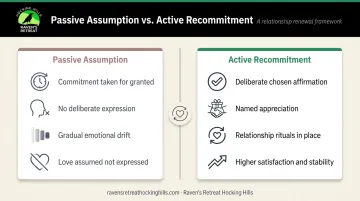
One of the most underrated effects of a vow renewal is the psychological shift it creates: moving from passive assumption to active, deliberate choice.
Long-term relationships are vulnerable to the quiet erosion that comes from taking a partner for granted. A renewal disrupts that. It requires both people to articulate, specifically, what they value, what they're grateful for, and what they're committing to going forward. Research on gratitude in long-term relationships consistently shows that specific, expressed appreciation strengthens relationship quality — not vague sentiment, but named, particular acknowledgment.
The Role of Witnesses
That shift from private intention to public commitment matters. Whether two people or thirty are present, being witnessed changes something. Externalizing a private bond — inviting others into the recommitment — reinforces accountability, shared joy, and social support for the relationship. Research on social networks and romantic relationships indicates that community support and approval are associated with greater relationship stability and commitment over time.
How to Plan a Vow Renewal That Truly Means Something
The most meaningful vow renewals share three qualities: they're personal, intentional, and unhurried.
Start with the Right Questions
Before choosing a venue or writing vows, sit with these:
- What do we want to name from the years we've had together?
- What promises feel different now than they did at the beginning?
- Who do we want present — and why?
- What kind of space allows us to be fully here, not distracted by logistics?
Key Planning Considerations
Size and tone shape everything else. An elopement-style renewal for two feels fundamentally different from a gathering of thirty. Neither is better — but decide what emotional experience you're after first, then build backward from there.
Write new vows. This is the most important detail most couples skip. Repeating the original vows is fine, but rewriting them to reflect who you actually are now — what you've learned, what you want to carry forward — makes the ceremony specific rather than ceremonial.
Choose a setting with intention. The environment shapes the experience more than most couples anticipate. A forest preserve, a private property surrounded by nature, a place with no noise or agenda — these settings make it easier to be present.
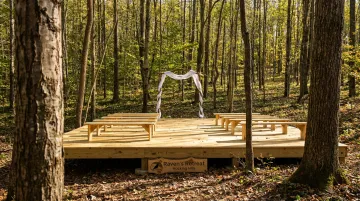
Raven's Retreat Hocking Hills, an adults-only sanctuary on a 58-acre private preserve in Ohio, offers a dedicated forest ceremony space with:
- An elevated platform and rustic arch
- Guest benches already in place
- On-site officiating by Raven Morgan or Dustin Weatherby — both are ordained ministers, so couples can have the ceremony led by the people who know the property best
- Add-on experiences including guided meditation, sound healing, chef-prepared delicious, healthy meals, and forest bathing
Build in unhurried time. The worst version of a vow renewal is one that feels rushed. Book a night or two. Let the ceremony be part of a longer experience rather than the only moment. Give yourselves space to actually feel it.
After the Ceremony
A vow renewal is most valuable when it's the beginning of something, not just a single event. The Gottman Institute describes rituals of connection as intentional practices that help partners consistently turn toward each other — appreciation, presence, weekly check-ins. The renewal ceremony can inaugurate that kind of practice rather than stand alone.
Frequently Asked Questions
What does it mean when a married couple renews their vows?
Renewing vows is a voluntary ceremony where a married couple reaffirms or rewrites their original wedding promises. It carries no legal weight — no new license is required — but holds deep emotional significance as a deliberate, chosen act of recommitment.
What are some promises couples commonly make during a vow renewal?
Vow renewal promises tend to be more specific than original vows. Common examples include committing to continued growth together, promising to choose each other daily rather than by default, pledging honest and kind communication, and honoring each other through whatever challenges come next.
What color dress is appropriate for a vow renewal?
There's no strict dress code. White remains popular and entirely appropriate. Soft neutrals, blush tones, florals, and any color that reflects the couple's style and the tone of their ceremony are all fitting choices — the only real guideline is that it feels like them.
When is the right time to renew wedding vows?
There is no set timeline. Couples renew vows after milestone anniversaries (10th, 25th, 50th), after major life transitions, after periods of hardship, or simply when the moment feels right. Some couples do it annually; others wait decades. There's no wrong answer.
Do you need an officiant or legal paperwork for a vow renewal?
No legal documents, licenses, or certified officiant are required. Since the couple is already legally married, any meaningful person in their lives can lead the ceremony — a friend, a family member, a spiritual leader — or the couple can simply exchange vows privately between themselves.