Introduction
Most executive teams aren't struggling because their people lack talent. They're struggling because strong personalities pull in different directions, unspoken tensions calcify into silos, and decisions that should take days stretch into weeks.
According to McKinsey, companies whose top executive teams work effectively together are 1.9x more likely to achieve above-median financial performance — yet only 21% of senior leadership teams ever reach outstanding status.
Traditional team-building rarely moves the needle at the C-suite level. Trust falls and icebreakers address the wrong problem. What senior leaders actually need are experiences designed to surface honest disagreement, sharpen strategic alignment, and hold up under real pressure.
This guide covers 29 executive team building activities across five categories, so you can match the right experience to your team's actual pain point.
Key Takeaways
- Executive team building must address strategic alignment and decision-making, not just social bonding
- Activities fall into five categories: strategic, communication, creative, outdoor, and reflection
- Nature-based off-sites give executives space to think differently — something structured conference rooms don't allow
- Choose activities based on your team's specific pain point, not popularity or novelty
- Regular structured reflection — monthly or quarterly — outperforms a single annual event every time
Why Executive Teams Need a Different Kind of Team Building
Executive team dynamics differ from general employee teams in one critical way: the downstream impact of dysfunction is exponential. A fractured sales team hurts one department. A fractured executive team damages the entire organization.
Three factors compound this:
- Stronger personalities mean unspoken tensions persist longer and cut deeper
- Higher stakes mean strategic misalignment produces costly, slow-moving decisions
- Organizational distance means the ripple effects of poor collaboration only surface months later
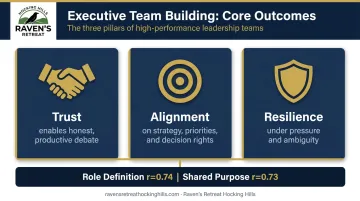
That gap shapes what effective activities actually look like. Forbes Coaches Council contributors note that generic team-building fails senior leaders because it focuses on personality chemistry — not the decision-making clarity and strategic alignment executives actually need. The highest-impact activities focus on three outcomes:
- Trust that enables honest, productive debate
- Alignment on strategy, priorities, and decision rights
- Resilience under pressure and ambiguity
McKinsey's top-team research found that role definition (r=0.74) and shared purpose (r=0.73) are among the strongest correlates of top-team performance. That points to a clear implication: the highest-value activities clarify who owns what and why the work matters — not just whether people get along.
29 Executive Team Building Activities for High-Performing Teams
The activities below are grouped by the primary leadership outcome they address. Identify your team's biggest gap first, then select activities accordingly.
Strategic Decision-Making & Leadership Activities
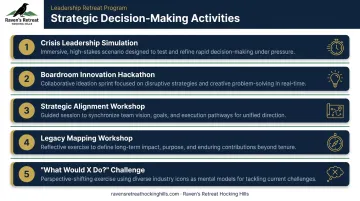
1. Crisis Leadership Simulation Teams receive a realistic, evolving scenario — a PR disaster, sudden budget collapse, or security breach — and must strategize responses under time pressure before presenting decisions to a panel. Simulation-based learning produces 20% higher self-efficacy and 14% higher procedural knowledge than traditional instruction. For executive teams, the real value is in what the debrief reveals: who delegates well under pressure, who freezes, and where cross-functional clarity breaks down.
2. Boardroom Innovation Hackathon Small executive sub-teams tackle a real organizational challenge in 2–4 hours, then pitch solutions to the group. Using an actual business problem is the key design choice — it stops feeling like team building and starts feeling like valuable strategic work. Executives engage more honestly when the output might actually be implemented.
3. Strategic Alignment Workshop (Team Canvas) The Team Canvas is a structured framework where executives collaboratively map shared goals, individual roles, team values, and working agreements on a single visual document. It works best for newly formed leadership teams or teams resetting after conflict — converting vague assumptions into explicit agreements everyone can hold each other to.
4. Legacy Mapping Workshop Leaders individually articulate their core values, key accomplishments, and the impact they want to leave behind — then share in small groups and commit to one concrete next step. This reconnects senior leaders with their "why," which erodes faster than most executives realize during sustained high-pressure periods.
5. "What Would X Do?" Leadership Challenge Each leader approaches a real business challenge as a specific historical or contemporary figure — Bezos, Chouinard, Machiavelli, or whoever fits the problem. Forced perspective-taking loosens cognitive defaults and generates strategic angles that internal groupthink tends to bury.
Communication & Trust-Building Activities
6. Active Listening Pairs One person speaks uninterrupted on a chosen topic while their partner listens, then paraphrases back what they heard before roles reverse. Deceptively difficult for executives conditioned to respond rather than absorb — and the gap between what was said and what was heard is almost always instructive.
7. Conflict Response Workshop Using the Thomas-Kilmann conflict model as a framework, small groups analyze past or hypothetical leadership conflicts and identify their instinctive response style. Teams then develop shared norms for healthier disagreement. The TKI was normed on 8,000 employees and applies across organizational levels, making it a credible and practical framework for executive teams.
8. Heard, Seen, Respected (HSR) This Liberating Structures exercise invites participants to share moments when they felt genuinely valued and heard in a team setting. The emotional specificity of the stories creates a foundation for psychological safety that abstract trust discussions rarely achieve.
9. Silent Leadership Challenge A structured task — building something, navigating an obstacle, solving a puzzle — where verbal communication is prohibited. Executives are forced to lead and coordinate through non-verbal cues alone. The blind spots it surfaces — around presence, body language, and unspoken assumptions — are hard to replicate in any other format.
10. Storytelling Circle Leaders share personal narratives tied to specific life stages or defining moments. Vulnerability at the executive level is rarer than it should be — and when it appears, it builds the kind of trust that holds under real pressure, not just during good times.
11. Temperature Check A brief team sentiment exercise using a weather metaphor or simple 1–10 scale. Underutilized at the executive level because emotional honesty feels risky in high-status groups. Building it into regular leadership meetings normalizes candor and surfaces problems before they become crises.
Creative & Collaborative Challenges
12. Cover Story Exercise Teams design a fictional magazine cover featuring their organization's biggest future success — headlines, pull quotes, images, and all. The creative format forces alignment on vision while making the conversation energized rather than bureaucratic. Teams that can't agree on the headline often discover they're not as aligned as they thought.
13. Improv Lab for Leaders Unscripted improv scenarios — negotiating with a difficult client, pitching an absurd product, building on a colleague's idea in real time — strip away rehearsed executive personas. The core improv principle of "yes, and" maps cleanly onto collaborative responsiveness and adaptability in leadership settings.
14. Dinner Challenge Teams collaborate to cook a meal together with limited ingredients and a time constraint. The shared physical task and informal environment reveal leadership dynamics in ways a boardroom never does. Who takes charge immediately? Who listens? Who problem-solves when the plan breaks down?
15. Egg Drop Engineering Challenge Small teams design and build a protective structure for a raw egg using limited materials before dropping it from height. Constraint-based challenges activate resourcefulness and prototyping thinking — and the competitive stakes create genuine laughter that bonds teams across organizational levels.
16. Mystery Box Brainstorming Give a leadership team a rubber duck, a vintage map, or an absurd prompt and ask them to build a real strategy around it. The forced randomness is the point — it breaks the habit of defaulting to familiar frameworks in teams that have grown formulaic in their thinking.
17. Drawing Together Team members contribute one element at a time to a shared drawing, building a collective artwork. Watch who controls the composition, who builds on others' ideas, and who quietly expands the canvas. Those behavioral patterns map onto how the team creates strategy.
Outdoor & Nature-Based Activities
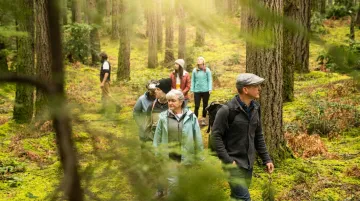
18. Forest Bathing Walk (Shinrin-Yoku) A guided mindful walk through a natural environment where participants slow down, engage all five senses, and observe without agenda. Field experiments involving 280 participants across 24 forests found forest environments associated with lower cortisol, lower pulse rate, and higher parasympathetic nervous system activity (the body's rest-and-recovery state) compared with city environments. For executive teams operating in sustained high-alert mode, this physiological reset has direct implications for decision quality.
19. Outdoor Strategy Scavenger Hunt A competitive, clue-based challenge set in a natural or urban outdoor environment where teams must allocate limited resources, delegate roles, and make fast decisions across checkpoints. The physical movement and time pressure mirror real business decision environments while bypassing the status dynamics that slow down conference room problem-solving.
20. Nature Journaling & Group Reflection Structured solo journaling in a natural setting, using prompts related to leadership vision or team dynamics, followed by small-group sharing. It earns its place on a retreat agenda before intense structured sessions or after emotionally demanding work — the quiet reset makes everything that follows land harder.
21. Orienteering / Wilderness Navigation Challenge Teams use maps — no GPS — to navigate natural terrain to a series of checkpoints. No one has a pre-existing hierarchy advantage. Communication, trust, and shared problem-solving have to develop organically and fast. The challenge works precisely because it's unfamiliar.
22. Campfire Storytelling & Closing Debrief Ending a retreat day at a fire, screens away, leaders reflecting on what they observed, felt, and want to carry forward. Removing status cues and digital distraction in a natural evening setting creates a quality of candor that's difficult to manufacture in any other setting.
23. Immersive Art & Nature Retreat Experience The growing trend of full-property nature retreats for executive teams reflects a recognition that transformation requires genuine environmental change. Raven's Retreat Hocking Hills is a purpose-built example — a 58-acre private preserve near Laurelville, Ohio built specifically for this kind of work. The full property buyout accommodates up to 18, with the Sculptor's Art Lodge, guided forest bathing, live sculpture performances by master sculptor Dustin Weatherby, and fully customizable wellness programming.
The entire property is designed as a living work of art. One CEO forum group put it plainly: "The creative energy was contagious, and the forest hikes were better than therapy."
Reflection, Celebration & Alignment Activities
24. Appreciations Exercise Team members write specific, meaningful affirmations about each colleague and share them aloud or in written form. At the executive level, positive feedback is often crowded out by performance focus — this exercise creates goodwill that persists through difficult decisions and high-stakes disagreements.
25. History Map Teams collaboratively create a visual timeline of their shared journey — challenges faced, pivots made, milestones reached. Restores a sense of shared identity and resilience that's easy to lose when leadership teams are locked in forward focus.
26. Coat of Arms Each leader draws a symbolic crest representing their values, then a partner interprets and presents it to the group. The combination of creative expression and unexpected self-disclosure works even for highly analytical executives who would resist more overtly emotional exercises.
27. Team Retrospective (What? So What? Now What?) A structured reflection framework: review what happened, discuss its significance, commit to next steps. Scalable and repeatable — it embeds continuous improvement into executive culture without requiring a formal retreat. Run it at the end of any significant initiative or quarter.
28. Diversity & Inclusion Roundtable Abstract D&I principles rarely change behavior. Assigning real organizational case studies to executive sub-groups for role-play forces the conversation to specific situations, specific choices, and specific people — the level where behavioral change actually happens.
29. Bus Trip Visioning Exercise A metaphorical alignment exercise: imagine the leadership team as passengers on a bus. Who's driving? Who's navigating? What's the fuel? What are the roadblocks? The metaphor does something formal frameworks don't — it gives people permission to name what they've been thinking but haven't said about direction, decision ownership, and accountability.
How to Choose the Right Activities for Your Executive Team
Start with an honest assessment of your team's primary pain point. The wrong activity for the right group still fails.
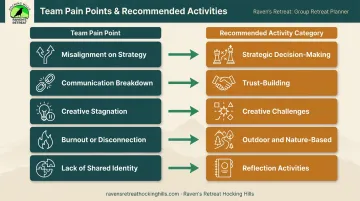
Common pain points and matching activity categories:
- Misalignment on strategy → Strategic Decision-Making activities (Team Canvas, Legacy Mapping, Bus Trip)
- Communication breakdown → Trust-Building activities (Active Listening, Storytelling Circle, Conflict Workshop)
- Creative stagnation → Creative Challenges (Cover Story, Improv Lab, Mystery Box)
- Burnout or disconnection → Outdoor and Nature-Based activities (Forest Bathing, Campfire Debrief)
- Lack of shared identity → Reflection activities (History Map, Appreciations, Coat of Arms)
Four practical selection criteria:
- Team size — Groups under 10 go deeper with unstructured dialogue; larger groups need formats that channel participation without chaos
- Available time — Half-day sessions suit targeted skill work; 1–2 day retreats allow the kind of alignment that doesn't happen over lunch
- Setting preference — Indoor formats work for tactical skill-building; outdoor settings shift perspective and accelerate relationship depth faster than most indoor alternatives
- Primary goal — Strategic (high cognitive load, problem-solving focus) vs. relational (connection, decompression, trust-building)
The most common mistake: choosing activities based on novelty rather than a clear goal. A one-off experience without follow-through rarely sticks. Every activity should end with a structured debrief and one named behavior change the team commits to before leaving the room.
Planning a Successful Executive Team Building Retreat
A well-designed executive off-site doesn't happen by default. It requires deliberate structure.
Key planning elements:
- Define what success looks like for this specific team at this specific moment
- Give participants a voice in activity selection — buy-in rises when people help shape the design
- Choose a venue with physical distance from the office; separation changes how people think and talk
- Protect unstructured time — informal conversations often produce the most lasting breakthroughs
- Close with a debrief that converts shared experience into specific commitments; without it, the retreat becomes a nice memory
That venue choice matters more than most planners assume. Research on Attention Restoration Theory indicates that natural environments restore directed attention by allowing effortless mental processing — directly relevant to executives whose decision-making capacity is chronically depleted.
A PLOS One study found that four days of nature immersion combined with technology disconnection improved creative problem-solving performance by 50%.
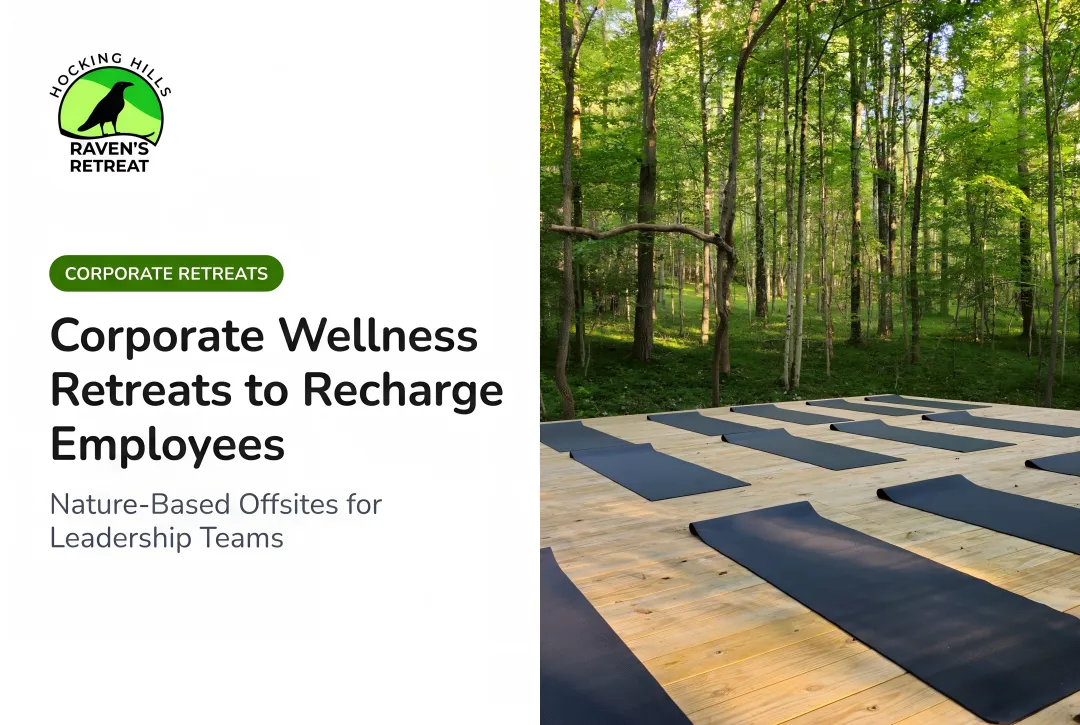
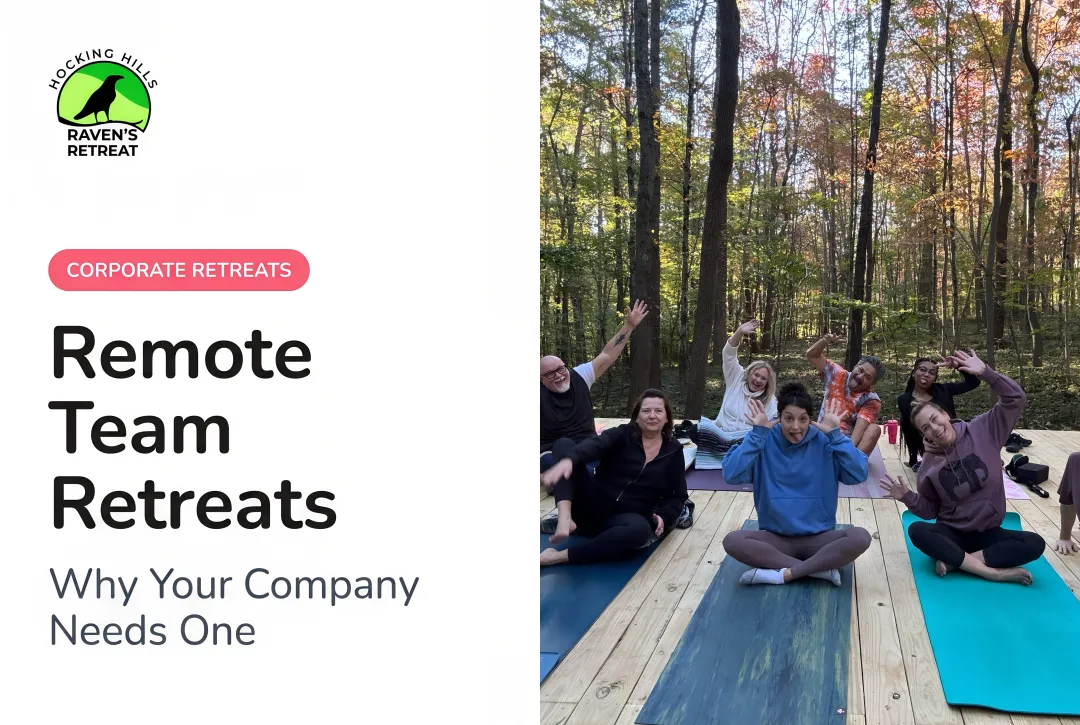
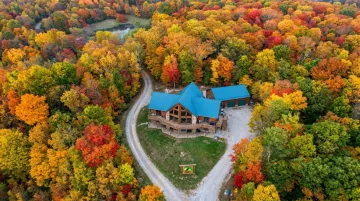
For Midwest and Ohio-based corporate teams, Raven's Retreat Hocking Hills is one venue that delivers on this research. The 58-acre private nature preserve outside Laurelville is available for full property buyout and includes:
- A 4,000-square-foot Art Lodge sleeping up to 16
- A Sculptor's Art Bungalow sleeping an additional 2 (18 overnight guests total)
- 300+ Mbps Wi-Fi for hybrid sessions
- Over a mile of private hiking trails
- Customizable programming: guided forest bathing, live sculpture performances, NLP coaching, yoga, sound healing, and chef-curated catering
A recent corporate retreat guest noted: "Planning was easy and our team left feeling recharged, focused, and more connected than ever." Near-perfect ratings across Airbnb (4.96), VRBO (4.95), and Google (4.97) reflect consistent delivery on that promise.
Conclusion
The 29 activities in this guide give you a strong starting point, but the leadership teams that sustain high performance treat connection, alignment, and honest reflection as ongoing disciplines — not something to schedule once a year and check off.
Start with your team's biggest gap, choose activities with intention, and build in real follow-through. When the team is ready for something genuinely transformative, take them out of the conference room entirely.
If you're planning an executive off-site in Ohio or the Midwest, Raven's Retreat Hocking Hills is worth a conversation. The 58-acre private preserve offers full property buyout, customizable wellness and creative programming, and near-perfect ratings across Airbnb, VRBO, and Google.
Reach out to co-founder Raven directly at 614-783-6143 or book a complimentary consultation call to start designing your team's experience.
Frequently Asked Questions
What makes team building activities effective specifically for executive teams?
Effective executive team building goes beyond social bonding to address strategic alignment, psychological safety, and decision-making under pressure. The most effective activities mirror real leadership challenges — conflict, ambiguity, resource constraints — not generic group tasks that feel disconnected from C-suite realities.
How long should an executive team building retreat last?
Half-day sessions work well for targeted skill-building on a specific challenge. A full 1–2 day off-site is recommended for deeper alignment work, as longer retreats create space for both structured activities and the candid conversations that often shift team dynamics in lasting ways.
What are the best team building activities for small executive teams of under 10 people?
Small groups benefit most from high-depth, dialogue-heavy formats — Storytelling Circles, Team Canvas sessions, Strategic Alignment Workshops, and Appreciations Exercises all work well because every voice gets heard and relationships can deepen meaningfully without the noise of a larger group.
How do you measure the success of executive team building activities?
Look for improved decision speed, fewer escalations, more candid dialogue in meetings, and stronger alignment on strategic priorities. A simple pre/post reflection survey on trust and psychological safety can quantify shifts that are otherwise difficult to track.
Should executive team building be done off-site or can it work in the office?
In-office activities have value for regular cadence work. But off-site settings — especially nature-based environments — produce noticeably different outcomes: physical distance from work triggers genuine perspective shifts and reduces the status-driven behavior that inhibits honest conversation.
How often should executive teams do team building activities?
A combination of brief monthly check-ins (Temperature Check, Team Retrospective) embedded in regular meetings, plus one substantive off-site retreat per year, is a practical rhythm for most teams. What matters most is maintaining that cadence — even a 30-minute structured check-in does more for team health than an annual event alone.