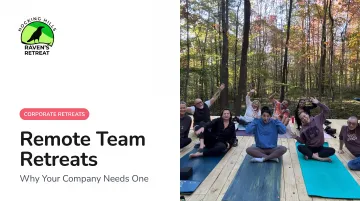
Remote team retreats are one of the most direct tools available for that. This article explains what they are, why they matter, and how to get the most from them.
Key Takeaways
- Remote team retreats are structured offsites that give distributed teams time and space to connect, align, and recharge
- They directly address isolation, weak team bonds, communication gaps, and declining engagement
- Companies that invest in regular retreats consistently see improvements in culture, productivity, and retention
- The setting matters: nature-rich, creatively stimulating environments produce stronger results than standard conference rooms
- A single retreat creates momentum — but teams that return regularly build lasting culture shifts
What Is a Remote Team Retreat?
A remote team retreat is an intentional, offsite gathering where distributed employees come together — in person — to reconnect, collaborate, and focus on goals beyond the daily workflow. Unlike a work trip or conference, it's designed around people first, not deliverables.
Retreats differ from regular team meetings in one fundamental way: they prioritize human connection over task execution. They create space for the kinds of conversations and breakthroughs that video calls simply don't produce: the honest conversation on a walk, the creative spark from a shared meal, the offhand comment that reshapes how a team works together.
A retreat is an operational investment — a structured mechanism for solving real business problems. Team fragmentation, communication breakdowns, and the slow cultural drift that accumulates in distributed organizations are exactly the kinds of issues a well-designed retreat is built to address.
Key Advantages of Remote Team Retreats
The advantages below aren't abstract. Each one maps directly to metrics that leadership and HR teams already track.
Rebuilding Human Connection and Company Culture
Remote work creates a persistent gap in informal human connection. The casual conversations, shared lunches, and hallway moments that naturally build trust in physical offices don't happen on Zoom — and that gap has measurable consequences.
Gallup found that 25% of fully remote employees felt lonely on any given day, compared to 16% of on-site workers. The same research showed engaged workers were 64% less likely to feel lonely — connecting engagement, belonging, and the risk of losing people who feel isolated.
McKinsey reinforced this: more than half of employees who left jobs in a prior six-month period didn't feel valued, and 51% didn't feel a sense of belonging at work. Belonging isn't a soft metric — it's a retention driver.
A retreat creates concentrated, immersive time for teams to interact as full humans. Shared meals, unstructured downtime, and group experiences generate relational depth that months of virtual meetings cannot replicate.
KPIs most impacted:
- Employee engagement scores and eNPS
- Cultural cohesion indicators
- Voluntary turnover rate
When it matters most: Newly formed remote teams, organizations that have recently scaled, teams navigating restructuring, or any company that has never brought its distributed workforce together.
Sparking Creativity, Innovation, and Strategic Alignment
Routine environments limit thinking. The same home office, the same Slack threads, the same meeting cadence — they crowd out the mental breathing room needed for fresh ideas. Removing people from their everyday settings — especially into places with new sights, sounds, and surroundings — breaks that pattern.
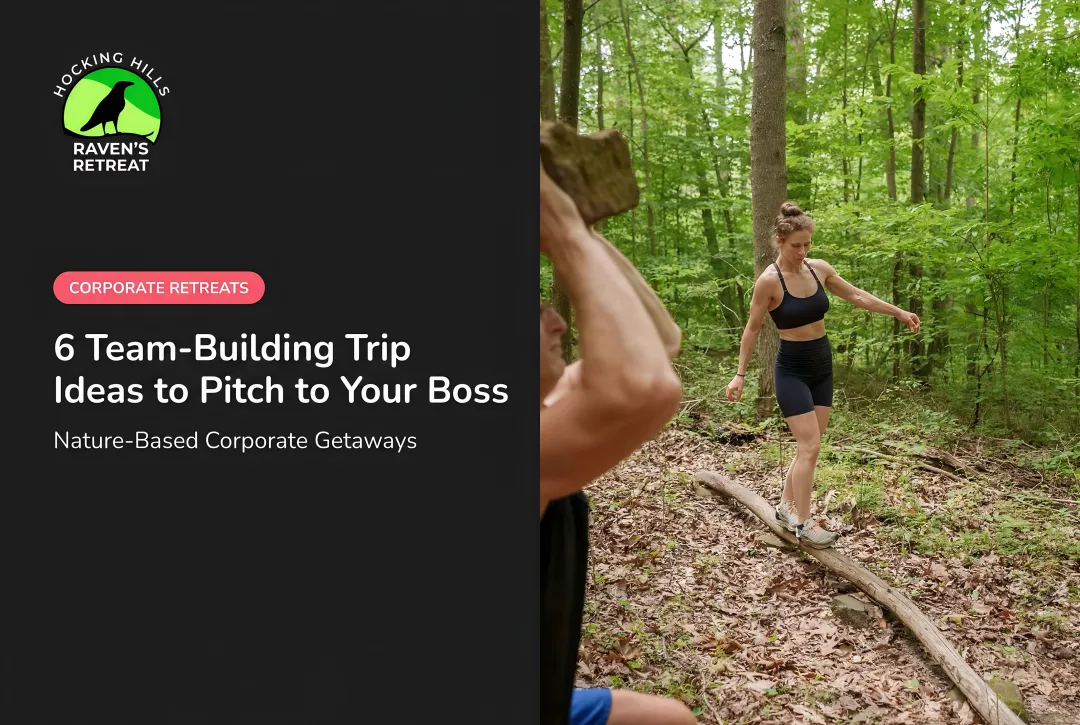
A PLOS ONE study found that four days of nature immersion increased creative problem-solving performance by roughly 50%. Separate research from Berman, Jonides, and Kaplan found that even walking in nature or viewing nature imagery improved directed-attention abilities — the cognitive capacity needed for focused, flexible thinking. That's precisely why nature-based offsites, like those held at preserves in Hocking Hills, Ohio, translate research into practice so effectively.
Retreats also serve a strategic function. They give leadership a rare opportunity to align cross-functional teams on shared goals, surface blind spots, and build genuine buy-in — something remote-only communication rarely achieves.
A 2021 Nature Human Behaviour study of 61,182 Microsoft employees found that remote work made collaboration networks more static and siloed, reducing the bridges between teams. An offsite directly addresses that siloing.
Track these metrics:
- Quality and volume of new ideas generated
- Cross-functional collaboration frequency
- Speed of decision-making post-retreat
This matters most: Before major product launches, annual planning cycles, or any inflection point where teams need to move from fragmented effort to unified direction.
Boosting Team Productivity and Long-Term Performance
Productivity in remote teams is directly tied to interpersonal trust. Teams that know each other well communicate more efficiently, escalate problems faster, and cover for each other without friction. Retreats accelerate that trust.
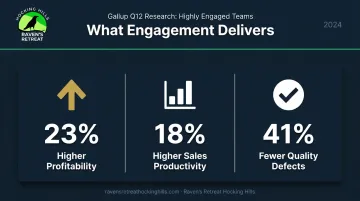
Gallup's Q12 research shows highly engaged teams — built on connection and trust — achieve 23% higher profitability, 18% higher sales productivity, and 41% fewer quality defects than their peers. Engagement and trust aren't separate from productivity — they're the mechanism behind it.
The activities, challenges, and shared downtime of a retreat create a shared reference frame: inside jokes, discovered strengths, mutual understanding. Those carry directly into smoother daily collaboration for months after the event.
Teams that have bonded in person default more naturally to direct communication, honest feedback, and peer accountability — reducing the delays that come from hesitation and misunderstanding.
KPIs most impacted:
- Project completion rates and meeting efficiency
- Cross-team collaboration scores
- Time-to-resolution on escalated issues
When it matters most: During rapid growth, high-stakes project cycles, or any period where miscommunication is visibly slowing execution.
Attracting and Retaining Top Talent
Top talent — especially younger workers — evaluates employers not just on compensation but on how the company invests in them as people. Retreats signal that leadership prioritizes well-being and human connection alongside results.
The cost of getting this wrong is steep. Gallup estimates that replacing a technical or professional employee costs around 80% of their annual salary, and replacing a leader or manager runs roughly 200%. Meanwhile, 42% of employee turnover is preventable but routinely ignored. Retreats belong in the prevention budget.
Deloitte's research on Gen Z and Millennial workers — now the dominant share of the workforce — found that work is a significant source of stress for 42% of Gen Zs and 46% of Millennials, with fewer than half feeling their employers take mental health seriously. A well-executed retreat directly addresses that perception.
Employees who return from a meaningful retreat become genuine advocates for the organization. That word-of-mouth shapes employer brand — one of the most underrated recruiting advantages a company can build.
KPIs most impacted:
- Employee retention rate and time-to-fill open roles
- Employer brand perception
- Employee satisfaction and well-being scores
When this applies most: In competitive hiring markets, during organizational change, or when teams have been operating under sustained pressure without acknowledgment.
What Happens When Remote Teams Skip the Retreat
Without intentional in-person investment, teams experience a slow drift. Bonds weaken, miscommunication hardens into friction, and employees begin to feel more like contractors than members of a shared mission. It happens gradually, which is exactly why it's so often missed until the damage is significant.
The operational consequences compound over time:
- Rising turnover as employees disengage from teams they don't feel connected to
- Slower collaboration and more frequent misalignment because relational context is absent
- Onboarding failures as new hires never develop the interpersonal foundation needed to integrate into a distributed team
- Structural siloing — cross-functional communication breaks down and teams stop reaching across organizational lines
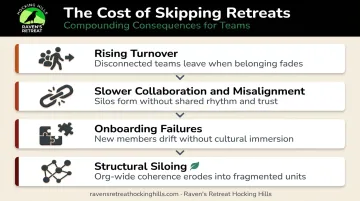
The cost of skipping retreats rarely appears on a single budget line. It materializes instead in turnover expenses, declining velocity, and cultural fragmentation — often attributed to other causes because the root is invisible. Budgets scrutinize flight costs and venue fees; they rarely account for the slower, compounding expense of a team that never fully gels.
How to Get the Most Value from Your Remote Team Retreat
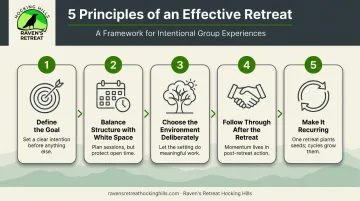
What separates a retreat that changes things from one that gets forgotten in two weeks comes down to three factors: clear goals, a thoughtfully sequenced agenda, and genuine follow-through on commitments made during the event.
A few principles that separate effective retreats from forgettable ones:
- Define the goal before the agenda. Is this about team cohesion, strategic alignment, creative reset, or leadership development? The answer shapes everything else.
- Balance structure with white space. Over-scheduled agendas kill organic connection. Leave room for unstructured time, informal meals, and wandering conversation.
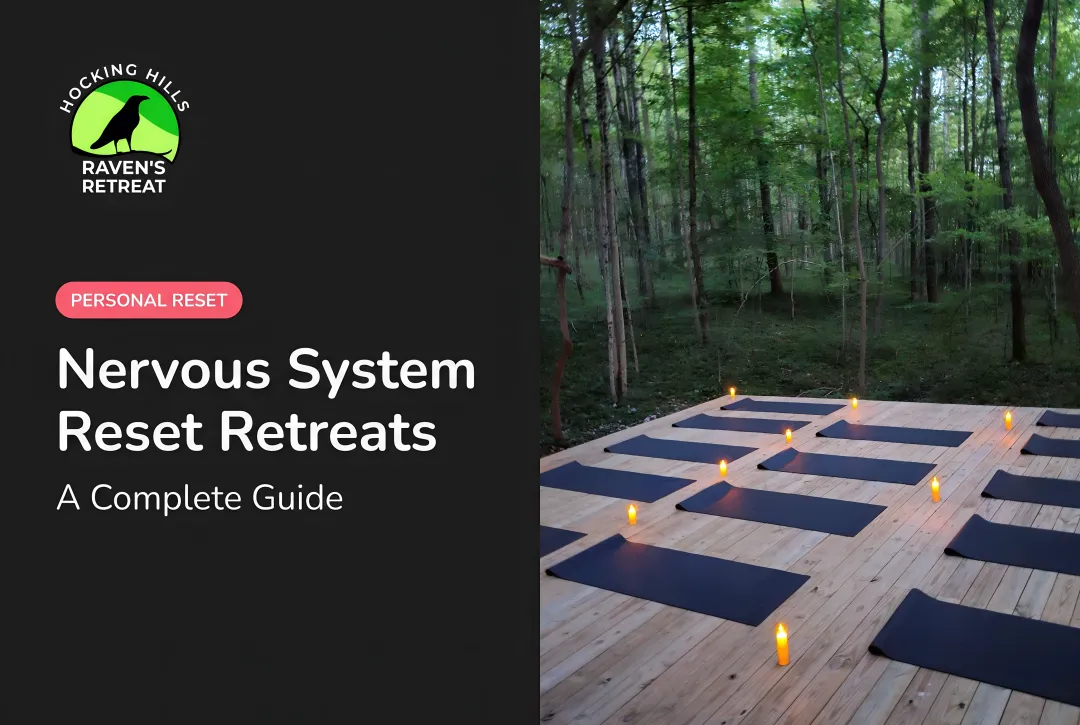
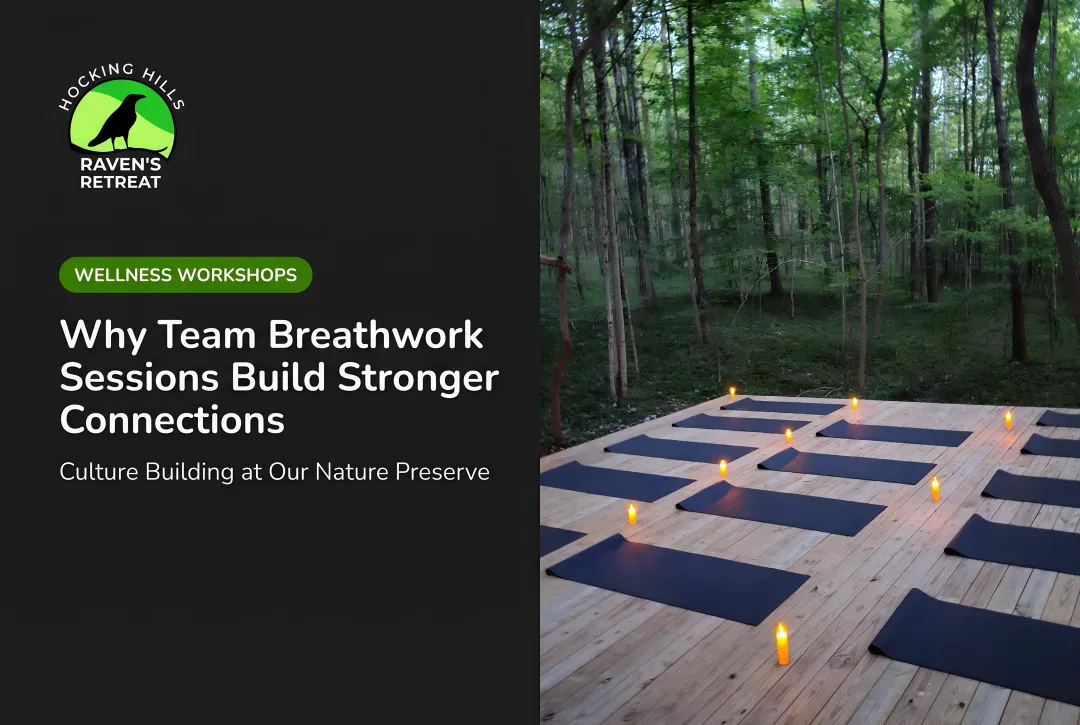
- Choose the environment deliberately. The setting isn't a neutral variable. Nature-immersive, creatively stimulating environments unlock different thinking than hotel conference rooms.
- Follow through after the retreat. Connections made and commitments built don't sustain themselves. Reinforce them actively back in daily operations.
- Make it recurring. A single retreat is a spark. Organizations that see lasting returns treat retreats as a rhythm, not a one-time event.
this way: teams left "feeling recharged, focused, and more connected than ever." A CEO forum group noted that "the creative energy was contagious, and the forest hikes were better than therapy."
Raven's Retreat accommodates groups of up to 18 overnight, making it well-suited for small work teams, leadership groups, and founders. It's also accessible — one hour from Columbus, two from Cincinnati, and within driving range for most Midwest business hubs.
Conclusion
Remote team retreats aren't optional perks or rewards for a good quarter. They are a strategic investment in the operational foundations that distributed teams most urgently need: trust, alignment, creativity, and a shared sense of purpose.
The benefits build on each other. Stronger culture reduces turnover, deeper trust accelerates productivity, and a team that has shared something meaningful together tends to be more resilient and more committed than one that hasn't. The question isn't whether a retreat is worth it — it's whether you can afford to keep skipping it.
If you're planning your team's next offsite, Raven's Retreat Hocking Hills offers full-property buyouts for groups up to 18, with customizable programming that blends creative workshops, nature immersion, and strategic working sessions — set on a 58-acre private preserve in Hocking Hills, Ohio.
Frequently Asked Questions
How often should a company host a remote team retreat?
Most experts recommend at least one annual full-team retreat, with smaller department offsites added quarterly for teams with higher day-to-day isolation. Atlassian, for example, brings teams together three to four times per year with clear purpose behind each gathering.
How do you measure the ROI of a corporate retreat?
Track pre- and post-retreat engagement scores, retention rates, collaboration quality, and project velocity — along with qualitative signals like communication efficiency and idea-to-execution speed. Using Gallup's replacement cost benchmarks (80–200% of salary depending on role) as a baseline makes the financial case concrete.
What should be included in a remote team retreat agenda?
Balance structured elements — strategic sessions, workshops, team-building activities — with deliberate unstructured time for informal connection, shared meals, and rest. The best agendas leave white space for organic relationship-building rather than packing every hour. A rough split of 60% structured to 40% unstructured tends to work well for multi-day retreats.
How long should a remote team retreat be?
Most effective retreats run two to four days — long enough to allow genuine connection and strategic depth, short enough to maintain energy and minimize work disruption. Shorter formats (one to two days) work well for smaller or more frequent offsites where the goal is reconnection rather than deep strategic work.
What makes a retreat venue the right fit for a remote team?
The ideal venue removes teams from their everyday environment, supports both collaborative work and restorative downtime, offers flexible indoor and outdoor spaces, and has reliable connectivity. Nature-rich or creatively stimulating settings consistently outperform standard hotel conference rooms — the environment actively shapes what teams produce.
How do you get buy-in from leadership to invest in a team retreat?
Build the case around cost-of-turnover data, engagement benchmarks, and productivity metrics — framing the retreat as a retention and performance investment, not a morale expense. Propose a measurable pilot with pre- and post-event tracking, so the first retreat generates the data needed to justify the second.