The problem most planners run into isn't whether to invest. It's how much to invest — and what they're actually paying for. Per-person costs can range from under $30 for a virtual game show to well over $1,500 for a fully immersive multi-day retreat. Misreading that range leads to two common failure modes: underspending on facilitation and ending up with an afternoon everyone forgets, or overspending on a premium venue without clear outcomes to justify it.
This guide breaks down real pricing tiers, the cost factors that matter most, and a practical framework for calculating the right budget for your team's specific goals.
Key Takeaways
- Per-person costs range from roughly $30–$75 (entry-level) to $500–$1,500+ for multi-day retreats
- Group size, event format, facilitation quality, and venue choice are the biggest cost levers
- Smaller groups (under 20) typically pay the highest per-person rates due to fixed minimums
- The quoted facilitation fee rarely covers venue, catering, or travel — plan a separate budget for each
- Retreat-style events cost more upfront but produce stronger alignment and sustained engagement
What Corporate Team Building Events Actually Cost
There's no universal price tag for a corporate team building event. Format, group size, location, and experience level all move the number — sometimes dramatically. Underspending often produces a forgettable afternoon. Overspending without a clear objective isn't much better.
Here's how the three main tiers break down in the current US market:
Entry-Level: $30–$75 Per Person
This tier covers virtual game shows, DIY office activities, or short facilitated in-person sessions with basic props. Planning support, custom programming, venue, and catering are typically out of scope.
Works well for small teams, tight budgets, or organizations testing structured team building for the first time.
One caveat worth flagging: provider data from Feet First Events shows most professional team building companies charge a minimum event fee of around $2,000 even for groups as small as 15. The per-person rate can look deceptively low until minimums enter the picture.
Mid-Range: $75–$200 Per Person
Professionally hosted in-person activities — game shows, scavenger hunts, creative workshops — with experienced facilitators, props, and planning coordination. Venue hire, catering, and out-of-market facilitator travel costs are generally separate.
This is the most common range for teams of 20–100+ running a half-day or full-day event with a specific engagement or culture goal. Per-person costs drop noticeably as headcount grows — one provider example shows 15 people at $133/person versus 200+ people at $50–$60/person.
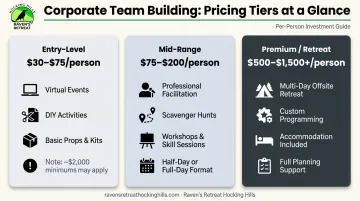
Premium / Retreat-Style: $500–$1,500+ Per Person
At this level, you're typically booking multi-day off-site retreats with custom-designed programming, full planning support, accommodation, and extended facilitation. Some providers bundle venue, meals, and accommodation into a single fee — which simplifies budgeting considerably compared to assembling components separately.
This tier suits leadership teams, mastermind groups, and organizations focused on deep culture work rather than a single afternoon activity. Raven's Retreat Hocking Hills, for example, offers full property buyouts on a private 58-acre nature preserve in Ohio — consolidating accommodation, immersive programming, and facilitation into one experience for small corporate groups of up to 20.
Key Factors That Drive Corporate Team Building Costs
Pricing is shaped by logistical, experiential, and operational decisions. Knowing where costs concentrate helps planners allocate budget deliberately — not react to line items after the fact.
Event Format
Format is the single biggest cost variable:
- Virtual events eliminate venue and travel costs but may include shipping materials to participants ($45–$150+ per person depending on kit complexity)
- In-person day events add facilitation, logistics, and venue costs
- Retreat-style formats layer in accommodation, meals, and extended facilitation fees that can multiply the total significantly
Choose format based on team goals, not just cost. A virtual game show won't fix a leadership team in crisis; a three-day retreat won't deliver value if the team has no clear objectives for it.
Group Size
Most professional providers charge a minimum event fee regardless of headcount. TeamBonding's published pricing puts small group minimums at $3,500–$4,500 for groups of 10–20 people — making the per-person rate for very small teams high even before any customization.
Per-person costs typically decrease as headcount grows, because fixed facilitation costs spread across more attendees. Groups under 20 consistently pay the highest per-person rate in the market.
Facilitation Quality
Experienced facilitators cost more and deliver measurably better outcomes — in event energy, inclusivity, and the conversations that actually happen afterward. This is where budget events cut corners most aggressively, and where premium events justify their pricing most clearly.
A skilled facilitator adapts in real time, draws out quieter voices, and keeps energy high through a full-day program — not just reciting from a script.
Location and Venue
Venue costs range from $0 (using your own office) to thousands for off-site properties or hotel ballrooms. According to Eventbrite's 2025 venue data, typical pricing breaks down as follows:
- Conference rooms: $70–$160 per hour
- Hotel ballrooms: $1,000+ per day
- Dedicated conference centers: $30–$60 per person per day (bundled with basic AV and meals)
Retreat venues outside major cities add facilitator travel costs but often provide genuinely better environments for the event's goals.
Customization and Add-Ons
Off-the-shelf programs cost less than custom-designed experiences. Add-ons — branded materials, event photography, catering upgrades, post-event surveys, themed programming — each add value but also expand the scope. Budget overruns most often trace back to add-ons that felt small individually but compounded quickly.

What the Total Cost Actually Includes
The quoted price from a team building provider rarely tells the whole story. Here's what to budget for separately:
| Cost Component | Typically Included in Quote? | Notes |
|---|---|---|
| Facilitation & staffing | ✅ Usually yes | The core of any provider quote; most directly affects event quality |
| Activity materials & props | ⚠️ Sometimes | May be bundled or invoiced separately; higher for hands-on creative events |
| Venue hire | ❌ Almost never | Invoiced directly by location; ranges from $0 to thousands |
| Catering & meals | ❌ Rarely | Full-service catering averages ~$70 per person for food, ~$85 including drinks |
| Facilitator travel | ❌ Not usually | Applies when providers travel outside their local market |
| Participant accommodation | ❌ Never (unless retreat package) | Major cost layer for overnight or multi-day events |
Bundled retreat packages (where venue, accommodation, and programming roll into a single fee) eliminate most of these line-item surprises. For small corporate groups considering a full off-site experience, this structure simplifies budgeting and typically costs less than sourcing each component on its own.
Budget vs. Premium: What's the Real Difference?
The gap between a $40-per-person event and a $400-per-person event isn't just price. It reflects fundamentally different levels of planning support, facilitation depth, and post-event impact.
| Factor | Budget Events | Premium/Retreat Events |
|---|---|---|
| Facilitation | Generalist or freelance hosts | Specialized facilitators with event-specific expertise |
| Customization | Off-the-shelf programs | Designed around specific team goals and culture |
| Planning support | Minimal | Dedicated coordination from experienced planners |
| Environment | Office or generic venue | Purpose-built or nature-based immersive settings |
| Post-event impact | Short-term entertainment | Behavior changes that carry into daily work |
| Outcomes | Social engagement | Strategic alignment, creative reset, or leadership clarity |
SHRM reports that employee replacement costs range from 50% to 200% of annual salary. Against that benchmark, a $300-per-person retreat that meaningfully improves retention or alignment pays for itself quickly.
Premium doesn't automatically mean better results, though. A team celebrating a quarterly win needs something different than a leadership group working through a significant organizational change. The format should match the purpose — a nature-based immersive offsite, for instance, tends to serve creative resets and leadership clarity far better than a catered conference room ever could. Start with the outcome you need, and the right investment level follows from there.
How to Calculate the Right Budget
Rather than starting with a number and working backward, effective budgeting starts with a clear goal and works outward.
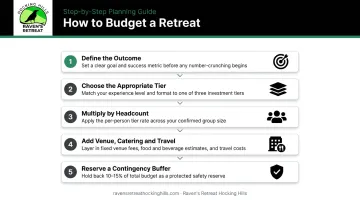
Step-by-step framework:
- Define the outcome — Is this about team connection, leadership development, strategic planning, or creative reset? The goal determines the format.
- Choose the appropriate tier — Match the format to the goal and budget a per-person baseline accordingly.
- Multiply by headcount — Apply that per-person baseline to your group size, adjusting for minimum fees if your group is small.
- Add venue, catering, and travel separately — These aren't in most facilitation quotes and can represent a substantial portion of the total.
- Reserve a contingency buffer — Build in approximately 10% for last-minute changes, additions, or pricing adjustments.
Common budgeting mistakes to avoid:
- Focusing only on the per-person facilitation fee while ignoring venue, catering, and travel — which can effectively double the total
- Choosing the cheapest option without evaluating facilitation quality or activity-goal alignment
- Under-specifying outcomes, which produces generic programming that doesn't justify any investment level
- Ignoring the cost of doing nothing — Gallup estimates voluntary turnover alone costs US businesses $1 trillion annually, making team building a retention investment rather than a discretionary spend
For teams considering a full off-site or retreat, all-inclusive bundled pricing solves the scope creep problem by design. Raven's Retreat Hocking Hills offers small corporate groups (up to 20 for day retreats, up to 18 overnight) a single pricing structure covering the 58-acre private preserve, Art Lodge facilities, and planning coordination.
Add-on programming — guided forest bathing, live sculpture performances, chef-curated catering, NLP coaching — is itemized separately, so there are no hidden costs to reconcile after the fact.
Frequently Asked Questions
How much do companies spend on team building per employee annually?
Industry estimates vary widely. One vendor benchmark puts typical annual per-employee spend at $100–$500, though this varies significantly by company size, industry, and how seriously the organization treats team culture as a strategic investment. No authoritative US survey with company-size segmentation currently exists.
What is a reasonable per-person budget for a corporate team building event?
It depends on format, group size, and intended outcomes. Entry-level virtual or short in-person events typically run $30–$75 per person. Mid-range professionally facilitated day events run $75–$200. Premium or retreat-style formats run $500–$1,500+. The right budget is simply the one that fits your goals and group.
Does group size affect team building event costs?
Yes, significantly. Most providers charge a minimum event fee ($2,000–$4,500 depending on the provider), which makes small groups expensive on a per-person basis. As headcount grows, per-person costs decline because fixed facilitation costs spread across more participants — making larger events more cost-efficient per head.
Are corporate team building events tax deductible?
Possibly. Under IRS Section 274(e)(4), employee recreational or social activities primarily benefiting non-highly-compensated employees may qualify for deductions. Events framed around training, leadership development, or communication skill-building may also qualify. However, events with a primarily entertainment focus are treated differently under current rules. Confirm your specific situation with a CPA or tax advisor before making assumptions.
What are the 5 P's of team building?
The 5 P's vary by framework, but a common formulation includes Purpose, People, Process, Place, and Progress — covering why you're gathering, who's involved, how the event is structured, where it happens, and how outcomes are measured.
What's the cost difference between a day event and a multi-day retreat?
A professionally facilitated day event typically runs $75–$200 per person plus venue and catering. A multi-day retreat — accounting for accommodation, extended facilitation, and meals — runs $500–$1,500+ per person based on current industry guidance.