Introduction
Done well, a strategic planning offsite creates organizational alignment, produces bold decisions, and generates momentum that carries a team for months. Done poorly, it's an expensive room full of people reading slides — what one senior executive described as a meeting that "leaves no fingerprints."
Most organizations hold some version of an annual strategy offsite. Yet a McKinsey survey of 796 executives found that only 23% said major strategic decisions were actually made within the planning process — and 45% said planning failed to track execution of strategic initiatives. That gap between effort and outcome is almost always a design problem — not a people problem.
This article walks through the exact steps to design and run a strategic offsite that produces results: from objective-setting and participant selection to agenda structure, venue environment, facilitation, and follow-through.
Key Takeaways
- Pre-work drives outcomes: objectives, participants, and pre-reading set the stage before anyone arrives
- Cap strategic initiatives at four to ten; a focused list beats a sprawling one
- Structured agendas outperform open-ended formats — build in decision checkpoints, not just discussion topics
- Nature-based settings reduce cognitive load and measurably improve the quality of strategic thinking
- Leave the room with named owners, clear milestones, and a written decision summary — follow-through is where most offsites fail
What Is a Strategic Planning Offsite and When Does It Make Sense?
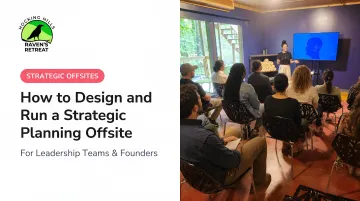
A strategic planning offsite is a dedicated gathering — typically one to three days, held outside the normal office — where leadership steps back from operations to examine organizational direction and make deliberate choices about priorities and resource allocation.
This differs from a standard executive session in two key ways: the time horizon is longer (usually three to ten years), and the expected output is strategic alignment and prioritized initiatives — not operational updates.
Knowing the distinction matters, but so does knowing when an offsite is actually the right tool. It earns its place when:
- Entering a new annual planning cycle
- Navigating a meaningful market shift or competitive disruption
- Onboarding new leadership who need to establish shared direction
- Preparing for significant growth, restructuring, or transformation
- Operating in execution mode long enough that strategic thinking has been crowded out
If none of these conditions apply, a focused half-day leadership meeting will likely get the job done — at a fraction of the time and cost.
How to Design and Run a Strategic Planning Offsite
Every strategic offsite has a lifecycle: design, preparation, execution, and follow-through. Each phase requires deliberate choices. Treating any one of them as administrative rather than strategic is where most offsites start to fail.
Step 1: Define Objectives and What Success Looks Like
Before booking a venue or building an agenda, identify three to five specific objectives for the session. Ask: what does the organization need to have at the end of this meeting that it doesn't have now?
Common answers include a prioritized initiative list, alignment on a three-year direction, or resolution of a specific strategic tension the leadership team has been circling for months.
What time horizon are you planning for — three years, five years, longer? Is the team ready to make firm decisions, or is this an exploratory session? These answers should define the agenda structure, not the other way around.
Equally important: decide what will not be discussed. Limiting scope is a strategic act. Issues outside the defined objectives can be handed to internal teams after the offsite. Scoping tightly is how you protect the room's focus.
Step 2: Select the Right Participants
Keep the group to ten to twelve people. That size is large enough to bring diverse perspectives, small enough to allow real dialogue and genuine accountability for outcomes. Larger groups consistently turn strategic offsites into town halls.
Let the objectives determine the invite list. If firm decisions are required, ensure decision-makers are in the room. Avoid inviting people purely as observers — every seat should come with a clear role.
Practical planning timeline:
- Begin planning at least 60 days out
- Send invitations 45 to 60 days in advance
- Assign pre-work tasks during the pre-offsite window so attendees arrive informed
Step 3: Choose a Venue That Enables Strategic Thinking
Venue choice is a strategic decision. The environment where a team thinks directly shapes the quality of that thinking.
A 2012 PLOS ONE study found that four days of immersion in nature — disconnected from multimedia and technology — improved performance on creative reasoning tasks by 50%. Separate research on Attention Restoration Theory shows that natural environments replenish directed attention capacity, the exact cognitive resource required for strategic work.
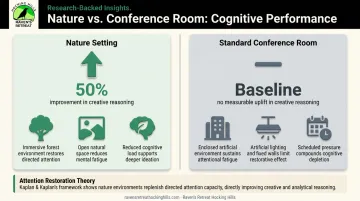
Standard hotel conference rooms are efficient but mentally indistinguishable from the office. They do nothing to signal that this is a different kind of conversation.
For Midwest leadership teams, private retreat properties like Raven's Retreat Hocking Hills — set on a 58-acre nature preserve near Laurelville, Ohio — offer a meaningfully different environment. The property includes full buyout availability, 4,000 square feet of indoor gathering space in the Art Lodge and a 400-square-foot Sculptor's Art Bungalow, an elevated forest yoga platform for outdoor sessions, forest meditation zones, and over a mile of private hiking trails.
Wi-Fi at 300+ Mbps means connectivity isn't sacrificed for seclusion. About an hour from Columbus and within a half-day drive of Cincinnati and Cleveland, it removes travel logistics as a barrier for most Midwest teams.
Practical venue criteria to evaluate:
- Enough space for both plenary sessions and small-group breakouts
- Overnight accommodations if running a multi-day format
- Proximity to nature or restorative surroundings for breaks between sessions
- Reliable connectivity if remote participants or digital tools are required
- Full-property exclusivity to maintain confidentiality
Step 4: Build a Structured, Balanced Agenda
HBR's research on strategic offsites is clear: overbroad agendas are one of the primary failure modes. Structured agendas consistently outperform open formats.
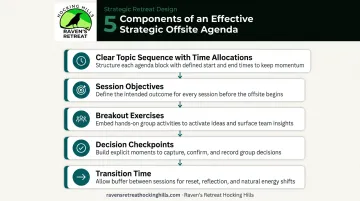
An effective agenda includes:
- Clear sequence of topics with time allocations
- Stated objectives for each session block (not just topic labels)
- Breakout exercises to generate diverse input
- Decision checkpoints embedded at logical intervals
- Transition time between work sessions
Balance focused work time with deliberate recovery time. Shared meals, a walk between sessions, and an unstructured evening are not wasted time — they are where trust is built and informal alignment happens. Introverted participants often do their most meaningful connecting in low-pressure settings, not structured icebreakers.
For multi-day offsites, consider splitting the design: an initial two-day session followed by a one-day follow-up a month later. This gives participants time to validate early decisions with their teams and arrive at the second session with genuine commitment rather than off-the-cuff agreement.
Step 5: Facilitate the Conversation With Intention
Set ground rules at the start. Ask the group: what behaviors do we need to commit to so everyone gets the most from this time? Give participants explicit permission to call out drift when the conversation strays from objectives.
Two facilitation risks to manage actively:
- Senior leader anchoring — when the most senior person expresses a strong opinion early, it shuts down the conversation before it opens. Structure the agenda so the group generates options before the leader weighs in.
- Hidden-profile failure — groups naturally sample information already shared among members rather than pooling unshared insights (Stasser & Titus, 1985). Structured breakouts and round-robin sharing counteract this.
Use structured exercises rather than PowerPoint-heavy presentations. Anonymous voting, breakout prioritization, and visual mapping move groups from data to analysis without the weight of positional politics. Research from the Academy of Management found that groups using multivoting were 50% more likely to identify the correct option than those using plurality or ranked-choice methods.
What to Prepare Before the Offsite Starts
The quality of a strategic offsite is largely determined before anyone walks into the room.
Pre-Meeting Surveys and Executive Interviews
Conduct short individual interviews or an anonymous survey with participants in advance. Surface what issues they believe are most critical, where they see strategic divergence, and what they hope the session will resolve. Compiling and sharing these insights — without attribution — gives the facilitator a clear picture of where the real conversations need to happen.
Build a Focused Fact Book, Not a Document Dump
Replace the common practice of circulating ten-plus business plan documents with a lean fact book: a curated compilation of company performance data, market context, and competitive landscape that gives participants a shared foundation. Add one to three targeted readings directly relevant to the meeting's objectives.
Assign Pre-Reading With Clear Expectations
Make it explicit: participants are expected to absorb the pre-reading before arriving. The offsite session is for problem-solving and decision-making, not for walking through materials that should have been read in advance. Enforcing this expectation — even gently — is what separates a productive offsite from a glorified status update.
Prepare the Facilitator
Brief any facilitator — external or internal — before the session. A thorough briefing should cover:
- The non-negotiable outcomes required from the session
- Political dynamics and any sensitive interpersonal tensions
- How the group typically makes decisions
- Topics that need careful framing or sequencing
A facilitator who arrives oriented to the room will do far better work than one still taking their bearings when the session begins.
Common Mistakes That Derail Strategic Offsites
Even well-planned offsites produce inconsistent results when these failure modes aren't actively managed.
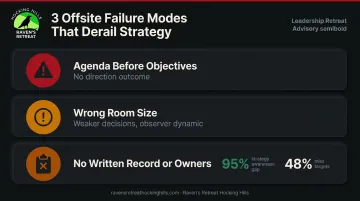
Three patterns show up repeatedly when offsites fall flat:
- Agenda before objectives. Many organizers book the venue, set a date, and build an agenda before clarifying what the meeting needs to produce. Without clear objectives, the session generates energy without direction.
- The wrong room. Larger groups feel inclusive but consistently produce weaker decisions. Participants without a defined role end up observing rather than contributing, and too many functional advocates turn the session into a departmental negotiation.
- No written record, no assigned owners. Harvard Business School research found that 95% of employees don't understand their company's strategy — and 48% of organizations fail to reach at least half of their strategic targets. That gap often starts with a "we'll follow up" close. Without a written summary and named owners before people leave the room, the session's momentum dissipates within days.
How to Follow Through After the Offsite
Before the session ends, produce a concise one-page written summary — what was discussed, what was decided, and what the next steps are. Assign an executive owner to each strategic initiative. Establish the reporting cadence (monthly review, quarterly check-in) before anyone leaves the building.
A simple accountability structure works best:
- RACI charts or action registers that specify who is responsible, accountable, consulted, and informed for each initiative
- Red/yellow/green status indicators reviewed at regular leadership meetings
- A scheduled follow-up session (whether a full day or a half-day) within 30 to 60 days
Treat the offsite as the beginning of an ongoing strategic conversation, not a one-time event. Teams that return to the same intentional setting year after year tend to move faster from big-picture discussion to concrete decisions — because the environment, the rhythm, and the trust are already in place. That continuity is what turns a single productive day into a genuine strategic practice.
Frequently Asked Questions
What is a strategic offsite?
A strategic offsite is a dedicated meeting held outside the normal work environment — typically one to three days — where leadership teams step back from daily operations to examine strategic direction, align on priorities, and make decisions about the organization's future. The setting and structure distinguish it from routine executive meetings.
What are the 4 types of strategic planning?
The four commonly cited types are:
- Operational planning — short-term, day-to-day standards and procedures
- Tactical planning — medium-term resource allocation to support strategy
- Strategic planning — long-term direction and positioning, typically one to five years
- Contingency planning — scenario-based responses to disruption or significant change
What are the 5 stages of strategic planning?
The five stages are:
- Developing a strategic vision
- Setting objectives
- Crafting a strategy
- Implementing and executing the strategy
- Monitoring results with corrective adjustment
Most failures occur at implementation and monitoring.
What are the 5 P's of strategic planning?
Henry Mintzberg's Five P's define strategy as:
- Plan — a deliberate course of action
- Ploy — a tactical maneuver
- Pattern — consistency in behavior over time
- Position — how the organization situates itself in its environment
- Perspective — the organization's fundamental way of seeing and doing things
How long should a strategic planning offsite be?
Most effective offsites run one to three days. For organizations making significant directional decisions, a multi-day format is recommended. Splitting the event into a two-day initial session and a one-day follow-up one month later often produces stronger commitment than a one continuous session.
How many people should attend a strategic planning offsite?
Ten to twelve participants is the proven sweet spot — large enough to bring diverse perspectives, small enough to allow genuine dialogue, real decision-making, and individual accountability for outcomes. Beyond twelve, the dynamics shift from strategic conversation to managed presentation.