Introduction
You eloped. You said your vows in a forest, a courthouse, or a mountain overlook — just the two of you, exactly the way you wanted. And it was perfect.
Then came the quiet wish: I wish Mom had been there. I wish we had photos that actually looked like us. I wish we could celebrate with the people who love us.
That feeling doesn't mean your elopement was wrong. It means you're ready for the next chapter. A vow renewal after eloping is its own thing — not a correction, not a do-over, but a celebration on your own terms. The Knot's 2020 Real Weddings Study found that one-third of couples who held both a ceremony and reception still planned a larger future celebration to share the moment with loved ones.
This guide covers everything: what a post-elopement vow renewal actually is, why couples choose it, how to plan it without the weight of full wedding logistics, and how to find the right setting for it.
Key Takeaways
- A vow renewal after eloping is a sequel celebration — it honors where you've been, not a correction of it
- No legal requirements, no officiant license needed, no marriage license to file
- The ceremony can be two people in a forest or 30 guests at a private retreat — you decide
- Write new vows — reflect the years lived together, not just the day you signed
- Venue sets the tone — intimate, nature-based settings shape how personal and memorable the ceremony feels
What Is a Vow Renewal After Eloping?
A vow renewal is a ceremony in which a married couple reaffirms their commitment — no paperwork, no legal function, no binding document. As Brides explains, vow renewals have no legal standing and don't require a marriage license or registered officiant. You're already married. This is purely symbolic — which is exactly what makes it meaningful.
How It Differs From Other Ceremony Types
Three terms come up often in this space, and they're worth distinguishing:
| Term | What It Means |
|---|---|
| Traditional vow renewal | A recommitment ceremony, typically tied to a milestone anniversary (10, 25, 50 years) |
| Sequel wedding | A full celebration designed to mirror the wedding experience that was skipped or minimized |
| Post-elopement vow renewal | A blend of both — recommitting privately while also sharing the marriage with people who weren't there the first time |
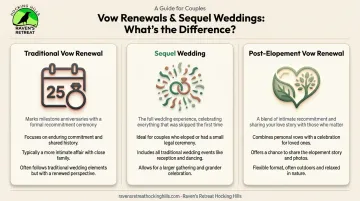
The post-elopement version is uniquely flexible. It can be intimate or celebratory, immediate or years later, just the two of you or your closest 20 people.
That flexibility extends to the legal side, too. A post-elopement vow renewal is not a legal remarriage. Clark County, Nevada explicitly states its Certificate of Vow Renewal is not a record of marriage and cannot be used to prove marital status. Orange County's Clerk-Recorder describes renewal ceremonies as "symbolic celebrations with no legal significance."
No officiant licensing requirements. No marriage license. No bureaucratic checklist. That freedom is what gives this kind of ceremony so much room to be exactly what you need it to be.
Why Couples Choose a Vow Renewal After Eloping
Why Couples Choose a Vow Renewal After Eloping
The "Missing Out" Gap
Many couples who eloped — especially those who did so during 2020 and 2021 — felt a real sense of loss alongside their joy. The Knot reported that 96% of 2020 couples altered their original wedding plans, and 47% postponed to 2021 or later. For couples who went ahead with intimate ceremonies, the celebration was real, but the sharing of it wasn't.
A vow renewal closes that gap without pretending the elopement didn't happen — it builds on it.
Relationships Evolve
A couple who eloped in a courthouse three years ago is not the same couple today. You've moved homes, navigated hardship, maybe become parents. A vow renewal ceremony can reflect who you actually are now — the harder, richer version of your commitment. That's different from the version that existed when you signed a license.
The Photography Problem
Beyond the emotional reasons, there's a practical one: many elopers have few or no professional photos from their original ceremony. A vow renewal gives couples the chance to document their relationship in a setting and style that genuinely represents them — forest clearings, mountain light, artistic backdrops — rather than a courthouse hallway or a rushed outdoor moment without a photographer.
A Gift to the People Who Love You
Some couples frame the vow renewal not as something they're doing for themselves but as something they're giving to parents, siblings, and close friends who never got to witness the moment. That reframe shifts the whole emotional weight of the event — it feels generous rather than compensatory, and that distinction matters to the people being invited.
How to Plan Your Vow Renewal After Eloping
Planning a post-elopement vow renewal is genuinely simpler than planning a wedding. No marriage license. No legally certified officiant. No venue contract requirements tied to ceremony permits. But simpler doesn't mean thoughtless — the ceremony still benefits from intentionality before you book anything.
Decide on Scale and Guest List
This is the first and most consequential decision. Everything else — venue, budget, vendor list — flows from it.
The spectrum looks like this:
- Elopement-style: Just the two of you, a photographer, maybe a musician. Private and intimate, a deliberate echo of your original ceremony
- Micro-gathering: 10–20 close family and friends. Feels like a celebration without the logistics of a full event
- Sequel wedding: 30+ guests, a reception, the works — the full wedding experience you didn't have the first time
Unlike a first wedding, no one has a social expectation to be invited. That's a meaningful freedom.
Set a Timeline and Date
There is no required waiting period. Zola confirms that couples can renew vows at any point — after one year or after twenty. Milestone anniversaries (5, 10, 25 years) are popular but optional.
Meaningful date options include:
- Your original wedding anniversary
- A date that marks another significant milestone (the day you bought your home, moved cities, or became parents)
- A completely new date with no prior significance — chosen because it's now
Write New Vows
Don't simply re-read what you said during your elopement. Write vows that acknowledge what's happened since — the hard parts and the beautiful ones. The renewal is meaningful precisely because it's current.
Vow styles to consider:
- Heartfelt and personal — rooted in specific memories, earnest without being scripted
- Lighter in tone — humor-forward but still emotionally grounded
- Family-inclusive — written to acknowledge children, parents, or the wider community present
- Values-centered — focused on commitment and shared life, without religious framing
Assemble Vendors Based on Scope
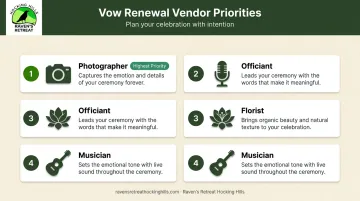
A lean vendor list for a post-elopement vow renewal:
- Photographer — prioritize this above everything else, especially if your elopement had no professional photography
- Officiant — valuable for ceremony structure and pacing; can be a friend, family member, or professional
- Florist — even minimal florals can transform a natural setting
- Musician — live acoustic music during an outdoor ceremony creates an atmosphere recordings can't replicate
If you're planning a ceremony in a natural setting, the venue itself shapes the experience as much as any vendor. Places like Raven's Retreat Hocking Hills — a 58-acre nature preserve in Hocking Hills, Ohio — offer an immersive backdrop for intimate elopement-style renewals, with forest surroundings, art installations, and privacy that a traditional event space can't replicate.
What to Include in Your Vow Renewal Ceremony
The ceremony arc can be completed in 10 minutes or expanded into an hour-long ritual. Either is valid.
A simple structure:
- Welcome the moment — an officiant, a family member, or the couple themselves sets the tone with a brief opening
- Exchange new vows — fresh words written for who you are now, not a repeat of the original
- Mark the moment with a gesture — ring re-exchange, new bands, or a unity ritual
- Close intentionally — a kiss, a reading, or even a shared silence
Symbolic Elements Worth Considering
Post-elopement renewals lend themselves to rituals that feel more resonant than traditional wedding unity candles. Some options:
- Plant something together — rooted in the landscape and lasting well beyond the ceremony
- Bring in a cultural or spiritual tradition that didn't make it into the elopement
- Invite children into a role if your family has grown since you eloped
- Write letters beforehand and read them privately before the ceremony begins
Honoring the Original Elopement
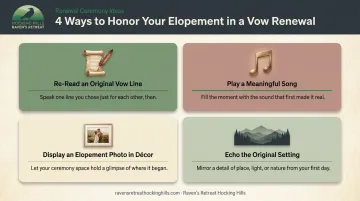
The renewal shouldn't erase the elopement — it should hold it. Small touches that honor where you started:
- Re-reading a single line from your original vows
- Playing a song that mattered during your elopement
- A photo from the original ceremony woven into the décor
- Choosing a setting that echoes your elopement's spirit (if you eloped in mountains, find another forested or elevated space)
Attire
There's no rule requiring white or formal dress. Couples can wear:
- Their original elopement outfits — a powerful symbolic choice
- Something entirely new that reflects who they are now
- A hybrid, such as a new outfit that incorporates an element from the original
Let the venue and tone guide the wardrobe decision, not social expectation.
Choosing the Right Setting for Your Vow Renewal
Venue selection for a post-elopement renewal should reflect your current story — not default to a traditional wedding hall because that's what ceremonies look like.
Nature-based settings are especially suited for this type of ceremony. They offer intimacy, visual beauty, and a sense of occasion without the formality of a conventional venue. National Geographic named Hocking Hills, Ohio a "natural wonderland" in 2024, and the region has become a destination for exactly this kind of intimate, nature-centered celebration.
What to Look For
An ideal vow renewal venue offers:
- Complete privacy or full property buyout, so the ceremony feels held rather than interrupted
- Natural beauty that photographs well: forest canopy, water features, elevated overlooks
- Flexibility for both the ceremony and a small gathering or meal on-site
- Proximity to amenities for guests traveling in
Raven's Retreat Hocking Hills
Raven's Retreat Hocking Hills is a 58-acre private art and nature preserve near Laurelville, Ohio — adults-only, designed for intentional, small-scale ceremonies.
The property offers:
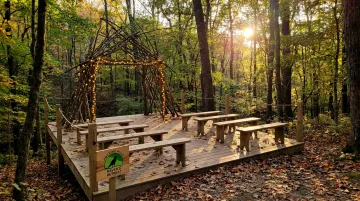
- A 24-by-24-foot elevated forest platform with a rustic arch and guest benches, already configured for ceremonies
- Secluded wooded ceremony areas, ravine-front photo spots, and forest clearings
- Immersive art installations by master sculptor Dustin Weatherby throughout the property: steel sculptures, wood carvings, and tile murals that create striking photography backdrops
- Over a mile of private trails for processionals, portraits, and quiet moments
- A 6-person hot tub, 4-person infrared cedar sauna, and outdoor shower for pre- and post-ceremony ritual
- Full property buyout for exclusive use of the entire preserve
The Sculptor's Art Lodge sleeps up to 16 guests across 6 bedrooms; the Art Bungalow sleeps 2. Combined overnight capacity is 18, with day-event capacity up to 20. Weekend packages range from $4,500–$8,000 depending on season; weekday bookings run $2,500–$6,000.
Add-on experiences can be layered into your ceremony day through a complimentary consultation with co-founder Raven:
- Plant-based chef meals and massage therapy
- Sound baths, guided forest bathing, and yoga on the forest platform
- Live sculpture performances by Dustin Weatherby
The retreat is less than six miles from iconic Hocking Hills State Park attractions and only 2 miles from Laurelville's restaurants and services — accessible for traveling guests without sacrificing the forest sanctuary feeling.
Frequently Asked Questions
How soon after getting married can you renew your vows?
There is no minimum waiting period. Couples can renew vows after one year or after several decades — the right time is whenever it feels meaningful.
What is the etiquette for a vow renewal ceremony?
Vow renewals carry far fewer social expectations than weddings. Gifts should not be solicited or expected, and there's no obligation to follow traditional ceremony structure. The couple sets the entire tone.
Can you elope for a vow renewal?
Yes — and a private, couple-only vow renewal is genuinely popular, particularly for couples who want reconnection rather than another celebration. Venues like Raven's Retreat are specifically designed for this type of intimate, two-person experience in a meaningful natural setting.
What do you call a celebration after an elopement?
Common terms include "sequel wedding," "post-elopement celebration," "vow renewal," and "reception party." The name matters less than the intention: these events range from small family gatherings to full wedding-style parties.
Do you need an officiant for a vow renewal after eloping?
No. Since you're already legally married, no licensed officiant is required. Many couples choose one anyway for ceremony structure and emotional guidance. A close friend, family member, or professional officiant can all fill this role. At Raven's Retreat Hocking Hills, both Raven Morgan and Dustin Weatherby are ordained ministers and can officiate ceremonies for couples who prefer to keep everything within the retreat experience.
What's the difference between a vow renewal and a sequel wedding?
A vow renewal focuses on the intimate reaffirmation of promises and can be any size or formality. A "sequel wedding" typically describes a larger celebration designed to mirror the full wedding experience that was missed. Both are valid, and the terms are often used interchangeably by couples and vendors alike.