Now picture the same team arriving at a 58-acre nature preserve, spending two days working through real strategic questions in the morning, followed by creative workshops and forest walks in the afternoon. They leave with specific commitments, stronger trust, and a shared experience worth talking about.
The gap between those two outcomes isn't budget. It's design.
According to Emburse's 2025 survey of 2,000 U.S. employees, 85% of attendees said corporate offsites strengthened connections — but that figure drops sharply at underperforming organizations, where only 49% of employees were excited for events compared to 72% at high-performers. The difference consistently traces back to intentionality.
This guide walks through the full design process — from defining purpose to post-retreat follow-through — and covers the variables that most reliably determine whether a retreat actually moves the needle.
Key Takeaways
- A retreat without a defined purpose is just a well-catered meeting somewhere scenic
- Your venue should actively contribute to your goals, not simply house your group
- Balance structured sessions with unstructured time; cutting either one undermines the whole design
- Group size, pacing, environment, and activity-goal alignment predict outcomes more than budget does
- Build in feedback loops and post-retreat accountability — without them, gains rarely survive the return to routine
How to Design a Custom Retreat for Your Organization
Step 1: Define the Purpose and Set Measurable Goals
Every design decision flows from one foundational question: what do we want to be different after this retreat?
"Team bonding" is not an answer. It's a category. The real goal beneath it might be: improve cross-departmental trust so collaboration on the Q3 product launch accelerates, or reduce creative burnout enough that our design team can ship without constant manager intervention.
The specificity matters. Locke and Latham's research on goal-setting consistently shows that specific, challenging goals outperform vague intentions — not because vague goals are uninspiring, but because they give people nothing concrete to direct attention toward.
For retreat design, keep goals to 2–3 maximum. Not because a magic number was proven in a lab, but because more than three goals virtually guarantees agenda bloat. Examples of well-formed retreat goals:
- Leadership alignment on the company's Q4 strategic priorities
- Rebuild interpersonal trust after a difficult organizational restructure
- Creative reset for a remote product team that hasn't been in the same room in 18 months
Once goals are framed this way, every subsequent decision — venue, activity mix, facilitation approach, schedule — has something concrete to evaluate against.
Step 2: Understand Your Group Before Designing Anything
Who's in the room changes everything about how the room should be designed.
A leadership team that's been working together for six years needs different sessions than a cross-functional group that's never spent more than an hour on a Zoom call together. A team recovering from a difficult period needs psychological safety established before you ask anyone to be candid about what's not working.
Edmondson's research on team psychological safety makes this explicit: teams don't engage in interpersonal risk-taking — the kind required for real honesty — unless they first believe it's safe to do so.
Key variables to understand before you design:
- Seniority mix — Does hierarchy need to be consciously disrupted to get honest input?
- Personality types — Introverts need solo reflection built in; extroverts tend to need group discussion and interaction
- Conflict history — Teams with unresolved tension need facilitator scaffolding before high-stakes exercises
- Familiarity levels — Low familiarity means more investment in connection before diving into complex work
For organizations booking a retreat at Raven's Retreat Hocking Hills, the complimentary 30-minute consultation with co-founder Raven serves exactly this function — surfacing group dynamics, specific goals, and sensitivities before the agenda gets designed.
Step 3: Build a Budget Framework Early
Getting budget clarity early keeps venue selection honest. Fall in love with the wrong property first, and you'll either overspend or settle for something that undercuts your goals.
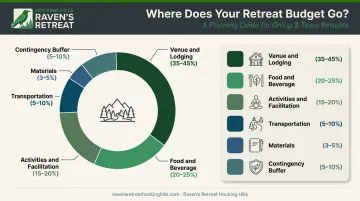
Break the total spend into categories:
| Category | Typical % of Budget |
|---|---|
| Venue and lodging | 35–45% |
| Food and beverage | 20–25% |
| Activities and facilitation | 15–20% |
| Transportation | 5–10% |
| Materials | 3–5% |
| Contingency buffer | 5–10% |
For per-person benchmarks: PlanRetreat's 2023 Annual Retreat Report found the most common single-offsite budget was $1,001–$2,000 per person, with hotel costs averaging $150–$200 per person per night. Multi-day retreats, private venue buyouts, and curated programming with facilitators and wellness providers will sit at the higher end of that range — but so will the quality of outcomes.
Duration changes costs significantly. A single overnight requires fewer logistics and budget than a 3-night multi-day format, but a 3-day retreat can accomplish substantially more. Plan for the retreat length your goals actually require, then fit the budget to that.
Step 4: Choose a Venue That Enables Customization
The right venue does more than hold your group — it actively contributes to what you're trying to accomplish.
This means asking whether a venue offers:
- Multiple space types: group gathering areas, breakout spaces, outdoor environments, and private lodging
- Flexibility to bring in external facilitators, chefs, or wellness providers
- Physical separation from the everyday work environment — which removes psychological noise and signals to attendees that this gathering is different
Research on physical environments and creativity consistently finds that setting influences how people think and communicate. A 2023 scoping review covering 33 studies found measurable relationships between physical environment design and individual and organizational creativity. Nature-immersive settings add another dimension: exposure to natural environments supports stress regulation, reduces cortisol, and creates the psychological distance that generates more honest conversations.
For organizations in the Midwest, Raven's Retreat Hocking Hills offers full property buyout on a 58-acre private preserve. The Art Lodge sleeps up to 16 guests across 6 bedrooms, with the Sculptor's Art Bungalow adding capacity for smaller groups. Customizable add-on experiences include:
- Plant-based chef meals
- Live sculpture performances by master sculptor Dustin Weatherby
- Guided meditation and sound healing
- Forest bathing and wellness trails
- NLP coaching and breathwork sessions
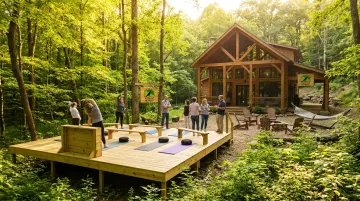
A private nature preserve operates differently than a hotel conference center. The environment starts shaping group dynamics before the first session begins — and that effect compounds across a multi-day retreat.
Step 5: Design the Agenda and Activity Mix
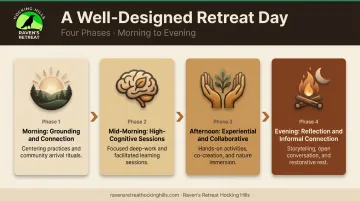
A well-designed retreat day has a deliberate shape. Here's a framework that consistently works:
- Morning — grounding and connection: Open with something low-stakes that builds presence and group cohesion. A guided walk, a breathing practice, or a creative warm-up prepares people for the cognitive work ahead.
- Mid-morning — high-cognitive sessions: Strategic work, decisions, and complex facilitated discussions belong here. This is when attention is sharpest.
- Afternoon — experiential or collaborative: Hands-on creative activities, team challenges, nature-based experiences, or skill-building workshops. Lighter cognitive load, stronger relational and creative outcomes.
- Evening — reflection and informal connection: Debrief the day, share meals, gather around a fire pit. Unstructured time is not filler — it's where informal relationship-building happens.
Microsoft WorkLab's 2021 brain research found that back-to-back high-cognitive sessions accumulate stress-associated brain activity, while even short breaks help reset attention. Pacing matters as much as content selection.
For every proposed activity, apply this test: what specific shift in thinking, feeling, or behavior does this create — and does that shift serve our goals? Entertainment value alone isn't enough justification. A live sculpture performance by a master artist works as a leadership activity because it viscerally demonstrates adaptation, creative problem-solving, and patience in real time — the fact that it's memorable is a bonus, not the reason.
At Raven's Retreat, corporate agendas commonly layer guided yoga or breathwork alongside strategy sessions, with forest bathing or creative workshops filling the afternoon and fire pit gatherings closing each evening.
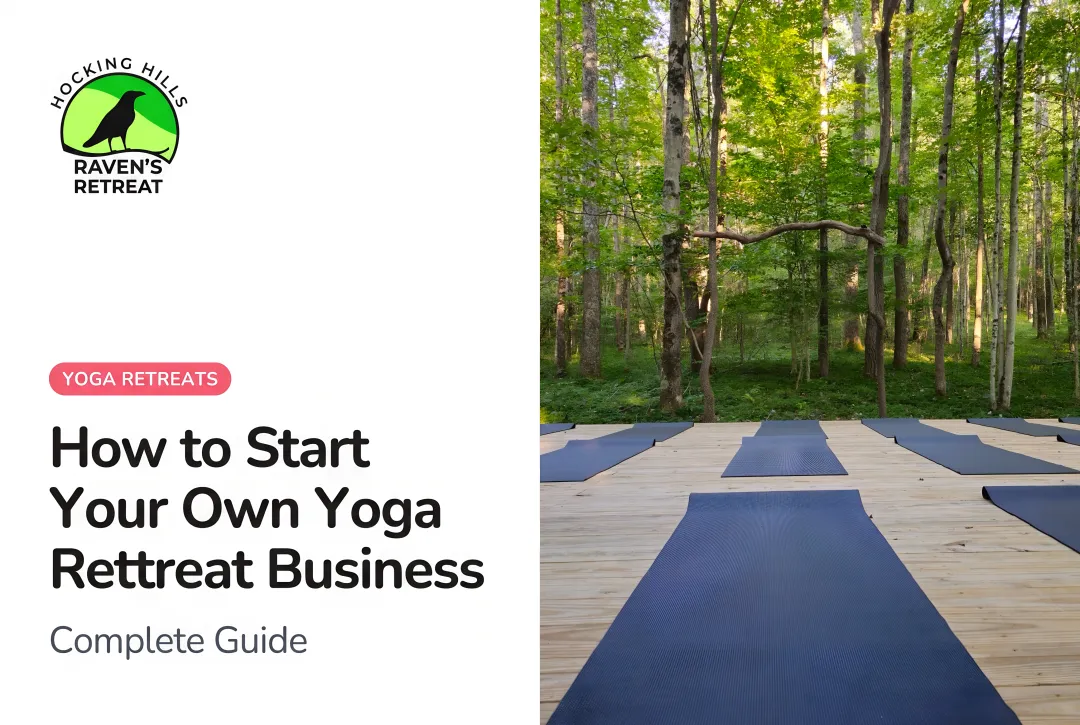
The property's multiple spaces support this kind of environmental flow: The Shala for indoor wellness, an elevated forest platform for outdoor practice, the Art Lodge for group sessions, and the wellness trails for informal connection between activities.
Step 6: Plan for Feedback and Follow-Through
A retreat without accountability structures is essentially a very expensive morale event.
Build in two feedback touchpoints:
- Mid-retreat pulse check (informal): A quick read on energy, engagement, and whether sessions are landing. Do this at lunch on day two, not in a formal survey. Ask three questions: What's working? What's not? What do you need more of?
- End-of-retreat reflection (structured): Capture insights while they're fresh. Written individual reflections plus a group share-out take 30–45 minutes and produce the raw material for your action plan.
The post-retreat action plan should be specific:
- Identify 2–3 commitments that emerged from the retreat
- Assign a named owner to each
- Schedule a 30-day check-in to assess whether behavior has actually changed
Raven's Retreat offers optional post-retreat wellness support for corporate clients, and the team recommends a follow-up recap meeting to reinforce insights. The goal is continuity — the retreat experience should connect to changed behavior back at work, not exist as a memory that fades by the following Monday.
What to Prepare Before You Start Designing
Before design work begins, three things need to be in place:
- Stakeholder alignment — Leadership must agree on purpose, budget, dates, and must-have attendees before design starts. One alignment conversation upfront saves weeks of iteration.
- A pre-retreat needs assessment — A short survey or a few conversations with key team members surfaces what's working, what people hope to gain, and any concerns about format. It also signals to attendees that their input shaped the design, which increases buy-in.
- An honest timeline — Plan earlier than you think you need to. PlanRetreat's data shows 63.1% of companies with more than 101 participants needed 4+ months to organize their retreat.
For private venue buyouts, external facilitators, or customized programming, early booking is encouraged to secure your preferred dates. Raven's Retreat recommends booking early for full property buyouts, with spring and fall representing peak availability windows.
Key Variables That Determine Retreat Success
Even with clear goals and a solid agenda, outcomes vary. These four variables most directly predict whether a retreat actually delivers on its goals.
Group Size and Composition
Small groups — under 15 — allow for more intimate, vulnerable work. Larger groups require structured breakout formats and more facilitation scaffolding to prevent some voices from dominating.
Seniority mix also matters. When executives and junior team members are in the same room, psychological safety needs to be established before you can expect honest input from the less senior participants. Breaking into cross-functional small groups for certain sessions can neutralize hierarchy effects.
For deep facilitated work, aim for 8–14 participants — the range at which intimacy and personalized attention are most achievable.
Duration and Pacing
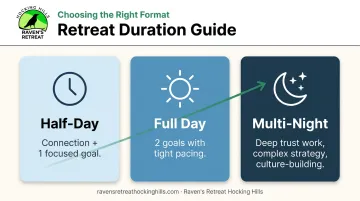
Trying to accomplish 3-day retreat goals in a single day is one of the most common design errors. Duration shapes what's achievable:
- Half-day: Connection and one focused goal
- Full day: Two goals, if pacing is tight
- Multi-night: Deeper trust work, complex strategic alignment, or meaningful culture-building
Rest, meals, transitions, and free time are active retreat ingredients. Removing them to pack in more sessions backfires.
Setting and Environment
The physical environment influences how people think, communicate, and open up. A 2019 study published in Frontiers in Psychology found that urban nature experiences reduced salivary stress biomarkers (cortisol and alpha-amylase) in participants over an 8-week period.
Nature-immersive settings — like a private preserve in Hocking Hills — work partly because the environment shifts the nervous system state of participants before any facilitated session begins.
A hotel ballroom with fluorescent lighting communicates something specific: this is a business meeting in a different location. A private preserve communicates something else entirely.
Activity-to-Goal Alignment
Effective team-building activities address at least one of four core components:
- Goal setting — clarifying what the team is working toward
- Role clarification — resolving ambiguity around who owns what
- Problem solving — working through real challenges together
- Interpersonal relations — building the trust that makes everything else work
Activities chosen primarily for entertainment may actively undermine trust-building goals by signaling that the retreat isn't serious.
For each proposed activity, ask: does this serve our goals, or does it just fill time?
Common Mistakes When Designing Custom Organizational Retreats
Skipping the purpose conversation produces a well-organized event that accomplishes nothing measurable — and retreats without clear goals rarely receive budget approval the following year.
Over-programming the schedule leaves no room for the informal conversations and unstructured processing that often generate the most lasting value — a schedule with breathing room is usually better than one that's packed end to end.
Choosing a venue based on convenience or cost alone can undermine the experience before the first session starts. A generic hotel conference room rarely supports creative thinking or genuine renewal — evaluate the space against your goals, not just your budget.
Skipping follow-through: without post-retreat action items, assigned owners, and a scheduled check-in, the energy and insight generated during the retreat dissipate quickly. It becomes a pleasant memory rather than a driver of real decisions.
Conclusion
Designing a custom retreat that actually changes something requires purpose-first thinking, honest group diagnosis, a venue that works with your goals rather than against them, and enough structural discipline to build in accountability after the group returns home.
The retreats that fail most often aren't underfunded — they're under-designed. Organizations that approach retreat planning with the same rigor they bring to strategic planning cycles walk away with stronger teams, sharper alignment, and decisions that actually stick.
When you're ready to move from planning to booking, the right venue does a lot of the heavy lifting. Raven's Retreat Hocking Hills offers fully customizable retreat programming for small teams and leadership groups — set on a 58-acre private nature preserve in Hocking Hills, Ohio, with accommodations, wellness add-ons, and facilitated experiences built around your objectives.
The core design principles that make retreats work:
- Start with a clear outcome, not a theme
- Match your venue to your goals (not just your budget)
- Build structured time for both focused work and genuine rest
- Assign accountability before the group leaves the property
Explore custom retreat options at Raven's Retreat →
Frequently Asked Questions
What is the average cost of a custom retreat?
Most organizations spend $1,001–$2,000 per person for a single offsite, with hotel costs averaging $150–$200 per person per night. Multi-night retreats with external facilitators or private venue buyouts typically land at the higher end of that range.
How do you structure a custom retreat?
Let your retreat's purpose dictate its shape. A typical flow opens with connection and grounding, moves into goal-focused work sessions during peak cognitive hours, incorporates experiential or creative activities in the afternoon, and closes each day with reflection and informal time together.
Does insurance cover wellness retreats?
Coverage depends on how the retreat is categorized — business travel, professional development, or employee wellness programming each fall under different policy language. Consult your HR department or insurance provider before assuming coverage applies.
How far in advance should you plan a custom organizational retreat?
Plan 3–6 months out for most group retreats. For private venue buyouts, custom facilitation, or peak-season dates (especially spring and fall), 6–12 months is more realistic and gives you substantially better venue and facilitator options.
What activities work best for a corporate retreat?
The most effective activities tie directly to retreat goals:
- Strategic alignment: facilitated workshops and structured planning sessions
- Innovation and burnout recovery: creative, nature-based, or sensory experiences
- Interpersonal trust: collaborative challenges and somatic or movement-based practices
How do you measure the success of an organizational retreat?
Track two layers: immediate and delayed. A post-retreat survey captures first reactions, but the real indicators are progress on the 2–3 commitments made during the retreat and observable shifts in team behavior at the 30- and 60-day marks.