Introduction
Most project management teams look cohesive on paper. Clear roles, defined workflows, stakeholder alignment documented in a RACI chart. Then a deadline shifts, a stakeholder changes priorities mid-sprint, and the communication gaps that were always there become impossible to work around.
The problem isn't that PM teams lack skill — it's that the pressures they face are unusually specific. Cross-functional dependencies and the constant need to align people with competing priorities create friction that generic team building activities simply don't address.
According to PMI's communications report, poor communication is a factor in 56% of failed projects — and $75M of every $135M at risk per $1B spent traces directly back to ineffective communication.
This guide covers team building activities chosen specifically for PM teams, organized by communication, problem-solving, and trust — including how an off-site nature retreat can shift team dynamics in ways that a conference room setting rarely does.
Key Takeaways
- PM-specific team building targets communication gaps, role conflicts, and decision-making under pressure — not just morale
- Activities organized by communication, problem-solving, and trust help teams address their actual weaknesses
- Debriefs improve team performance by 20-25% — skip the debrief and you lose most of the gain
- Nature-based off-sites like Raven's Retreat Hocking Hills build trust that office environments rarely can
Why Project Management Teams Need Dedicated Team Building
Generic team building — the kind that involves trivia nights and trust falls — misses the mark for PM teams. Their collaboration challenges are more specific.
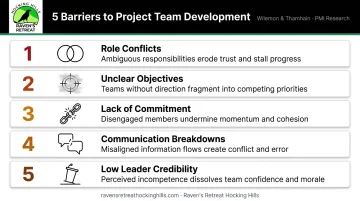
In a foundational study published by PMI, Wilemon and Thamhain surveyed over 90 project leaders and identified 11 major barriers to project team development. The most recurring:
- Role conflicts and unclear team structure
- Objectives that aren't clearly communicated
- Lack of member commitment during long project cycles
- Communication breakdowns across departments
- Low credibility of the project leader under pressure
These aren't personality problems. They're structural, and they show up in almost every cross-functional PM team at some point.
The Double Duty of Good Team Building
Effective team building in a PM context does two things at once: it builds interpersonal trust and directly strengthens the skills that drive project outcomes. Communication clarity, creative problem-solving, accountability, and delegation aren't soft extras — they're the mechanics of delivery.
PMI's 2023 Pulse of the Profession report found that organizations prioritizing these "power skills" — communication, problem-solving, collaborative leadership — reported 72% of projects meeting business goals, versus 65% for organizations that didn't — a 7-point gap that compounds across every initiative on the roadmap.
That makes team building a performance investment, not a calendar obligation.
Communication-Focused Team Building Activities for PM Teams
Communication failures don't usually happen because people are bad at talking. They happen because teams haven't built shared habits around listening, delegation, and expectation-setting. These activities create a low-stakes space to practice those habits before they matter under deadline pressure.
Blind Instruction Challenge
How it works: Divide into pairs. One person is shown a simple structure (built from LEGO, wooden blocks, or basic shapes) and must instruct their partner to replicate it — without showing the object or touching it themselves.
Why it works for PM teams: The debrief surfaces how differently two people can interpret the same instruction. The space between what a project manager communicates and what a team member hears is exactly where tasks go sideways. Use the debrief to draw out:
- Where instructions were too vague or assumed shared context
- How team members filled in gaps with their own assumptions
- What delegation habits could close that gap on real projects
Active Listening Pairs
How it works: Participants pair up. One person speaks for 3 minutes on a work-related challenge. Their partner listens without interrupting, then paraphrases back what they heard. Roles reverse.
The classic version from SessionLab uses triads (speaker, listener, observer), but pairs work well for PM teams where focused discussion is the goal. The debrief should surface assumptions and communication gaps, particularly across departments where context isn't shared.
Storytelling Without "I"
How it works: One person talks freely for 3 minutes without using the word "I." Their partner listens silently. Then roles reverse.
Why it matters: PM communication often defaults to self-centered framing — "I decided," "I think," "I escalated." This simple constraint shifts the narrative toward team-centered language. It's especially useful for onboarding cross-functional members who bring different communication norms to the team.
Problem-Solving and Creative Activities for PM Teams
PM teams operate under constraint by default — fixed budgets, shifting requirements, hard deadlines. The problem-solving activities below build strategic thinking and creative collaboration under exactly that kind of pressure.
Hackathon on a Real Challenge
Divide the team into small groups. Give each a real, simplified challenge your organization faces. Set a 60-minute timer. Each group must identify root causes and propose at least two viable solutions — divergent thinking encouraged.
Using actual work problems (not hypotheticals) makes this immediately applicable. Slack's hackathon approach — time-boxed and judgment-suspended — is the right spirit. The debrief focuses on how groups approached ambiguity and which ideas deserve further exploration.
Moonshot Brainstorm
Give the team an audacious constraint: "How would you deliver this project in half the time with the same budget?" Solutions don't need to be realistic. The goal is breaking habitual thinking patterns that form in teams locked into strict methodologies like Agile or Waterfall.
Research reviewing 145 empirical studies found that moderate constraints can actually support innovation — but too many constraints (the kind PM teams live with daily) can suppress it. Run this when the team feels creatively stuck — it surfaces approaches that structured planning rarely reaches.
Marshmallow Challenge
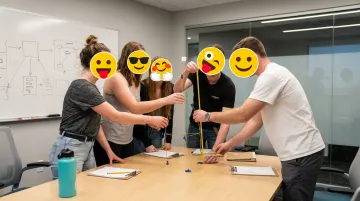
Groups of 4-5 receive 20 sticks of spaghetti, one yard of tape, one yard of string, and one marshmallow. They have 18 minutes to build the tallest freestanding structure with the marshmallow on top.
The debrief is where the value lives. Each question maps directly to real project execution dynamics:
- How did the group divide leadership?
- Who stepped up when the structure fell?
- What trade-offs were made under time pressure?
- Where did assumptions go untested until too late?
Team Canvas Session
Using the Team Canvas framework developed by Alex Ivanov and Mitya Voloshchuk, the group collaboratively maps shared goals, individual roles, personal motivations, and working agreements onto a visual artifact.
Newly formed PM teams and groups entering a new project phase get the most from this. The canvas produces a team-authored reference document — something concrete to return to at milestones when alignment starts to drift.
Trust-Building Activities for PM Teams
Without trust, information doesn't flow freely. Feedback doesn't land honestly. Team members protect their own interests instead of the project's. Wilemon and Thamhain's research confirmed this directly: high trust makes feedback more effective, while low trust creates gamesmanship and information hoarding — both project killers.
Google's Project Aristotle, which studied 180 teams, identified psychological safety as the single most important factor in team effectiveness. More than talent or experience, what mattered most was whether team members believed it was safe to speak up.
Appreciations Circle
Team members write genuine, specific appreciation notes for each colleague — focused on actual contributions to shared work. At the session's end, each person receives their collected notes.
This works especially well after a difficult sprint or a project phase with high friction. It doesn't pretend the stress didn't happen — it resets the emotional tone of the team before the next phase begins.
Heard, Seen, Respected (HSR)
In pairs, team members share a moment when they felt genuinely valued during a recent project. The listening partner reflects back without judgment or commentary. SessionLab's HSR format then expands the reflection into small groups.
For PM teams where hierarchy and pressure can suppress honest communication, this exercise builds the empathy foundation that makes psychological safety real — not just a value on a slide deck.
Shared Values Workshop
Each person writes down 2-3 values they believe the team operates by — or should. Groups then compare and synthesize those into a shared set of team agreements.
This works best in two situations:
- After navigating a difficult project or a high-conflict phase
- When a team is reforming after organizational change
The output is team-authored norms — ones people actually follow, unlike values handed down from a manager.
Taking Team Building Off-Site: Why a Retreat Setting Changes Everything
The office is full of hierarchy cues. The standing meetings, the Slack notifications, the physical proximity to the same problems the team is trying to solve — all of it makes genuine creative reset difficult. A different environment opens up a different kind of conversation.
Research supports this directly. A 2019 peer-reviewed study found that nature exposure as short as 20-30 minutes produces measurable cortisol reduction — with stress relief most efficient at 21-30 minutes, when cortisol drops 18.5% per hour beyond normal daily patterns. For PM teams running hot from deadline pressure, that stress relief matters.
Why Raven's Retreat Works for PM Teams
Raven's Retreat Hocking Hills is a 58-acre private nature preserve near Laurelville, Ohio — about an hour from Columbus and two hours from Cincinnati. It was designed specifically as an adults-only immersive art and nature retreat, and it's built for exactly the kind of team reset that office spaces can't deliver.
What makes it practical for PM teams, not just scenic:
- Work infrastructure built in: Wi-Fi at 300+ Mbps, a large presentation screen, and conference-ready open floor space in the Art Lodge
- Full property buyout available: Exclusive access to all 58 acres for complete privacy and focus, accommodating up to 18 overnight guests (groups of 30 possible for day events)
- Day retreat format for teams of 20 or fewer: All-inclusive packages bundling meals, wellness, creative activities, and team-building into a single day
- Custom itinerary consultation: A complimentary planning call with co-founder Raven Morgan to shape the experience around your team's specific goals
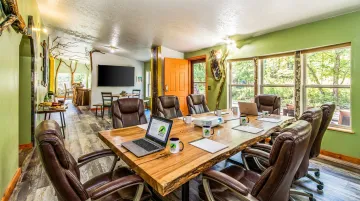
The property was built by master sculptor Dustin Weatherby and co-owner Raven Morgan. Steel sculptures, hand-carved installations, forest wellness trails, and an elevated yoga platform create an environment where creative thinking comes naturally and honest conversation feels less guarded.
Off-Site Activities That Reinforce PM Skills
The environment enables activities that simply don't translate to a conference room:
- Structured nature scavenger hunts built around communication and problem-solving — participants listen, combine ideas, and collaborate to navigate challenges, naturally surfacing individual strengths
- Live sculpture performances by Dustin Weatherby, where watching raw material become finished art illustrates adaptation, patience, and creative problem-solving in real time
- Guided group reflection walks through the forest preserve, led by certified practitioners, creating space for honest conversation that high-pressure project environments tend to shut down
- Mastermind sessions that combine strategic alignment with genuine personal connection, supported by the Art Lodge's conference-ready setup
A corporate team that stayed at Raven's Retreat reported: "We held a 2-day small corporate retreat. Planning was easy and our team left feeling recharged, focused, and more connected than ever."
Tips for Planning Team Building That Actually Sticks
The activity is only as valuable as the intention behind it.
Start by naming the actual PM team challenge you're trying to address. Communication gaps between departments? Low trust after a difficult project? Role ambiguity at a new project kickoff? The activity should serve a clearly defined purpose — not fill a calendar slot.
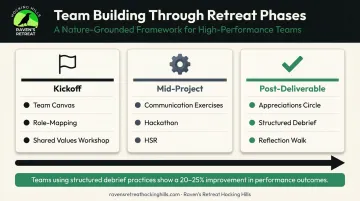
Match the activity to the project phase so it meets the team where they are:
- Kickoff → Team Canvas, role-mapping, shared values workshop
- Mid-project → Communication exercises, hackathon on a real challenge, HSR
- Post-deliverable → Appreciations circle, structured debrief, reflection walk
Debrief every session. Research across 46 studies found that structured debriefs improve team performance by 20-25%. Skip the debrief and you skip the learning. A 10-minute structured conversation after the activity is where behavior gets named, patterns get surfaced, and the session becomes something the team actually remembers.
Two final habits that separate one-off activities from lasting culture:
- Gather feedback anonymously — a short post-session survey captures what resonated, what felt forced, and what the team wants more of
- Iterate based on responses — over time, this shifts team building from a top-down program into something the team co-creates and genuinely invests in
Frequently Asked Questions
What are the C's of project management and team building?
Communication, collaboration, commitment, creativity, and conflict management are the core project management competencies most teams aim to develop. Team building activities address all five — communication exercises build the first, while trust and problem-solving activities reinforce the rest.
What are the 5 P's of project management?
One common framework defines them as People, Process, Plan, Performance, and Purpose. Team building activities most directly reinforce the "People" and "Purpose" pillars — helping teams align on shared goals and work together effectively throughout the project lifecycle.
What makes team building for PM teams different from other teams?
PM teams face cross-functional dynamics, strict deadlines, and the constant need to align stakeholders with competing priorities. Team building for these groups should specifically target communication clarity, trust under pressure, and creative problem-solving — not generic bonding activities.
How often should project management teams do team building activities?
A light activity monthly — a check-in, appreciation exercise, or active listening drill — maintains cohesion without requiring heavy lift. A more structured session quarterly, or at key project milestones (kickoff, mid-project, post-mortem), addresses deeper dynamics.
Should team building for PM teams happen off-site or in the office?
Both have value, but off-site settings — especially nature-based environments — are more effective for deeper trust-building and creative breakthroughs. Stepping away from the office removes the pressure of titles and deliverables, giving team members space to connect as people rather than project contributors.
How do you measure whether team building activities are improving project performance?
Track post-activity feedback scores, self-reported communication quality, project milestone adherence, and team engagement indicators before and after a structured program. Comparing these metrics across project phases gives a practical signal of what's working.