
Hilton's 2025 Trends Report, based on a survey of 13,001 adults across 13 countries, found that nearly 1 in 4 global travelers now actively power down and limit social media use on trips more than they used to. The demand for genuine disconnection is real, and it's growing.
This guide covers everything you need to plan a true unplugged weekend retreat: why your nervous system needs it, how to tell a real tech-free property from one that's just marketing the idea, what to actually do when you get there, and what to expect when the restlessness hits on day one.
Key Takeaways
- Nearly 1 in 4 travelers now actively reduce screen time on trips
- Just 48–72 hours offline can measurably reset your nervous system
- True tech-free retreats are built on environment and activity design, not marketing language
- The first 24 hours feel restless; the shift comes after
- Pack analog: journal, physical book, old watch, printed map
Why Your Brain Is Begging You to Unplug
The Hidden Cost of Constant Connectivity
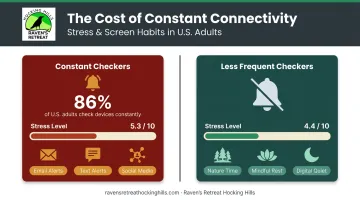
The APA's research on device checking found that 86% of U.S. adults constantly or often check email, texts, and social media. Those "constant checkers" reported average stress levels of 5.3 out of 10, compared to 4.4 for people who check less frequently. Compounded across every waking hour, every day, that gap adds up fast.
Notifications don't just interrupt tasks. A 2022 behavioral study found that participants performed more slowly on tasks paired with smartphone notification sounds versus neutral sounds. Your brain doesn't need to consciously register the ping — the alert state lingers.
Add decision fatigue from endless content feeds, and you have a nervous system that never fully shifts out of alert mode. Sleep degrades, creativity goes flat, and feeling genuinely rested — even after a full night — stops being a given.
What Research Says About Unplugging
A 2023 study published in PMC found that a two-week social media digital detox produced measurable improvements across multiple wellbeing markers in young adults:
- Improved sleep quality
- Reduced stress levels
- Increased life satisfaction
- Stronger supportive relationships
Shorter windows — the 48–72 hour range most retreat operators work within — won't produce the same depth of change, but they do produce a measurable shift in baseline tension. The adjustment period itself is informative: when you feel edgy and reach for your phone out of habit, that's your baseline becoming visible. Noticing it is the first step.
Wellness retreat operators call it a "reset window": enough time for the nervous system to stop scanning for incoming signals and start settling. Two to three days won't rewire long-term habits, but the felt contrast it creates makes new habits easier to sustain.
What Separates a True Tech-Free Retreat from "Detox-Washing"
The Problem with Digital Detox Marketing
Some resorts market themselves as digital detox destinations while offering room Wi-Fi, in-suite TVs, co-working setups, and 24-hour business centers. The label gets applied, but the environment doesn't change. Green Lodging News calls this "wellness-washing" — a pattern where hotels exaggerate or misrepresent their actual wellness commitments.
Before booking, ask these questions directly:
- Is Wi-Fi available in guest rooms — or only in common areas?
- Are devices actively discouraged during programming, or just not mentioned?
- Does the property have natural cell signal loss in portions of the grounds?
- Are evening activities designed to replace screens, or do guests mainly watch TV?
Properties with genuine commitments answer these questions directly. Hesitation or deflection is its own answer.
What a Real Tech-Free Retreat Looks Like
The hallmarks go beyond a no-phone policy:
- Natural signal scarcity — the landscape itself discourages connectivity
- Activity design that fills the void — hiking trails, meditation zones, creative workshops, communal fire pits; things that occupy the mind in restorative ways
- A property culture that matches the language — not just a tagline on the booking page
Some retreats use physical lockboxes for devices (Unplugged cabins in the UK, for example). Others rely on environment over enforcement. At Raven's Retreat Hocking Hills, high-speed Wi-Fi is available for guests who need it, but cell signal typically drops as soon as you head down the driveway. The environment does the work.
By day two, most guests report that phones stay in rooms without being asked. The trails, sculptures, and forest quiet become genuinely more compelling than anything on a screen.
Types of Unplugged Retreat Settings
| Setting | Best For |
|---|---|
| Wilderness/nature lodges | Hikers, outdoor enthusiasts, nature-first seekers |
| Art and wellness retreat centers | Creative professionals, burnout recovery |
| Silent/meditation retreats | Experienced practitioners, deep inner work |
| Glamping/off-grid properties | Comfort-seekers wanting nature without roughing it |
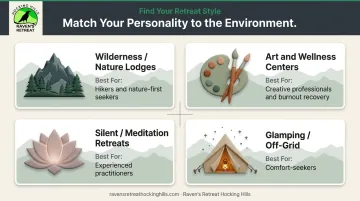
Match your personality to the environment. Someone who needs structure will struggle at a fully unstructured wilderness cabin. Someone who finds guided meditation frustrating won't thrive at a silent retreat. The right fit matters more than the marketing.
How to Prepare for a Successful Unplugged Weekend
Preparation starts before you leave. These steps reduce the mental drag that pulls you back toward your phone even when you're physically somewhere else.
Pre-trip logistics:
- Set an out-of-office autoresponder with a return date
- Leave the property's main phone number with one or two contacts as an emergency-only alternative
- Tie up any urgent work before departure — unfinished obligations create background anxiety that no amount of forest air can fully quiet
Ease the transition in the days before:
- Use your phone's built-in screen time limits to reduce checking frequency
- Start cutting the habit of reaching for the phone during idle moments — waiting in line, sitting at red lights
- Notice how often you reach for your phone without a reason — then stop mid-reach
Once your mind is prepped, your bag should match. Pack for analog living:
- Paper journal and a few good pens
- Physical books (not e-readers)
- A non-smartphone camera if you want to document the trip
- Printed directions and a map to the property
- An old-fashioned watch
- Comfortable layers for outdoor time
- Personal wellness items — yoga mat, foam roller, whatever supports your body
What you leave in the car matters as much as what you bring inside. Arriving with only what you actually need makes the first evening feel lighter than you expect.
What to Do at a Tech-Free Retreat
Nature Immersion as the Anchor
Start here, especially on day one. Multiple field studies support what most people intuitively sense: time in forested environments reduces cortisol, lowers heart rate, and increases parasympathetic activity compared to urban exposure. A 2025 narrative review confirmed forest bathing's documented benefits for reducing stress hormone activity and improving mood.
The practical application is simple. Walk without earbuds. Use all five senses deliberately — what do you hear beyond the ambient noise? What does the ground feel like underfoot? Attention Restoration Theory suggests that natural environments allow the directed attention system to recover from fatigue; you're not forcing focus, you're letting it rebuild organically.
At Raven's Retreat Hocking Hills, guests access over a mile of private wellness trails on the 58-acre preserve, including two designated forest meditation areas — one with a multi-canopy view, one beside a creek with pink granite boulders. Guided forest bathing sessions are available through certified ANFT practitioners for those who want structured immersion rather than solo exploration.

Creative Engagement and Evening Rituals
Active creative work — journaling, sketching, watching a live craft demonstration — occupies the mind in ways that are restorative rather than depleting. This is distinct from passive scrolling, which research associates with upward social comparison and reduced well-being.
You don't need to produce anything meaningful. The act of noticing — writing down what you observed on a walk, sketching the light through trees — keeps the mind engaged without the stimulation loop of a feed.
Evening options that work particularly well without screens:
- Stone fire pit conversations (Raven's Retreat seats 16–18 around theirs)
- Hot tub and sauna wind-down (guests frequently report using the infrared cedar sauna each evening as a natural transition toward sleep)
- Stargazing — the Hocking Hills region sits away from significant light pollution
- Live sculpture performances, like those by master sculptor Dustin Weatherby, who transforms raw logs into finished pieces in a few hours
Wellness Practices That Deepen the Reset
All of these practices work toward the same outcome: shifting the nervous system from sympathetic activation — the alert, scanning state that constant connectivity maintains — toward parasympathetic recovery:
- Somatic breathwork (available at Raven's Retreat, guided by co-founder Raven Morgan, a certified breathwork coach)
- Guided yoga on a forest platform
- Sound healing with singing bowls
- Meditation walks
None of these are requirements. Even sitting quietly beside a creek without an agenda accomplishes something similar. The point is presence, not a packed schedule.
A Sample 2-Day Unplugged Weekend Itinerary
This itinerary is built around the rhythm of Hocking Hills, Ohio — but the structure works anywhere you go fully offline. Treat it as a starting point, not a script.
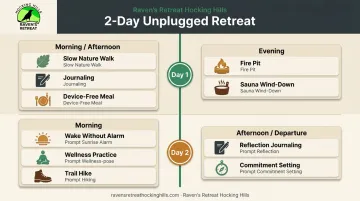
Day 1 — Morning/Afternoon
- Arrive mid-morning; resist the urge to document check-in on social media
- Slow nature walk — no earbuds, no podcasts — using all five senses deliberately
- End with 20–30 minutes of journaling or sketching what you observed
Day 1 — Evening
- Shared meal without devices at the table
- Explore the property: art installations, fire pit, or simply sit outside as darkness sets in
- Sauna or hot tub wind-down
- Go to bed earlier than usual; let natural darkness set the pace
Day 2 picks up where the stillness of the first night leaves you — slower, more open, and ready to go deeper.
Day 2 — Morning
- Wake without an alarm if possible
- Gentle wellness practice: yoga, breathwork, or a quiet meditation walk
- Slow breakfast, then a longer trail hike. Near Raven's Retreat, Old Man's Cave (14 miles) and Cedar Falls (16 miles) both reward the short drive with scenery that justifies the detour
Day 2 — Afternoon/Departure
- Final hours: journal your reflections — what came up, what felt different, what you want to carry home
- Commit to one or two specific, small changes for lower-tech living back home
- The clearer those commitments, the more likely the reset actually sticks
What to Expect Emotionally on Your First Tech-Free Getaway
The First 24 Hours
Most first-time detoxers feel restless, edgy, or oddly anxious on day one. Research on smartphone restriction confirms this: the brain reaches for its habitual patterns, and when the expected inputs don't arrive, discomfort follows. This is not a sign the retreat isn't working. It's the withdrawal phase, and it passes.
The urge to check — even when there's nothing to check — is the clearest possible evidence of how dependent on stimulation the nervous system has become.
The Shift That Follows
After the adjustment period, something shifts. Conversations feel deeper. Appetite returns more naturally. Small sensory details — birdsong, the texture of bark, the smell of rain — become vivid again. Creative thought re-emerges, often in the form of ideas that had been crowded out by the noise.
Guests at Raven's Retreat consistently describe a version of this: phones staying in rooms without being told, time feeling like it has expanded, a sense of presence that many hadn't experienced in years. One guest described the experience of "getting lost in nature and this incredible property" as "effortless" and "organic" — the disconnection didn't feel forced, it felt like relief.
Re-Entry: Making It Last
That sense of relief doesn't have to disappear when you get home. The reset evaporates quickly if you return to the same habits immediately — but small, specific commitments can hold the door open:
- A no-phone morning window (even 20 minutes before checking)
- One tech-free meal per day
- A short daily walk without earbuds
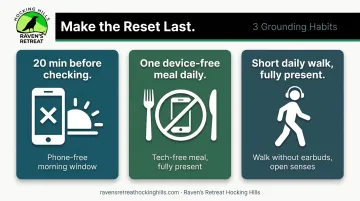
These aren't dramatic changes. But they create the same kind of deliberate space the retreat opened up — just in smaller doses, built into regular life.
Frequently Asked Questions
Why choose an unplugged weekend retreat?
An unplugged retreat removes the constant stimulation of notifications and feeds, allowing the nervous system to fully shift out of alert mode. Better sleep, reduced anxiety, and real mental renewal follow — none of which happen easily on a regular vacation where the phone stays in your pocket and old habits tag along.
What is the average cost of an unplugged weekend retreat?
Basic off-grid cabins run $100–$400/night; structured wellness retreats with full programming range from $500 to $3,000+ per person. At Raven's Retreat Hocking Hills, the Art Bungalow starts at $400/night and the Art Lodge (up to 16 guests) at $1,200/night, with wellness add-ons customized to your group.
Does insurance pay for unplugged weekend retreats?
Standard health or travel insurance does not cover retreat costs. Some HSA/FSA accounts may cover specific wellness components (meditation, guided sessions) if linked to a diagnosed condition with a Letter of Medical Necessity — but the IRS does not generally permit retreat costs as medical deductions. Confirm with your plan administrator.
How do unplugged weekend retreat cabins get power?
Most off-grid retreat cabins use solar panels, generators, propane, or a combination of these to power essentials — lighting, heating, cooking appliances. Raven's Retreat uses on-site solar paired with energy-efficient infrastructure and is not marketed as fully off-grid, but sustainability is built into the property's operations throughout.
How long does it take to feel relaxed on an unplugged weekend retreat?
Expect a 24–48 hour restlessness phase before genuine calm sets in. This is why two to three nights produce far better results than a single overnight — day one is adjustment, and the real benefit follows.
What should I pack for a tech-free weekend getaway?
Bring a paper journal, physical books, a non-smartphone camera, a printed map, an old-fashioned watch, comfortable outdoor layers, and any personal wellness items. Leave the laptop at home. Choosing what not to bring is as important as what you pack.