A deliberate change of environment can break that cycle. Writers have known this for centuries. What's changed is how accessible a well-planned solo retreat has become — and how clearly the evidence points to why it works.
The concept sounds simple: go somewhere, write. But the difference between a productive retreat and a frustrating one almost always comes down to preparation. The right goals, the right location, a realistic daily structure — these aren't nice-to-haves. They're the whole thing.
This guide walks through every step, from setting objectives before you pack to sustaining momentum after you return home.
Key Takeaways
- Define your writing goal before you book — vague intentions lead to unproductive retreats
- Choose a location that actively removes your routine cues and daily triggers
- Plan for 2–4 hours of focused writing per day, not an all-day grind
- Schedule daily walks as a core part of your writing process, not an afterthought
- Plan your post-retreat integration before you leave — momentum fades fast without a system
How to Plan a Solo Writing Retreat: Step by Step
Solo writing retreats don't require applications, committee approval, or expensive packages. What they do require is intentional preparation. Skip it, and you'll spend the first day staring at a blank document feeling worse than if you'd stayed home.
Step 1: Define Your Writing Goals Before You Go
The single biggest cause of unproductive retreats is arriving without a defined objective. "I'll see what happens" isn't a plan — it's an open invitation to spin your wheels for three days.
Before booking anything, answer this question: What specifically will I work on?
- Drafting new pages from scratch
- Revising specific chapters
- Solving a structural problem you've been avoiding
- Free-writing to break through a block
Once you have an overarching goal, set a daily target. Research on expert performance suggests that deliberate, focused creative work tops out at around 2–4 hours per day before diminishing returns set in. A daily word count of 750–1,000 words, or one revised scene, is realistic and confidence-building. Aiming for 3,000 words a day is how retreats become demoralizing.
Conservative targets build momentum steadily. Over-ambitious ones tend to collapse it before day two.
Step 2: Decide on Duration and Timing
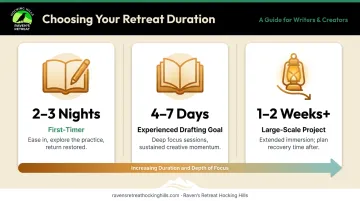
Retreat length should match both your goal and your experience level:
- First time? Start with 2–3 nights. A week feels like a long time until you're in it, at which point it can feel like too much pressure.
- Experienced retreater with a drafting goal? 4–7 days is the practical sweet spot for most writers.
- Beyond 1–2 weeks? Diminishing returns tend to set in unless you have a very clear, large-scale project plan.
Timing matters as much as duration. Before you book dates, clear your calendar of client calls, deadlines, and obligations. Let household contacts know you'll be largely unreachable. Managing expectations before you leave is far less disruptive than managing them in real time during the retreat.
Step 3: Research and Book Your Location
Not every quiet place is a good writing location. When evaluating options, check for:
- A dedicated writing workspace — not just a bed and a tiny nightstand
- Natural light in the work area
- Access to outdoor walking paths
- Reasonable quiet during your intended writing hours
- Basic food access nearby (or an equipped kitchen)
Budget options exist across every price tier. Midwest writers can find state park cabins in Minnesota for $80–$90/night or Michigan for $60–$120/night, and Ohio's Hocking Hills region offers private cabin and retreat options at similar price points. Airbnb cottage rentals, house swaps, and dedicated retreat centers are all viable depending on your needs and budget.
Step 4: Prepare Your Writing Materials and Essentials
The first hour of a retreat should not be spent hunting for files or reconstructing your outline. Arrive with your project organized:
- Printed chapters or a clean digital manuscript
- An updated outline or scene list
- Key research notes in one accessible place
Practical packing list:
- Laptop + backup drive + charging cables
- Notebooks and favorite pens (analog backup matters)
- Cozy layers — creative spaces are often cold
- A yoga mat for morning movement
- Pre-planned meals or groceries for simple cooking
- One craft book for evening reading
The food piece is underrated. Deciding what to eat three times a day drains the same mental energy you need for writing. Stock the kitchen on arrival day and don't think about it again.
Choosing the Right Location for Your Writing Retreat
Location shapes what you write. A space that feels stimulating but not distracting, private but not isolating, and comfortable without becoming about the amenities is what you're after.
Why "Away" Works
There's a practical psychology behind why any location away from home outperforms your home office, even a beautiful one. Unfamiliar spaces create what researchers call a break from routine cues — the brain registers the environment as different and stops generating the low-level domestic to-do list that competes with creative attention. You're not fighting the impulse to do the dishes when the dishes aren't yours.
Nature Settings and Creative Output
The location type matters too. A 2012 PLOS ONE study found that four days of nature immersion was associated with a 50% improvement in creative problem-solving performance. The mechanism — Attention Restoration Theory — suggests that natural environments reduce demand on directed attention, freeing up the diffuse, associative thinking that generates story connections and solves plot problems.
This doesn't mean you need a remote cabin in the wilderness. It means that access to trees, trails, and natural quiet matters, especially when your retreat goal involves generative drafting or breaking through structural problems.
What to Look For (and What Writers Often Overlook)
Check before booking:
- Read listing reviews specifically for desk quality and noise level — not just overall stars
- Confirm the Wi-Fi situation matches your intention (some writers want full connectivity; others want to lock the phone away)
- Verify walking path access — not just nearby roads or parking lots
- Assess natural light in the workspace, not just the bedroom photos
- Check whether other guests share common spaces or whether the property is private
For Midwest writers, purpose-built creative retreat centers address many of these criteria by design. Raven's Retreat Hocking Hills sits on a 58-acre private nature preserve near Laurelville, Ohio, about an hour from Columbus. The property includes over a mile of private hiking trails, two dedicated meditation areas, immersive art installations by master sculptor Dustin Weatherby, and high-speed Wi-Fi.
The Sculptor's Art Bungalow (starting at $400/night) is designed specifically for solo creatives: a private, adults-only space with a custom workspace, pond and forest views, and full kitchen access. The environment does the creative priming before you sit down to write.
How to Structure Your Writing Retreat Days
Unstructured time feels like freedom. In practice, it usually produces anxiety, drift, and a guilt spiral by day two. A loose but intentional daily rhythm gives your writing brain a container to work inside.
The Focused-Hours Reality
Even experienced professional writers rarely sustain more than 4–5 hours of genuinely focused generative writing per day. Hemingway wrote from first light until noon and tracked daily word counts like 450, 575, and 512 — not thousands.
Maya Angelou worked in a rented hotel room from 6:30 AM to 1:30 PM, often keeping 2–3 pages from 9 drafted. Both writers show the same pattern: short, protected blocks of real work.
Plan for two focused writing blocks, not a marathon. A morning block of 2–2.5 hours and an afternoon block of 1.5–2 hours will reliably outperform an undifferentiated "write all day" approach — and you'll end each day feeling accomplished rather than depleted.
A Sample Daily Structure
This isn't a prescription — it's a starting point to adapt:
- Morning movement (20–30 min) — a walk, yoga, or light stretching before sitting down
- First writing block (2–2.5 hours) — generative drafting or deep revision
- Real lunch break (45–60 min) — eat away from the screen; light reading if you want
- Second writing block (1.5–2 hours) — continue, or shift to lighter revision/editing
- Afternoon walk (30–60 min) — low-input, no podcasts (more on this below)
- Evening — craft reading, journaling, sauna, or simply resting
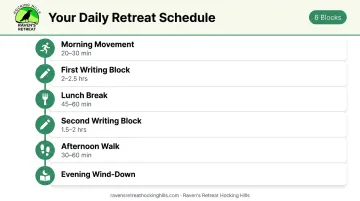
Retreat settings that include a sauna, hot tub, or forest trails — like Raven's Retreat Hocking Hills, which sits on a 58-acre nature preserve in Hocking Hills, Ohio — make that evening wind-down genuinely restorative rather than just a gap before sleep.
Walking Is Part of the Writing
Stanford research across four experiments with 176 adults found that walking increased creative output by an average of 60%. Dickens walked up to 20 miles a day. Wordsworth composed while walking — his companion noted he could go silent mid-conversation because he was drafting lines in his head.
The walk after your first writing block isn't recovery. It's where the structural problem you've been turning over gets solved. Build it in deliberately. Leave the phone behind.
Digital Discipline: Be Specific, Not Vague
"Limiting my phone" is not a plan. These specifics work better:
- Phone stays outside the writing room during blocks — not face-down on the desk. A 2023 Scientific Reports study found that a switched-off, face-down phone still reduced attention performance.
- Batch email into one window per day (after your second writing block is a natural fit)
- Set your out-of-office before you leave, not when people start texting you
Common Mistakes Writers Make on Solo Writing Retreats
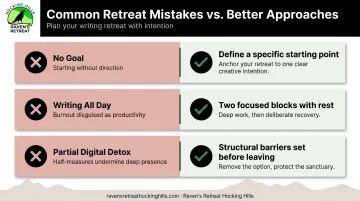
Going Without a Goal
"I'll see what happens" produces two days of staring at a blank document and returning home with less confidence than you left with. The blank page needs a starting point — a scene, a question, a rough chapter outline. Even a wrong direction is easier to course-correct than no direction at all.
Trying to Write All Day
Packing every hour with word-count obligations leads to burnout by day two. Rest, walking, and unstructured thinking time aren't wasted hours — they're when incubation happens. The writers who squeeze the most out of retreats are the ones who respect the creative cycle, not the ones who sit at the desk the longest.
Partial Digital Detox
"Checking in just once" typically unravels into full re-engagement. One notification triggers a reply, the reply pulls you into the thread, and suddenly you're back inside the exact mental headspace you left home to escape.
Productive retreats run on structural barriers, not willpower. Communicate your unavailability before you leave. Then be actually unavailable.
After the Retreat: Keeping Your Creative Momentum
The re-entry crash is real. You return home energized, write for two days, then domestic life reasserts itself and momentum stalls by day three.
Two practices help prevent this:
Write a post-retreat reflection document on your last day (not after you get home). Cover: what you accomplished, what the next project milestones are, and what daily writing habit will carry the energy forward. This takes 20 minutes and gives you a reference point when the routine starts pulling you back.
Schedule your next retreat before you leave. Even a tentative date. Writers who treat solo retreats as a recurring practice — something the writing life requires — are far more likely to protect their creative time than those who treat a retreat as a one-time reward for finishing something. Places like Raven's Retreat Hocking Hills — with its quiet 58-acre preserve, solo-friendly bungalow options, and 300+ Mbps Wi-Fi — are worth bookmarking as a recurring anchor for that practice, not just a one-time escape.
Frequently Asked Questions
How long should a solo writing retreat last?
First-timers do well with 2–3 nights — long enough to settle in, short enough to stay focused. Experienced writers often find 4–7 days optimal for serious drafting or revision. Beyond one to two weeks, most writers hit diminishing returns unless they have a very clear, large-scale project plan guiding the work.
How much does a solo writing retreat typically cost?
Costs vary widely. Budget-friendly options — state park cabins, Airbnb cottages, house swaps — can run under a few hundred dollars for a weekend. Purpose-built retreat spaces like dedicated bungalows or writer's centers cost more, often $400–$1,200+ per night depending on capacity and amenities.
Can I do a solo writing retreat at home?
Yes, with strict boundaries: notifications off, household members informed, domestic tasks suspended for the duration. A location away from home creates a stronger psychological break, removing the pull of chores and familiar distractions — making it easier to stay in creative mode all day.
What should I bring on a solo writing retreat?
The essentials: organized writing materials (manuscript, outline, backup storage), comfort items that support focus (cozy layers, yoga mat, a favorite mug), a pre-planned or simple meal setup, and one inspiring craft book for evenings. Don't overpack "just in case" items that fragment your attention.
How do I avoid writer's block during a solo writing retreat?
Arrive with a clear starting point rather than a blank slate. Build walking into your daily schedule as a thinking practice — movement is where structural solutions tend to surface. Give yourself explicit permission to write badly; momentum matters far more than quality during generative drafting.
Is a solo writing retreat worth it for hobbyist writers, not just professionals?
Absolutely. The NEA's 2022 participation data shows nearly 7% of U.S. adults engage in creative writing — the vast majority of whom aren't writing professionally. The value of a retreat isn't measured only in word count; it's also in the signal you send yourself by carving out dedicated time and space. Even a one-night local getaway can meaningfully shift your relationship to your creative practice.